.svg)
7 Signs Your Website Needs a Redesign (Not Just a Refresh)
.jpg)
Your website is not neutral ground. Every day, it either earns trust with the people who land on it or pushes them toward a competitor. Most business owners know something is off, but they talk themselves into a quick fix: new images, a font change, maybe a fresh color on the hero section. And sometimes, that is genuinely all it takes.
But other times, the problem runs deeper. A refresh updates what a site looks like. A redesign changes how it works, who it speaks to, and what it gets people to do. One is cosmetic. The other is strategic.
This article is for business owners, founders, and marketing leads who are starting to wonder if patching things up is still worth the effort. Below are seven specific signs that your website has crossed the line from "needs a touch-up" into "needs to be rebuilt."
What Is the Difference Between a Refresh and a Redesign?
A refresh usually involves updating visuals: swapping images, adjusting colors, cleaning up copy, or tweaking a layout. The structure underneath stays the same. Your navigation, your page hierarchy, your conversion flow, your technical setup: none of that changes.
A redesign goes back to the foundation. It means rethinking your site's goals, restructuring the pages, rebuilding the user journey from scratch, and often moving to a better platform. It takes longer and costs more, but it solves problems a refresh cannot touch.
Most websites need one every two to three years, according to web design research published by Spectrum Net Designs. But the honest answer is not time-based. It is behavior-based. If your website is showing any of the signs below, the clock started ticking.
Sign 1: People Leave Almost Immediately
If visitors land on your site and bounce within seconds without clicking anything, that is not a traffic problem. It is a signal that something about the experience broke down before it even started.
Bounce rate is the percentage of visitors who leave after viewing only one page. Research from Hostinger found that a high bounce rate is one of the top three reasons businesses pursue a redesign, cited by over 65% of those who have gone through one. A bounce rate above 55% across most industries is a sign worth taking seriously.
The causes are usually structural: pages that take too long to appear, a homepage that does not immediately communicate what the business does, or a layout so cluttered that users cannot find what they came for. According to research compiled by Blacksmith Agency, every ten-second delay in page loading increases the chance of a bounce by over 120%.
A refresh might clean up the visual noise on one page. But if the underlying structure is what is confusing people, the problem will keep showing up no matter how many images you swap out.
How to check: Open Google Analytics or a similar tool and look at your bounce rate by page. If your homepage, service pages, or landing pages are all running high, and those pages have not changed meaningfully in years, the foundation is the issue.
Sign 2: Visitors Can't Tell What You Do or What to Do Next
.jpeg)
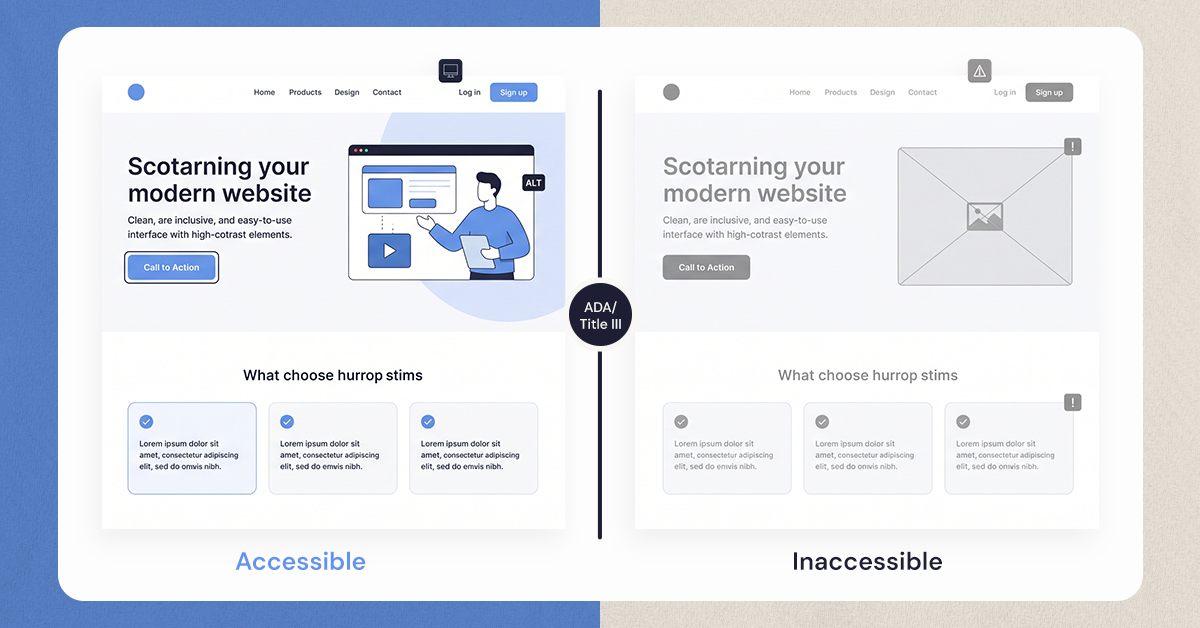
When someone lands on your homepage for the first time, they need to answer three questions almost instantly: What is this? Is it for me? What should I do? If your site cannot answer all three within the first few seconds, most people will leave without giving you another chance.
This is one of the most common issues in older websites. The messaging was written when the business was younger, the audience was different, or the founder was still figuring out what made them stand out. Over time, the business evolves but the homepage does not. The result is a site that talks about the company rather than speaking to the reader's actual problem.
A three-year study by Stanford University's Persuasive Technology Lab, conducted across 4,500 participants, found that nearly half of all users (46.1%) judge a website's credibility based on its visual design alone, including layout, typography, and color. Not the product. Not the price. The design. That snap judgment happens before a visitor has read a single sentence.
A refresh might tighten the headline or add a call-to-action button. But if the entire messaging hierarchy is off, you cannot fix it by adjusting fonts. You need to rethink the page from the ground up.
Poor user experience at this level is something a good UX audit can reveal before any design work begins, because the problem is rarely where you think it is.
Sign 3: Your Site Is Getting Traffic but Not Producing Results
Traffic that does not convert into leads, bookings, purchases, or inquiries is the most expensive version of a website problem. You are paying for attention, and the site is wasting it.
When a site is not converting, the culprit is almost always one of a few structural problems: no clear call-to-action above the fold, a contact form that is buried or too long, messaging that centers the business instead of the reader's problem, or no social proof placed near the decision point.
These are not problems you solve by changing the button color. They require rethinking the entire conversion flow, which is a redesign conversation, not a refresh one.
A well-executed redesign addresses the journey a visitor takes from the moment they land to the moment they decide to reach out. Every page has a role. Every section earns its place. Without that structure, you can drive as much traffic as you like and still see the same flat results.
Sign 4: Your Pages Take Too Long to Load
.jpeg)
Speed is not a nice-to-have. It is a baseline expectation that your website either meets or fails, and the consequences of failing are immediate.
When a page takes too long to load, visitors leave before they see a single word of your content. The longer it takes, the more of them go. That is not a theory. That is what happens every time someone clicks on a slow site and hits the back button before anything loads.
Older websites are particularly vulnerable here. Sites built on outdated platforms, loaded with unoptimized images, or running on slow hosting are carrying technical debt that compounds over time. You can compress images and clean up code, but there is a ceiling to what a refresh can achieve if the platform or architecture is fundamentally slow.
Google also factors speed into where your site ranks. Its Core Web Vitals system measures how fast a page loads, how quickly it becomes interactive, and how stable the layout is as content appears. Sites that score poorly on these metrics lose ground to faster competitors, not because of their content, but because of how slowly it arrives.
Run your site through Google PageSpeed Insights. If your score is consistently low and the recommendations point to structural issues rather than quick fixes, that is a sign the platform or the build itself needs to change, not just the images.
Sign 5: Your Website No Longer Reflects Your Business
Businesses change. Pricing evolves, target audiences shift, services get added or dropped, and the story you tell the world gets sharper with experience. But most websites stay frozen at the moment they were built.
If your site still leads with a service you phased out, uses messaging aimed at clients you no longer want to attract, or features a design aesthetic that no longer matches how you present yourself elsewhere, it is not just out of date. It is actively misleading. Research from Knapsack Creative notes that when a website is out of sync with the current brand, it can attract the wrong audience or create confusion for the right one.
This is one of the clearest signals that a refresh will not cut it. A new image or an updated paragraph can paper over small gaps. But if the entire positioning has shifted, the site needs to be rebuilt around who you are now, not who you were when you launched.
That kind of work starts with strategy. What does your business actually stand for today? Who are you trying to reach? What do you want them to do? Those answers shape everything from the navigation structure to the copy on the contact page. And they cannot be retrofitted into a site that was built for a different version of your business.
Sign 6: The Mobile Experience Is Broken, Not Just Smaller
.jpeg)
There is a difference between a mobile experience that feels slightly cramped and one that is genuinely broken. If your visitors have to pinch, zoom, scroll sideways, or wrestle with a navigation menu to do anything on their phone, you have a problem that a responsive tweak will not fix.
Most people browsing the internet today are doing it from a phone. That is not a trend anymore. It is simply how the internet works. When your site was built for desktop and mobile was bolted on afterward, the gap between what you intended and what users actually experience is wide enough to cost you real business.
The older the site, the more common this problem is. Many sites built before 2020 were designed for desktop and had mobile elements added as an afterthought. The layout adapts, technically, but the user experience does not. Buttons are too small to tap. Text stacks in ways that break readability. Forms require too many steps. By the time a user figures out how to navigate, they have already decided to leave.
The deeper issue is that Google ranks the mobile version of your site first. This is what Google calls mobile-first indexing. If your mobile experience is poor, your search rankings reflect that, which means you are losing both the visitor and the opportunity to be found in the first place.
Improving user experience on mobile is not a surface-level task when the site was never built for it. It requires rethinking the layout, navigation, and interaction design from the phone up.
Sign 7: You've Stopped Ranking on Google
If your site used to show up in search results and now it does not, or if it was never visible to begin with, the problem is likely structural. Content alone cannot rescue a site that was built without SEO fundamentals in place.
Research from Blacksmith Agency found that around 62% of top-ranking websites are highly optimized for SEO, conversions, and mobile. Meanwhile, research from Tingalls confirms that outdated site structure, missing metadata, no schema markup, and slow load times directly determine whether a search engine surfaces your site or your competitor's.
Many older sites were built when SEO was an afterthought or followed practices that have since been made obsolete by algorithm updates. Page structure that once helped rankings can now work against you. Duplicate content, broken internal links, or pages with no clear topic focus all create drag that is difficult to clean up without touching the structure of the site itself.
Good search visibility starts in the build. The UX techniques that make a site easier to navigate for users are often the same ones that help Google understand what a page is about. When those foundations are missing, adding blog posts or tweaking meta descriptions can only go so far.
A redesign done with SEO built in from the start creates pages that are easier to find, easier to read, and easier for search engines to rank.
So What Does a Real Redesign Actually Involve?
A redesign is not a design project with a strategy attached. It is a strategy project that ends in design and development.
It starts with understanding your business goals, your audience, and the gap between what your site currently does and what it needs to do. That means looking at your analytics, reviewing the pages that are underperforming, and identifying the moments in the user journey where visitors are dropping off.
From there, the structure of the site gets rebuilt: which pages exist, how they connect, what each one is responsible for, and how a visitor moves from landing to taking action. The visual design and copy follow that structure, not the other way around.
This is the kind of work where the difference between UX design and surface-level design becomes most visible. A site that looks good but is structured poorly will still underperform. A site built around the way users actually think and behave will outperform one that was built around what the business wanted to say.
For example, when Quality Collision Group needed to unify 21 partner brand sites that had been built separately on WordPress over the years, the challenge was not aesthetic. Each site had inconsistent structures, no centralized tracking, and layouts that made it difficult for customers to find the right location or book a service. A refresh of any one of those sites would not have solved the underlying problem. The entire ecosystem needed to be rethought, rebuilt on a unified framework, and redesigned around the customer journey from first visit to booking. That is what a real redesign looks like in practice.
Should You Redesign Your Website?
If you recognized two or more of the signs above, a refresh is unlikely to fix what is wrong. The problems described here are structural, and structural problems require structural solutions.
That does not mean every business needs to start from scratch tomorrow. But it does mean that continuing to patch a site that is actively costing you leads, rankings, and credibility is not a neutral choice. Every month a broken experience stays live is a month your competitors benefit from it.
A good starting point is an honest look at your data: your bounce rate, your conversion rate, your search rankings, and your mobile performance. If the numbers have been heading in the wrong direction and nothing on the surface has changed them, the surface is not where the problem is.
If you want to understand where your site stands before committing to anything, bo
.svg)


.jpg)
.jpg)

.svg)

.svg)

.svg)
