.svg)
Web Design vs UI/UX Design: What’s the Difference and Why It Matters
.png)
When you visit a website for the first time, you start forming an impression almost immediately. Within seconds, you begin deciding whether the business looks professional and trustworthy. In fact, research from the Stanford Web Credibility Project found that about 75% of users judge a company’s credibility based on its website design.
Before you read the content, check the pricing, or learn what the product does, the design of the website has already influenced how you perceive the brand.
Because of this, the way digital products are designed matters more than ever. When building websites today, terms like web design, UI design, and UX design often come up, especially when discussing modern website design and user experience.
These terms are closely related, but they do not mean the same thing. Each one focuses on a different part of how digital products are created and experienced.
Think of it like building a house. One part focuses on the structure itself. Another focuses on the controls people interact with. Another focuses on how comfortable and intuitive the entire experience feels.
Digital design works similarly. Different disciplines shape how a website looks, how it functions, and how easy it is for someone to use. At NUUX Design Studios, this is often the starting point of many projects. Businesses usually come in looking for a redesign, but the real challenge often turns out to be how users experience the product.
In this guide, you will learn how web design and UI/UX design differ, where they overlap, and why understanding the distinction matters when creating modern digital products.
What Is Web Design?
When people hear the term web design, they often think it means making a website look attractive. While visuals are a big part of it, web design goes beyond choosing colors or arranging images on a page. It also involves structuring pages and organizing information so visitors can easily navigate a website.
At its core, web design refers to the process of creating the visual layout and structure of a website, including how pages are organized, styled, and presented to users.
Web designers work with elements such as:
- page layouts
- typograph
- color schemes
- images and visual content
- navigation menus
- responsive design for mobile devices
These elements work together to create a website that is clear, functional, and accessible across different screen sizes.
Web design also requires some understanding of how people interact with websites. Designers often think about things like where to place a call to action button, how menus should be structured, and how content should be organized so visitors can quickly find what they need.
Because of this, many web designers also have basic knowledge of front-end technologies like HTML and CSS, which help turn visual designs into working web pages.
Web design plays an important role in both website usability and search engine performance, since clear page structure, fast loading speeds, and mobile-friendly layouts all influence how users and search engines interact with a site.
How Web Design Has Evolved
Web design has changed significantly since the early days of the internet.
In the 1990s, most websites were simple HTML pages with very limited styling and almost no interaction. At that time, web design focused mainly on displaying information rather than creating interactive experiences. As technologies like CSS and JavaScript developed, designers gained more control over layouts, styling, and visual presentation.
The rise of smartphones created another major shift. Designers could no longer build websites only for desktop screens. Instead, they had to create responsive web designs that adapt to different devices, including phones, tablets, and desktops. Today, responsive design is considered a core part of modern web design because users expect websites to work seamlessly across all screen sizes.
Today, web design includes much more than visual layout. Modern web design focuses on creating websites that are both visually appealing and easy for users to navigate.
Designers now consider factors such as:
- page speed and performance
- accessibility standards
- mobile first design
- SEO friendly page structures
These elements help ensure that websites are not only attractive but also easy to use, accessible to a wider audience, and optimized for search engines.
Modern web designers often use tools like Figma, Webflow, and WordPress, along with HTML and CSS, to design and build websites that look good, perform well, and function smoothly across devices.
What Is UI (User Interface) Design?
UI design stands for User Interface Design, which focuses on the visual elements users interact with when navigating a website or digital product.
In simple terms, UI design is about the parts of a product that users actually interact with.
UI designers typically work with elements such as:
- buttons
- forms
- navigation menus
- icons
- sliders and toggles
- search bars
A helpful way to think about UI design is to imagine using a remote control for a television. The buttons, layout, and labels determine how easily you can change channels or adjust the volume. If the buttons are confusing or poorly placed, the device becomes frustrating to use.
Digital products work the same way. UI design ensures the interface is clear, organized, and easy for users to interact with.
Why UI Design Matters
Small interface decisions can have a big impact on user behavior.
For example, changing the size, color, or placement of a call-to-action button can make it easier for users to complete an action, such as signing up or making a purchase. In several interface evaluations conducted by NUUX Design Studios, these kinds of changes often reveal something deeper: users were not struggling with the product itself, but with how the interface guided their next step.
When interface elements are clear and consistent, users can navigate a product more easily. This makes the experience feel smoother and helps people complete tasks without confusion.
What Is UX (User Experience) Design?
UX design stands for User Experience Design, and it focuses on the entire experience users have when interacting with a website, application, or digital product.
Instead of focusing only on visuals, UX designers analyze how people use a product and where they encounter friction or confusion.
They ask questions such as:
- How easily can users find what they need?
- How many steps does it take to complete a task?
- Where do users get stuck?
The goal is to create products that are useful, easy to use, and enjoyable.
What UX Designers Do
UX design often involves research and testing.
Common activities include:
- user research
- creating user personas
- mapping user journeys
- designing wireframes
- usability testing
- A/B testing
These activities help designers understand real user behavior and improve the overall experience.
In many UX investigations carried out by NUUX Design Studios, this research often reveals that what appears to be a usability problem is actually a deeper mismatch between what users expect and how the product is structured. Looking closely at these moments helps uncover where users hesitate, change direction, or abandon a task altogether, which is where meaningful design improvements usually begin.
The Origin of UX Design
The term user experience became widely known in the 1990s when cognitive scientist Don Norman introduced it while working at Apple. According to the Nielsen Norman Group, Norman believed products should be designed around human needs rather than just technical features.
Today, UX design is a central part of building successful digital products.
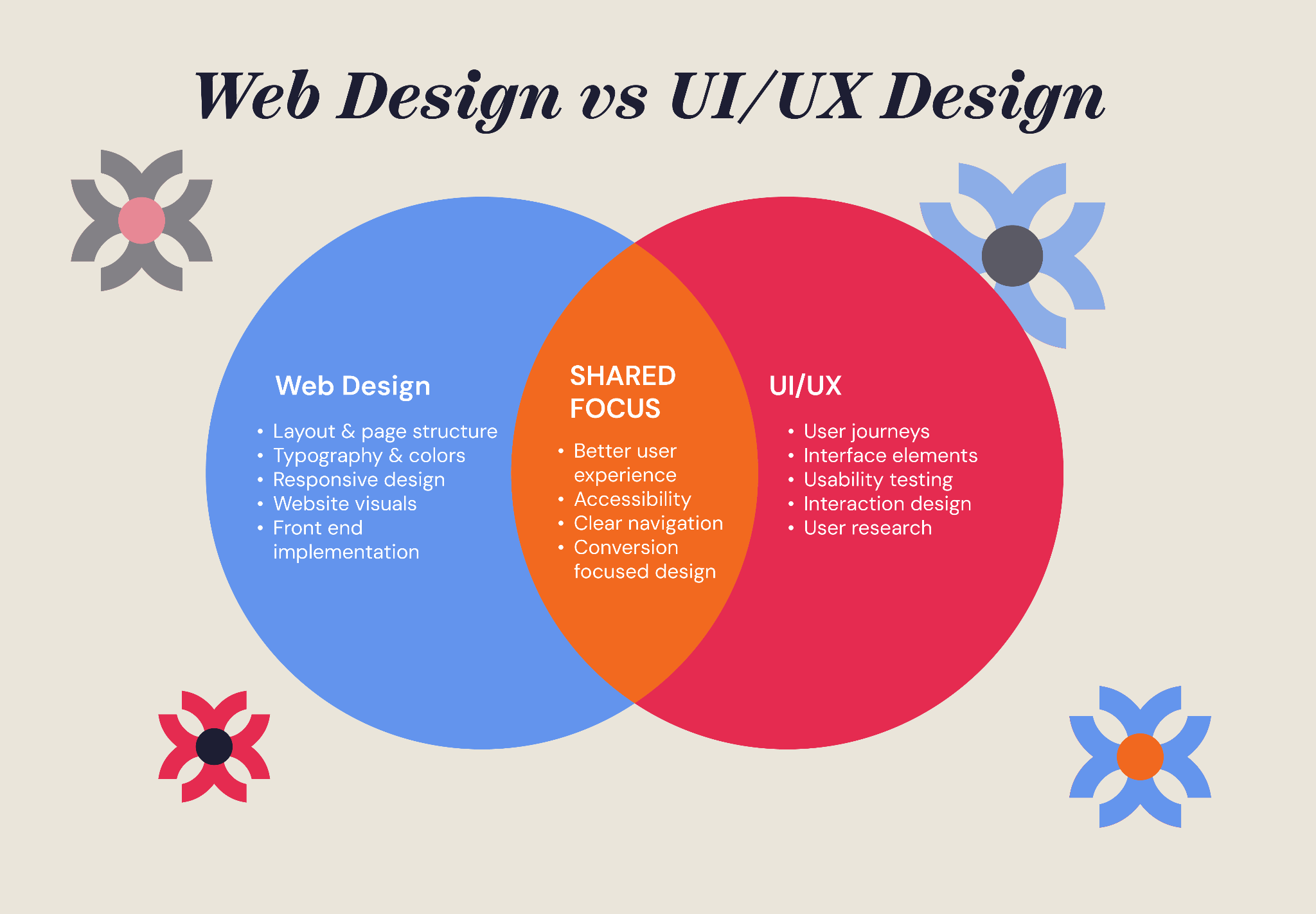
Web Design vs UI/UX Design: Key Differences
Although these fields overlap, they have different priorities and responsibilities.
Focus and Goals
Web design focuses primarily on building and styling websites. It determines how pages look and how content is structured.
UI and UX design focus on how users interact with the product. UX designers study behavior and define user journeys, while UI designers design the interface elements users interact with.
Deliverables
Web designers often produce:
- visual layouts
- responsive website designs
- page structures
UX designers produce:
- wireframes
- user journey maps
- interactive prototypes
These deliverables guide the final product design.
Where Web Design and UI/UX Overlap
Despite their differences, web design and UI/UX design often work together.
Both disciplines focus on creating digital experiences that are easy to understand and navigate.
Common areas of overlap include:
- responsive layouts
- accessibility improvements
- user-centered design
- prototyping and testing
In many modern product teams, these roles collaborate closely throughout the design process.
How Web Design and UI/UX Work Together
Modern product development usually follows a collaborative workflow.
A typical process looks like this:
User research
→ UX wireframes
→ UI design
→ web design implementation
→ development and testing
UX designers start by studying user behavior and defining the product structure. UI designers translate those ideas into visual interfaces. Web designers then build the actual website or product layout.
Companies known for strong digital experiences, such as Airbnb and Stripe, invest heavily in both UX research and design execution.
Conclusion
When you’re investing in a website or digital product, knowing the difference between web design, UI, and UX helps you prioritize what truly moves the needle: not just looking good, but helping users achieve their goals effortlessly.
At NUUX Studios, we bring all three together: strategy-first UX thinking, precise UI craftsmanship, and high-performing web design, to create digital experiences that build trust, reduce friction, and drive growth.
If you’re planning a new site, redesign, or product launch and want clarity on where to focus, we’d love to chat. Drop us a message for a no-pressure consultation; we listen first, then build with precision to help your brand thrive.
Let’s turn your vision into something people love to use.
.svg)


.jpg)
.jpg)

.svg)

.svg)

.svg)
