.svg)
What Is Product Design? How It Differs from UX Design and Why It Matters
Business owners hire the wrong kind of designer more often than most agencies will admit. A founder posts a job for a "UX designer" when what the business actually needs is someone who can shape the entire product strategy. A startup hires a product designer expecting deep usability research, then wonders why the checkout flow still confuses customers. The two terms get used as if they mean the same thing, and that mix-up costs real time and real budget before a single pixel gets designed.
The confusion is fair. Product design and UX design overlap so much that even people inside the design industry argue about where one ends and the other begins. But the distinction is not just academic. It changes who you hire, what they're responsible for, and what results you should expect from the work.
What Is Product Design?
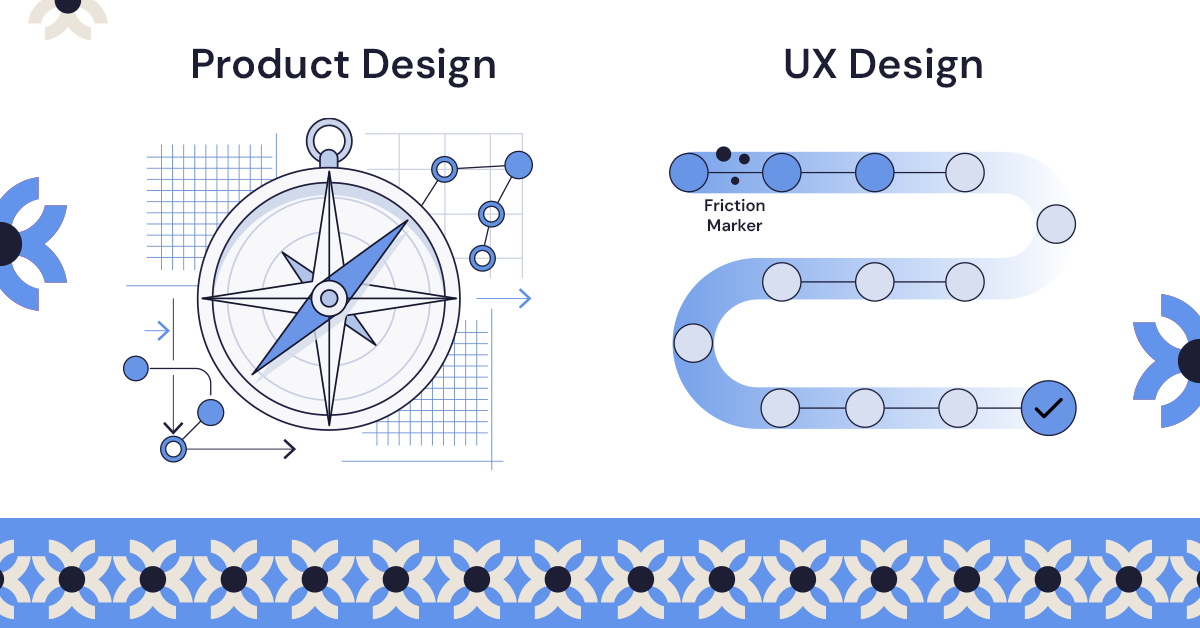
Product design is the practice of shaping an entire product, physical or digital, from the first idea through to launch and every version after that. It is a broad, ongoing discipline that touches far more than what shows up on screen.
A product designer typically owns or contributes to:
Strategy and validation. Before anything gets built, someone has to answer whether the idea solves a real problem for real people, and whether solving it is worth the cost. This is where market research, competitor analysis, and early customer conversations happen.
Roadmapping and prioritization. Once a direction is set, a product designer helps decide what gets built first, what gets delayed, and what gets cut entirely, usually by weighing user need against business impact and technical cost.
Prototyping and testing at the concept level. Long before final visuals exist, product designers build rough, testable versions of an idea to see whether it holds up when real people interact with it.
Visual and interaction direction. Product design does not stop at strategy. It also shapes how the product looks, feels, and behaves, often working closely with or overlapping into UX and UI work.
Long-term ownership. Unlike a project that wraps at launch, product design tends to be an ongoing function. A product designer stays involved as the product grows, evolves, and gets rebuilt around new customer needs or market shifts.
The clearest way to describe it: a product designer is accountable for whether the product works as a business asset, not just whether it works as a piece of software.
What Is UX Design?
UX design, short for user experience design, is a narrower and more specialized discipline that lives inside the broader product design process rather than replacing it.
A UX designer is focused almost entirely on one question: once this product exists, is it actually easy and satisfying for a real person to use? That focus breaks down into a few concrete areas of work.
User research. Interviews, surveys, and behavioral data collection to understand who the users actually are, what they are trying to accomplish, and where they get stuck.
Information architecture. Deciding how content and features get organized so that people can find what they need without hunting for it. This is the invisible structure behind every menu, page hierarchy, and navigation decision.
Wireframing and flow mapping. Sketching out the step-by-step path someone takes through a product, from landing on a page to completing a task, and identifying every point where friction could cause them to give up.
Usability testing. Watching real people attempt real tasks inside a product, then using what breaks down to guide revisions. This is often the single most valuable and most skipped step in the entire process.
Iteration. UX design rarely produces a finished answer on the first attempt. It is a cycle of testing, adjusting, and retesting until the friction points are gone.
A helpful comparison: product design decides what should be built and why it matters to the business. UX design decides how a person will actually experience that decision once it exists.
Where the Two Roles Overlap
Part of why this gets confusing is that the overlap is real, not imagined. Both roles use similar tools, like Figma or wireframing software. Both roles rely on user research to make decisions instead of guessing. Both roles care, deeply, about whether the end result actually works for the people using it.
In small companies, one person often wears both hats, doing light product strategy in the morning and detailed usability testing in the afternoon. In larger organizations, the two roles split into separate people or even separate teams, specifically because each side requires enough depth that doing both well, at scale, becomes difficult for one person to sustain.
The overlap is not a flaw in the industry. It reflects the fact that product design and UX design are two layers of the same problem, business viability on one layer, human usability on the other, and both layers need attention for a product to actually succeed.
Product Design vs UX Design: The Core Differences
Neither role replaces the other. A product can have flawless usability and still fail because nobody questioned whether it was worth building in the first place. A product can also solve a genuine business problem and still lose customers because the experience of using it is confusing, slow, or unclear.
Why This Distinction Actually Matters for Your Business
This is not a semantic argument that only matters to designers. Getting the scope of a hire wrong creates two common, expensive failure patterns.
Pattern one: hiring UX when the real issue is strategy.
A business brings in a UX designer expecting them to fix a product that is not performing. The designer improves the interface, tightens the flow, and cleans up the visuals. Usability scores go up. Revenue does not move, because nobody ever stepped back to ask whether the underlying offer or feature set actually matched what the market wanted.
Pattern two: buying product-level work but only getting surface treatment.
A business briefs what sounds like a full product design engagement, but the actual day-to-day user journey never gets properly tested against real behavior. The strategy looks solid in a slide deck. The friction hides inside a plan that was never validated with actual users.
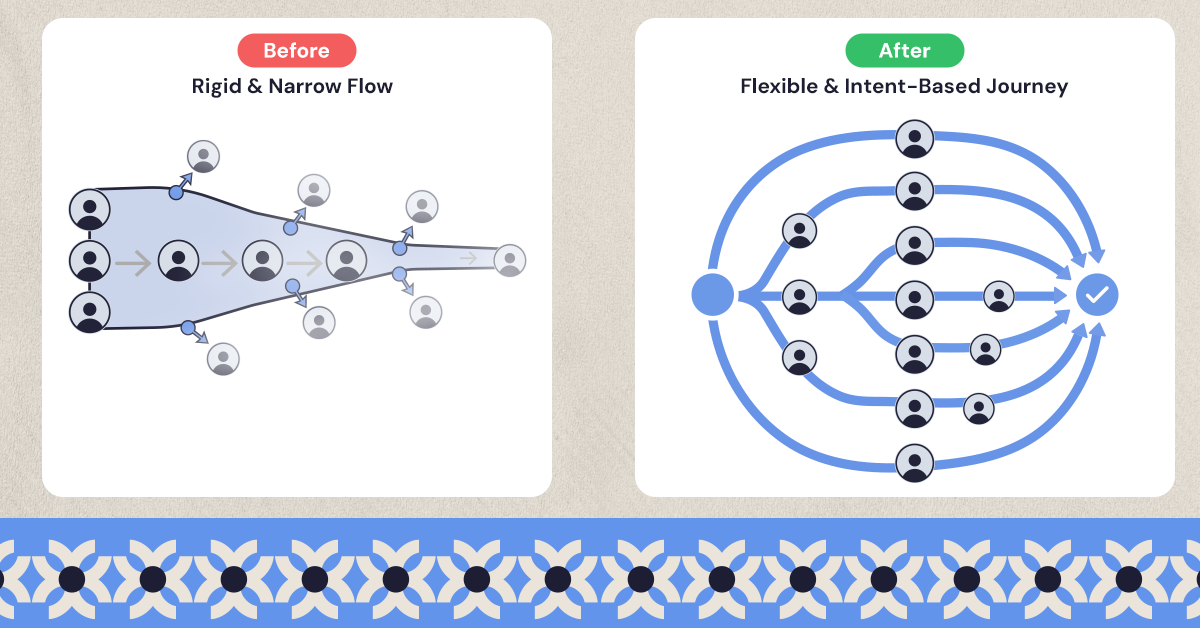
A real example of what happens when the two are treated as connected instead of separate: an insurance client came to NUUX with a quote request flow that looked fine on the surface but was quietly losing customers. The issue was not visual. Users were being pushed through a single rigid path that did not match their actual intent, a structural problem that only surfaced through proper research rather than a cosmetic redesign. Once the flow was rebuilt around how people actually approached getting a quote, completions rose by 10 percent. That kind of result only shows up when strategy and experience get treated as one connected process instead of two separate hires.
There is also a broader pattern backing this up. A study commissioned by Adobe found that companies who treat design thinking as core to how they build products report 41 percent higher market share and 50 percent more customer loyalty than competitors who treat design as a late-stage add-on. The advantage rarely comes from a nicer interface alone. It comes from strategy and experience being built together from the start rather than bolted on separately.
The Decision Framework: What Does Your Business Actually Need?
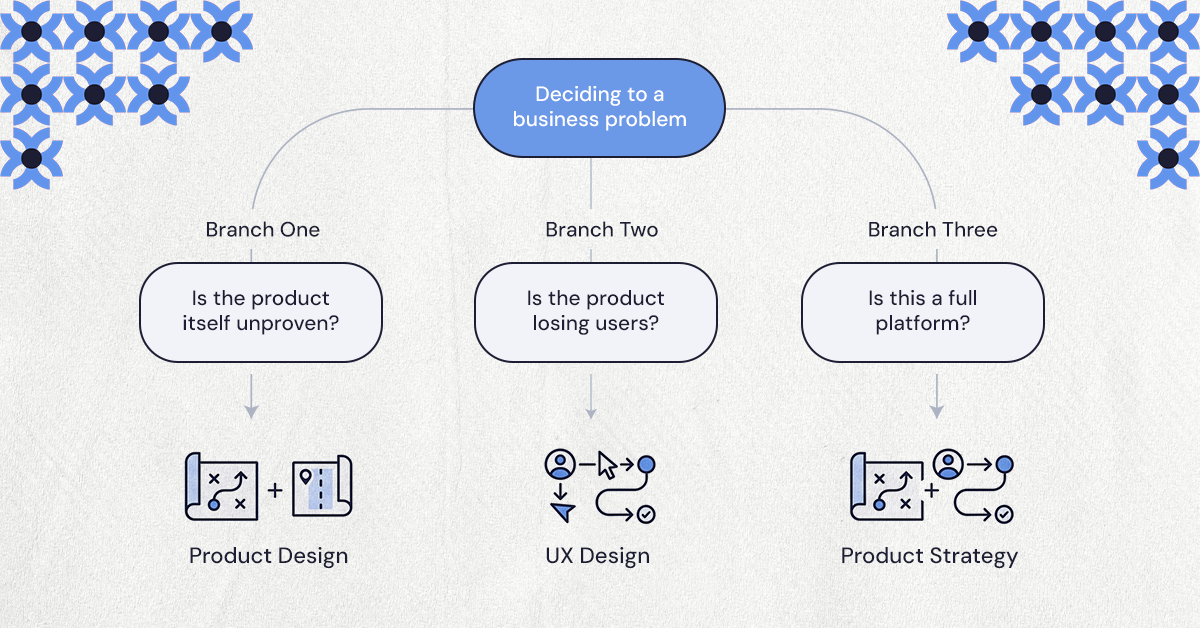
This is the part most guides skip, and it is usually the part that actually matters when a hiring decision is on the table. Four common scenarios cover most businesses trying to figure this out.
Scenario one: the product itself is unproven.
If there is no existing product yet, or the current offering has never been validated against real demand, this is a product design problem first. Signs this applies: uncertainty about whether people actually want what is being built, a feature list that grew from internal opinions rather than research, or a business plan that has not been tested against real customers. Bringing in someone to polish an interface before the product direction is settled almost always means redoing the work later, once the real direction becomes clear.
Scenario two: the product is losing users.
The offering itself is solid and proven, but people are dropping off, getting confused, or abandoning tasks partway through. Signs this applies: high traffic with low conversion, support tickets asking the same "how do I" questions repeatedly, or a checkout, signup, or booking flow with a steep drop-off at a specific step. This points squarely at UX design. The what is already settled. The how needs attention.
Scenario three: this is a full website, app, or platform.
When the scope spans strategy, structure, and daily usability all at once, which is true for most business websites and digital products, the honest answer is that both disciplines are needed together, not one instead of the other. This is why agencies like NUUX structure engagements around the two working in tandem rather than choosing one over the other from the start.
Scenario four: the business is choosing between outside help and an in-house hire. Once it is clear which type of work is needed, the next decision is who does it. Choosing between a design agency versus a freelancer usually comes down to the scope of the work, since that scope determines which option actually protects the budget and timeline.
How NUUX Approaches Product and UX Design Together
Most agencies specialize in one lane. NUUX was built around the idea that separating product strategy from user experience creates exactly the kind of gap described above. Every engagement starts with understanding the business problem first, not the screen. From there, the work moves into structure, flow, and usability testing, so the final product is both the right thing to build and something people can actually use without friction.
This approach played out clearly with Chin Chin, where the goal was not a prettier website but a unified experience across the site, ordering flow, and marketing funnel. Treating those as one connected system rather than separate projects contributed to the brand generating 150,000 dollars in revenue within its first year.
The Bottom Line
Product design and UX design are not interchangeable, and hiring for the wrong one is one of the most common and avoidable mistakes a growing business makes. Product design answers whether something should exist and whether it serves the business. UX design answers whether people can actually use it once it does. The businesses that grow fastest tend to be the ones that stop treating these as separate purchases and start treating them as one connected process.
.svg)


.jpg)
.svg)

.svg)

.svg)
