.svg)
UX Design Agency vs Freelancer: Which Is Right for Your Project?
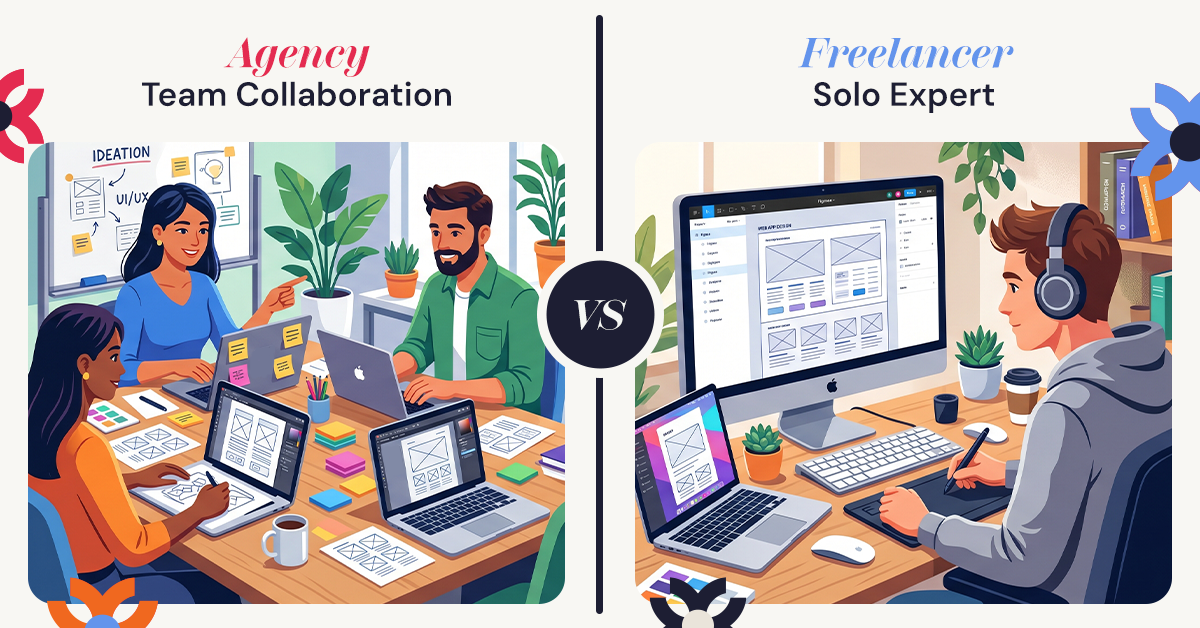
You have a project. You know you need great UX design. Now comes the question that trips up almost every founder, product manager, or marketing lead: do you hire a UX design agency or a freelancer?
It is a fair question, and the honest answer is that the right choice depends on what is actually at stake. A small task and a revenue-critical redesign do not carry the same risk, and they should not be approached the same way.
This guide walks through the real differences, backed by research, so you can make a decision with your eyes open.
What Is a UX Design Agency?
A UX design agency is a team of specialists working together under one roof. When you hire an agency, you are not just getting one person. You are typically getting a UX researcher, a UI designer, a strategist, and a project manager, all working on your project in a coordinated way, with each person checking the other's work along the way.
Agencies usually follow a defined process: discovery, research, wireframes, testing, visual design, and handoff. That structure exists for a reason. Nielsen Norman Group, one of the most respected research bodies in the UX field, studied hundreds of real design projects and found that teams who ran a proper discovery phase before designing cut their risk of project failure by 75 percent, and increased their chance of success by 59 percent. That is not a small edge. It is the difference between a project that quietly works and one that needs to be redone six months later.
At NUUX, that discovery-first structure is the starting point of every engagement, not an optional extra. When Chin Chin, a hospitality brand, came to us with a fragmented website and a broken online ordering experience, the first thing we did was map exactly where customers were dropping off and why, before any screen was designed. That groundwork is what led to over $150,000 in online revenue generated within the first year.
What Is a UX Freelancer?
A UX freelancer is an independent designer who works on a contract basis. You hire one person, agree on a scope, and they deliver the work. Freelancers tend to be flexible on timing and often come with lower price tags, especially for smaller, clearly defined tasks.
The trade-off is structural, not personal. A freelancer is one person with one set of skills and one set of hours in a day. If your project needs user research, interaction design, and visual design all done well, you are asking one person to be strong in three disciplines at once. Even excellent freelancers have specialties, and the parts outside their specialty are where quality tends to slip.
There is also a documented risk that rarely comes up before a contract is signed: scope creep. Project management research shows that 52 percent of projects experience scope creep when expectations are not tightly defined from the start, and freelancers absorb that risk almost entirely on their own, since there is no second person reviewing the brief or catching a request that has quietly expanded beyond what was agreed. For the client, that often shows up as missed deadlines or a final product that solves a narrower problem than the one they actually had.
The Real Cost Difference

One of the biggest reasons people lean toward freelancers is cost. And it is true that on paper, freelancers are cheaper per hour.
According to data from Clutch, Toptal, and Upwork (2026), here is what the market looks like:
- Junior to mid-level freelancers: $35 to $110 per hour
- Senior freelancers: $80 to $200 per hour
- UX design agencies: $75 to $250 per hour, or $3,000 to $30,000 per month on retainer
But here is where most people get the comparison wrong: hourly rate is not the same as total cost.
When you hire a freelancer, you are also taking on the job of managing the project. You will be writing the briefs, chasing updates, coordinating with developers, and making calls that you probably do not have the expertise to make. That takes time, and time has a cost too. It is also exactly where scope creep tends to creep in, since there is no one else holding the line on what was originally agreed.
An agency bundles that management into the engagement. You get one point of contact who owns the delivery from start to finish, and a defined process that exists specifically to prevent the budget and timeline from drifting.
For well-scoped, low-risk projects under $15,000 to $20,000, a senior freelancer can be a sound choice. For anything larger, more complex, or tied to revenue, the research consistently points toward structured, team-based delivery as the safer route.
When a Freelancer Makes More Sense
There are situations where hiring a freelancer is genuinely the smarter move.
Your scope is small and clearly defined. If you need a single landing page redesigned or a few screens refreshed, a skilled freelancer can handle that efficiently without the overhead of a full agency process.
You have an in-house team that needs a specific skill. Sometimes your internal designers are stretched thin or missing one specialty. A freelancer can fill that gap for a sprint without disrupting your existing workflow.
You are early-stage and need to move fast on an MVP. A freelancer can embed quickly into your process and get work done without a lengthy onboarding.
Budget is tight and the stakes are low. For a small business testing a new idea, a freelancer can be the most practical starting point.
When a UX Design Agency Makes More Sense
For bigger bets, the research and the risk both point in the same direction.
Your project has multiple moving parts. A new product launch, a full website redesign, or a complex app flow all require research, strategy, visual design, and testing happening in parallel. PMI's Pulse of the Profession research found that organizations using structured risk management practices have a 2.5 times higher project success rate than those that do not. A defined agency process is, in effect, that risk management built in.
UX directly affects your revenue or retention. Forrester Research found that every $1 invested in UX returns up to $100 in value, a 9,900 percent ROI. When the financial stakes are that high, the cost of getting it wrong outweighs the savings of going cheaper.
You need continuity. Agencies do not disappear if one team member takes a vacation or moves on. A good agency has backup capacity built in so your project keeps moving regardless.
You want someone who has seen your problem before. Agencies work across multiple industries and bring pattern recognition that a single freelancer often does not have, simply because they have run the same type of discovery process dozens of times. When NUUX worked with AMAX Insurance on their quote journey redesign, the team identified that users were dropping off because they were being pushed through one rigid flow that did not match their intent, an insight that came from structured research, not a guess. The result was a 10 percent lift in quote completions.
You need design plus strategy, not just execution. A freelancer can execute what you describe to them. An agency can challenge your assumptions, push back on the brief, and help you define the right problem before designing the solution. That difference alone often determines whether a project actually moves a business metric or just looks good in a portfolio.
The Hidden Risks People Do Not Talk About
With freelancers: Good freelancers are often booked weeks or months in advance. The hiring process alone, portfolio review, test task, contract, can take two to six weeks. There is also the single-point-of-failure risk. If your freelancer becomes unavailable mid-project, or the scope quietly grows beyond what either side accounted for, you are the one absorbing that cost, in time, money, or both.
With agencies: The risk with agencies is usually about fit, not capability. A large agency with dozens of clients may hand your project to junior team members while pitching you on senior talent in the sales call. This is worth investigating before you sign anything. Ask who will actually be doing the work. Boutique agencies that keep engagement teams small and senior-led tend to avoid this gap entirely, which is part of why clear, consistent communication shows up so often in client feedback for teams structured that way.
A Quick Comparison
So, Which One Is Right for You?

Here is the simplest way to think about it.
If your project is small, clearly scoped, and low-stakes, a freelancer is a reasonable, low-risk choice.
If your project touches revenue, conversion, or user retention, the research is fairly consistent: structured discovery, built-in checks, and a team rather than a single point of failure meaningfully reduce the chance of an expensive miss.
The most costly mistake is rarely the price point itself. It is choosing a delivery model that does not match the size of what is actually at stake, and finding that out three months in.
Understanding what makes a good user experience is step one. Choosing a process built to protect that outcome is step two.
Want to Know What the Right Approach Looks Like for Your Project?
We offer free consultations, not to pitch you, but to help you figure out what actually makes sense for your situation. Sometimes that answer is an agency. Sometimes it is not. Either way, you will leave with more clarity than you came in with.
.svg)
.jpg)


.jpg)

.svg)

.svg)

.svg)
