


Restaurant marketing that brings in more direct orders and reservations
We run the ads, SEO and website for restaurant groups and cafes, built around getting guests to order and book with you directly.
5.4x
return on ad spend on Google Ads for Chin Chin
4.7x
approximate blended return across Google and Meta, understated
What is restaurant marketing?
Restaurant marketing is the work of getting guests to find your restaurant, trust it and order or book with you directly, then showing which ads, searches and pages produced the orders.
Restaurants compete with delivery apps that make ordering easy and take a share of every order. A restaurant's own site and ads have to make ordering at least as quick, and show what each campaign earned.
Why do restaurants lose orders to third-party apps?
Restaurants lose orders to third-party apps because the restaurant's own site makes ordering slower than the app, menus are hard to read on a phone, and ads send people somewhere they cannot order. Guests choose the easiest path, and that is often the app.
A site that makes ordering slower than the app.
When ordering direct takes more steps than a delivery app, guests use the app and the restaurant pays for it.
Menus that are hard to read on a phone.
Most guests browse on a phone, and a menu that is a long list or a PDF is hard to read and easy to leave.
Ads that send people somewhere they cannot order.
Ad clicks that land on a homepage instead of the ordering flow waste the spend.
Restaurant digital marketing and website services
Most restaurants buy ads, SEO and a website from different vendors. We run them as one program, so every ad, search and page leads to the same place: an order or a booking you can trace.
Google Ads and Meta ads tied to orders and reservations
Paid search and paid social for guests who are hungry now, sent to pages and an ordering flow built to turn the click into an order or a booking.
5.4x return on ad spend on Google Ads at Chin Chin
Restaurant SEO and location pages
Search work and a page for each location, so every restaurant is found for its own area and shows up in Google results and in the answers AI assistants give.
Tracking that shows what each campaign actually earned
GA4 and conversion tracking set up before launch, so orders and bookings can be traced to the ad, search or page that produced them.
Mobile-first online ordering with a short checkout
An ordering flow designed on the phone first, with a short checkout, so ordering direct is as easy as using an app.
Menus built around the food photography
Photography-led menus that carry the personality of the restaurant instead of flattening it into a list, and stay easy to read on a phone.
Cafe and coffee shop websites
Simple, fast sites for cafes and coffee shops: hours, menu, location and an easy way to order ahead or find the shop.
Case study: Chin Chin
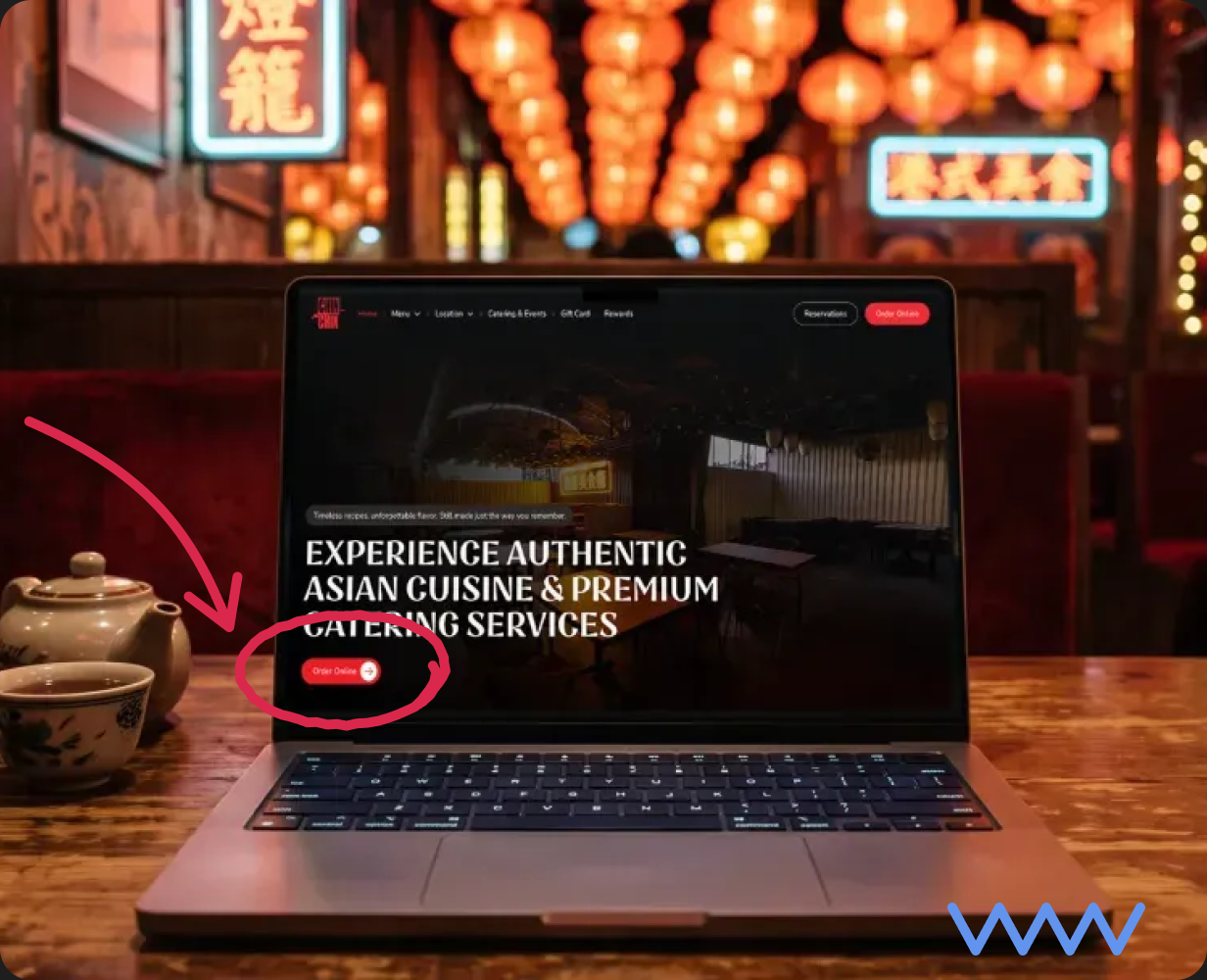
We built Chin Chin's website, ordering flow and marketing as one customer journey. Here is the result.
Chin Chin
5.4x
return on ad spend on Google Ads
4.7x
approximate blended return across Google and Meta, understated because reservation revenue is not trackable
One journey, not three systems: the site, the ordering flow and the marketing, built as one.
How do you track reservations and online orders from ads?
We set up GA4 and conversion tracking before launch, so online orders and bookings are tied to the ad, search or page that produced them. Reservation revenue often cannot be tracked end to end, so we report what can be measured and say clearly what is understated, as with Chin Chin's blended return.
Single cafe or restaurant group: what changes?
The fundamentals are the same. What changes as you add locations is keeping every menu and ordering flow consistent while each location still gets found and ordered from in its own area.
Single restaurant
- Brand One site, one voice
- Local search One neighborhood to win
- Reporting Restaurant-level numbers
- Migration One set of URLs
- Rollout One launch
Restaurant group
- Brand A shared component library, so every concept keeps its own personality
- Local search Every location found for its own area
- Reporting Orders and reservations broken out by location
- Migration Every location's URLs mapped before anything moves
- Rollout A repeatable framework, location by location
How does a restaurant marketing engagement work?
Research.
We go through your current site, search data and analytics, and map the path people take from first visit to the result you want.
Wireframe and design.
Mid-fidelity wireframes first, so you approve the structure before we move to high fidelity design.
Build and launch.
We build and test the pages, with tracking live on launch day so results can be measured from the start.
Improve every month.
We watch what people do on the site, fix what slows them down, and adjust search and ad spend toward what works.
Restaurant marketing FAQ
How do restaurants get more direct online orders instead of third-party app orders?
Make ordering on your own site as quick as the app. That means a mobile-first flow with a short checkout, a menu that is easy to read on a phone, and ads that land on the ordering page. Tracking shows which campaigns produce the orders.
What return should a restaurant expect from Google and Meta ads?
It depends on your market, menu and margins, so there is no fixed number. For reference, in our Chin Chin case study the restaurant saw a 5.4x return on Google Ads and about 4.7x blended across Google and Meta, which is understated because reservation revenue cannot be tracked.
Does a multi-location restaurant group need a page for each location?
Yes. A page per location lets each one show its own menu details, hours and reviews and rank for its own area. Build them from one template so the group stays consistent while every location stays distinct.
How do you track reservations and online orders from ads?
We set up GA4 and conversion tracking before launch so online orders and bookings are tied to the ad or page that produced them. Reservation revenue often cannot be tracked end to end, so we say clearly what is measured and what is understated.
What should a restaurant website include?
A restaurant website should include a menu that reads well on a phone, a fast way to order or book, hours and location, strong food photography and reviews. If you take orders directly, the ordering flow should be short and tested on a phone first.
What makes a good cafe or coffee shop website?
A good cafe website loads fast, shows hours, location and menu up front, and makes it easy to order ahead or find the shop. Photography of the space and the food gives it personality. Keep it simple, since most visitors want quick answers.