



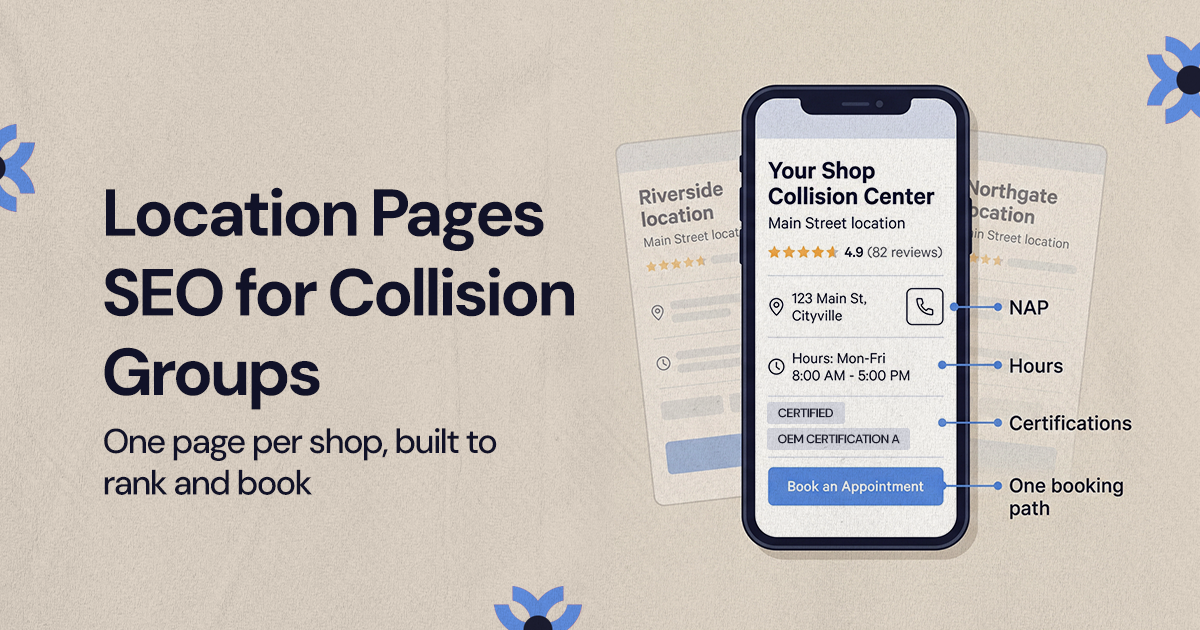
Good location pages SEO gives every collision shop its own page with accurate NAP, hours, the services and certifications that shop holds, directions, real reviews and photos, LocalBusiness schema and unique copy. Accurate, shop-specific detail helps Google match the page to local searches and helps drivers choose and book without calling around.
Location pages SEO for a multi-location collision group means giving every shop its own page with accurate name, address and phone number (NAP), hours, the services and certifications that shop actually holds, directions, real reviews and photos, LocalBusiness schema and copy written for that location. Each page should answer what a driver needs to know about that specific shop, so Google can match it to local searches and the driver can call or book without going back to the search results to compare competitors.
Below is what belongs on the page, why each element matters, how the technical side works and how to keep dozens of pages accurate as the group adds shops.
What is location pages SEO for collision repair shops?
Location pages SEO is the work of building and optimizing one page per physical shop so it can show up for local searches such as "collision repair near me" or "auto body shop in [city]." For a collision group, it connects each repair center with the drivers, insurers and fleet contacts searching in that shop's service area.
Drivers rarely search for a collision group in the abstract. They search for help near home, near work or near where the accident happened. Google says local results are based mainly on three things: relevance (how well a listing matches the search), distance and prominence (how well known the business is, including reviews and links from across the web). A strong location page supports relevance directly, and it gives each Google Business Profile a page to point to.
That second point matters more than most groups realize. Google's Business Profile guidelines ask each location to provide a phone number that connects to that location, or a website that represents that individual location. Pointing every profile at the homepage forces the driver to hunt for their shop, which is exactly the moment many of them give up.
Why do thin location pages hold collision groups back?
Plenty of collision websites have location pages that technically exist: a shop name, an address, a phone number and an embedded map. Those pages rarely answer the questions a driver actually has, such as whether the shop repairs aluminum, handles insurance claims, measures frames or is certified for their vehicle make. When the answers are missing, the driver calls the shop that looks more transparent.
Copied pages are the other problem. If every page says the same thing with a different city name, neither people nor search engines have much reason to treat each location as distinct. Google's spam policies describe doorway abuse as including "pages targeted at specific regions or cities that funnel users to one page" and "substantially similar pages that are closer to search results than a clearly defined, browseable hierarchy." A group with real shops is not doing that on purpose, but a set of swap-the-city pages drifts in that direction. Unique, location-specific detail is what keeps each page useful.
What should go on a collision shop location page?
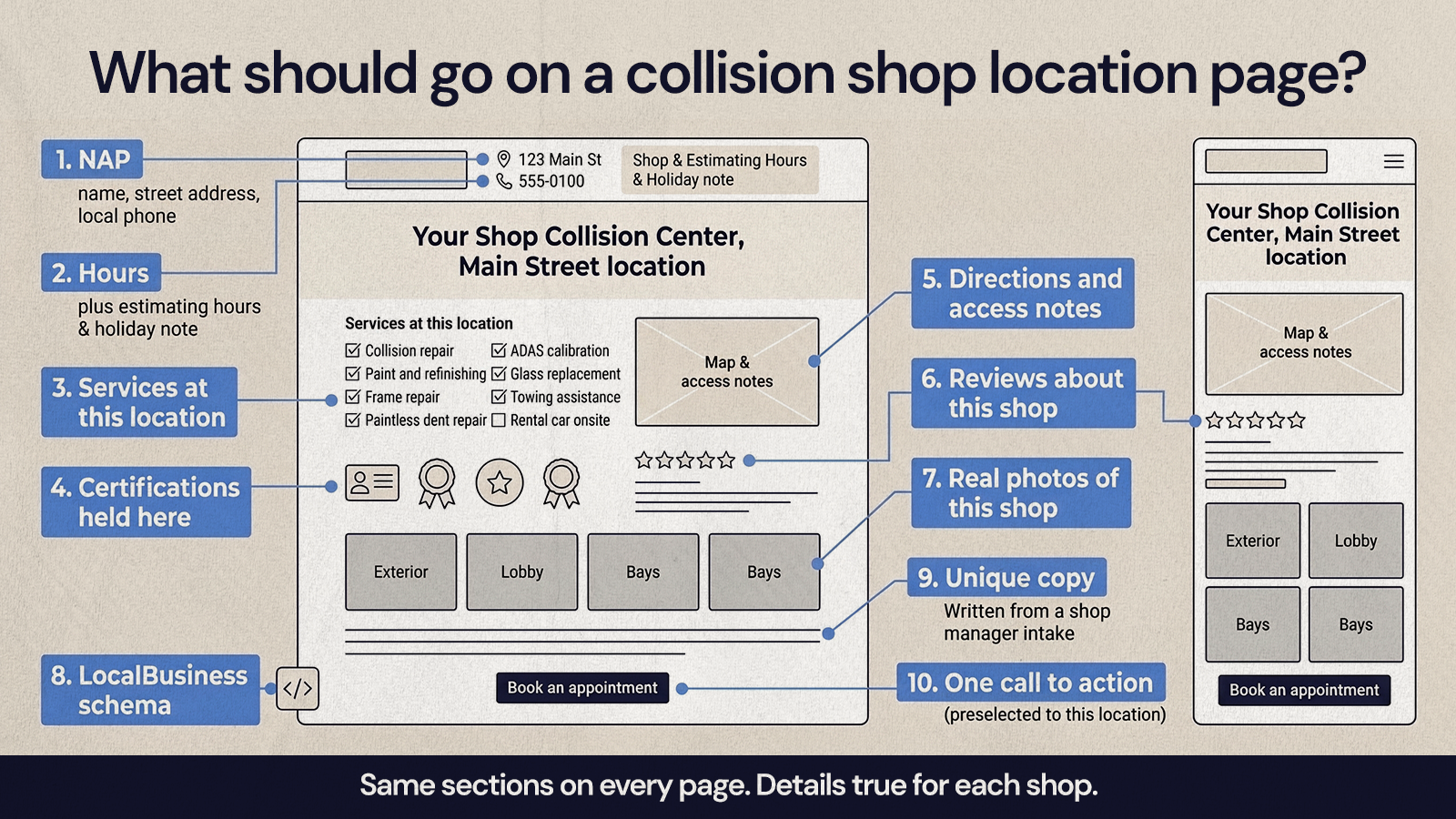
Treat the page as a decision tool. Someone may arrive from Google Maps, a paid ad, an insurer referral or a brand search, and the page has to confirm quickly that they found the right shop, then make the next step obvious. A complete collision location page includes:
- NAP. The exact shop name, full street address and a direct local phone number, written the same way as on the shop's Google Business Profile and major directories.
- Hours. Weekday and weekend hours, plus estimating hours, drop-off options and holiday exceptions where they differ.
- Services at this location. Only what this shop does: collision repair, paint and refinishing, frame and structural repair, paintless dent repair, glass, ADAS calibration or coordination. Leave out anything handled elsewhere.
- Certifications held at this location. I-CAR recognition and manufacturer certifications that apply to this facility, not the group as a whole.
- Directions and access notes. Major roads, cross streets, landmarks, entrance and parking details, and towing access.
- Reviews. Recent reviews about this shop specifically.
- Photos of this shop. Exterior, signage, lobby, estimate area, bays and team. Real photos only, never stock.
- Local schema. LocalBusiness structured data with the address, phone, hours and coordinates for this location.
- Unique copy. A few paragraphs about the facility, the communities it serves and what to expect on a visit.
- One clear call to action. The same booking or estimate path used across the group, preselected to this location.
Accuracy is the thread through all of it. If a certification or service belongs to one shop and not another, it should not be copied across every page. For the wider set of elements a collision site needs beyond its location pages, see our guide to what an auto body shop website needs to convert.
How do you keep NAP, hours and services accurate across every shop?
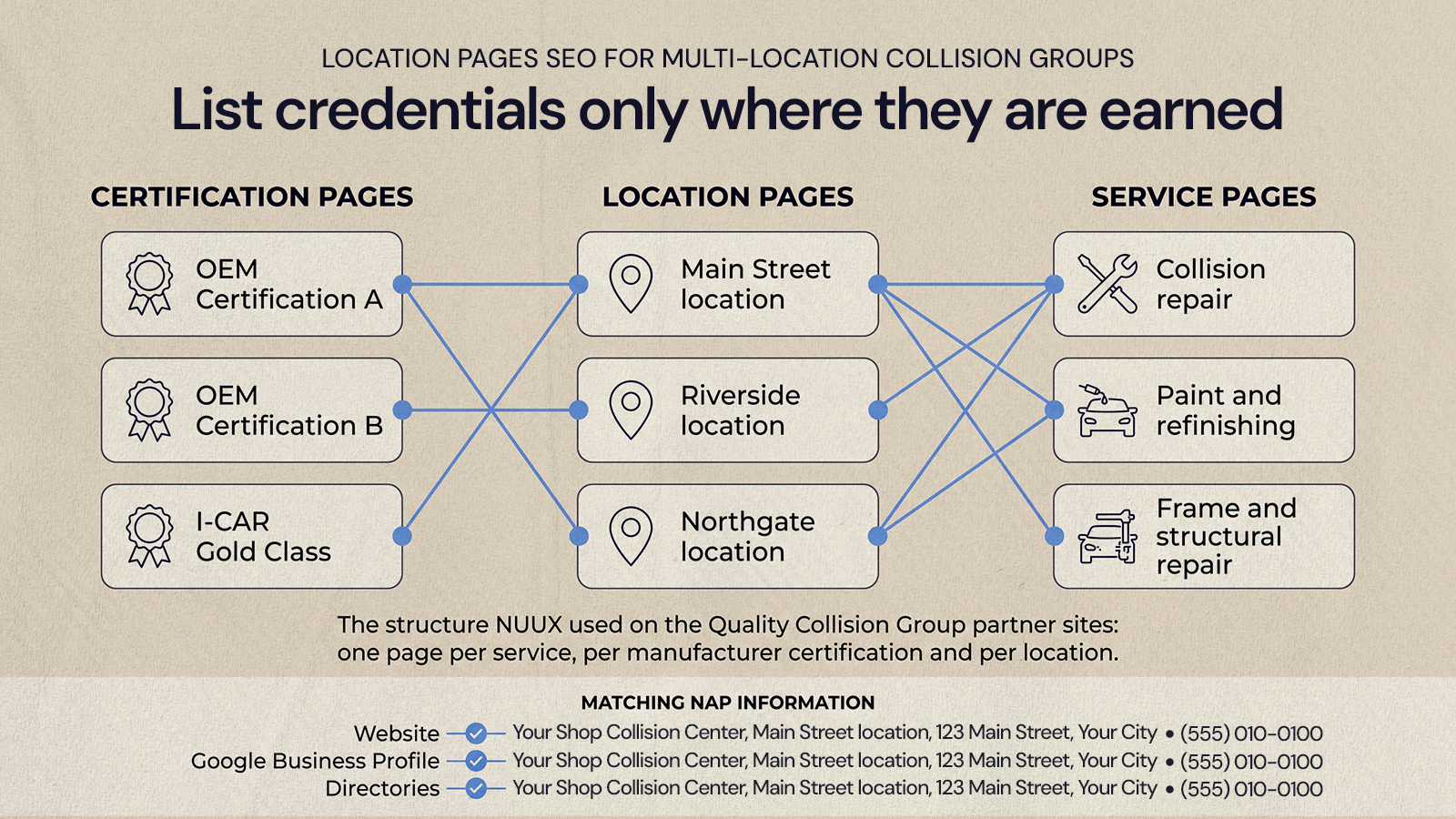
NAP is the foundation. Pick one format for each shop's name and address (including suite numbers) and use it on the website, the Business Profile and the main directories. Google's guidelines also say all locations of a chain should use the same business name unless the real-world signage consistently varies, which is worth checking for groups that kept an acquired shop's original name.
Hours need the same care. A front office may be open while estimators are not, or a shop may offer Saturday drop-off but no Saturday estimates. Say so clearly, because a wasted trip is a lost customer.
Services should reflect each shop's real capabilities. One location may be set up for heavy structural work, another for quick cosmetic repairs. When the page shows the truth, customers sort themselves to the right shop and staff spend less time redirecting calls.
Certifications deserve their own attention because they are usually tied to a facility. I-CAR, for example, awards Gold Class to a shop based on role-specific training completed by its estimators and technicians, with ongoing training required to keep it. Many manufacturer programs certify individual facilities as well. On the Quality Collision Group partner sites, NUUX made sure each location page lists only the credentials that shop actually holds.
How do unique location pages improve local rankings and conversions?
Google does not publish a formula for how a location page affects local rankings, so treat any promise of guaranteed results with suspicion. What is clear is that a page with specific, accurate local detail is more relevant to a local search and more useful to the person reading it. The conversion benefit is easier to see: a driver who finds their answers on the page is more likely to book than one who has to call around.
Unique copy does more than mention a city. For example, a hypothetical shop near a busy commuter corridor might lead with easy drop-off and rental coordination, while a shop in a hail-prone area might highlight paintless dent repair, if that location offers it. A useful structure for the copy:
- An opening that says who the shop serves and what customers can expect there.
- Service-area context: nearby neighborhoods, towns and commuter routes, written naturally.
- Facility-specific strengths: services, certifications, equipment and insurance support that apply to this shop.
- Visit information: parking, the entrance, whether appointments are recommended and what to bring for an estimate.
- A clear next step to book, request an estimate, call or get directions.
The fastest way to get this content is to ask each shop manager a short set of questions: what the shop does best, which certifications it holds, which areas it serves, what customers misunderstand before arriving, and any access quirks. Their answers usually turn into better copy than anything written from a head office.
Reviews, photos and directions that help drivers choose a shop
Collision customers often choose under pressure. They may be dealing with a claim, a rental, a tow or a safety concern. Location-specific reviews show how that team communicates and handles timelines. Google also lists review count and rating as part of prominence for Business Profiles, so asking happy customers to review the specific shop they used helps in two places at once.
Photos do quiet work. A clear exterior shot helps a driver recognize the building. Lobby and parking photos reduce uncertainty before arrival, and team photos make the shop feel established. They are also one of the easier improvements to make across a group without rewriting the site.
Directions should go beyond an embedded map. Written directions add local relevance and help with real-world conditions. A useful directions section covers:
- The closest highway or main road and the nearest cross street
- Neighborhoods and towns the shop serves
- Whether the entrance is visible from the street
- Parking and drop-off instructions
- Landmarks that help people find the building
- Towing access or after-hours drop-off, if offered
What local schema should a collision location page use?
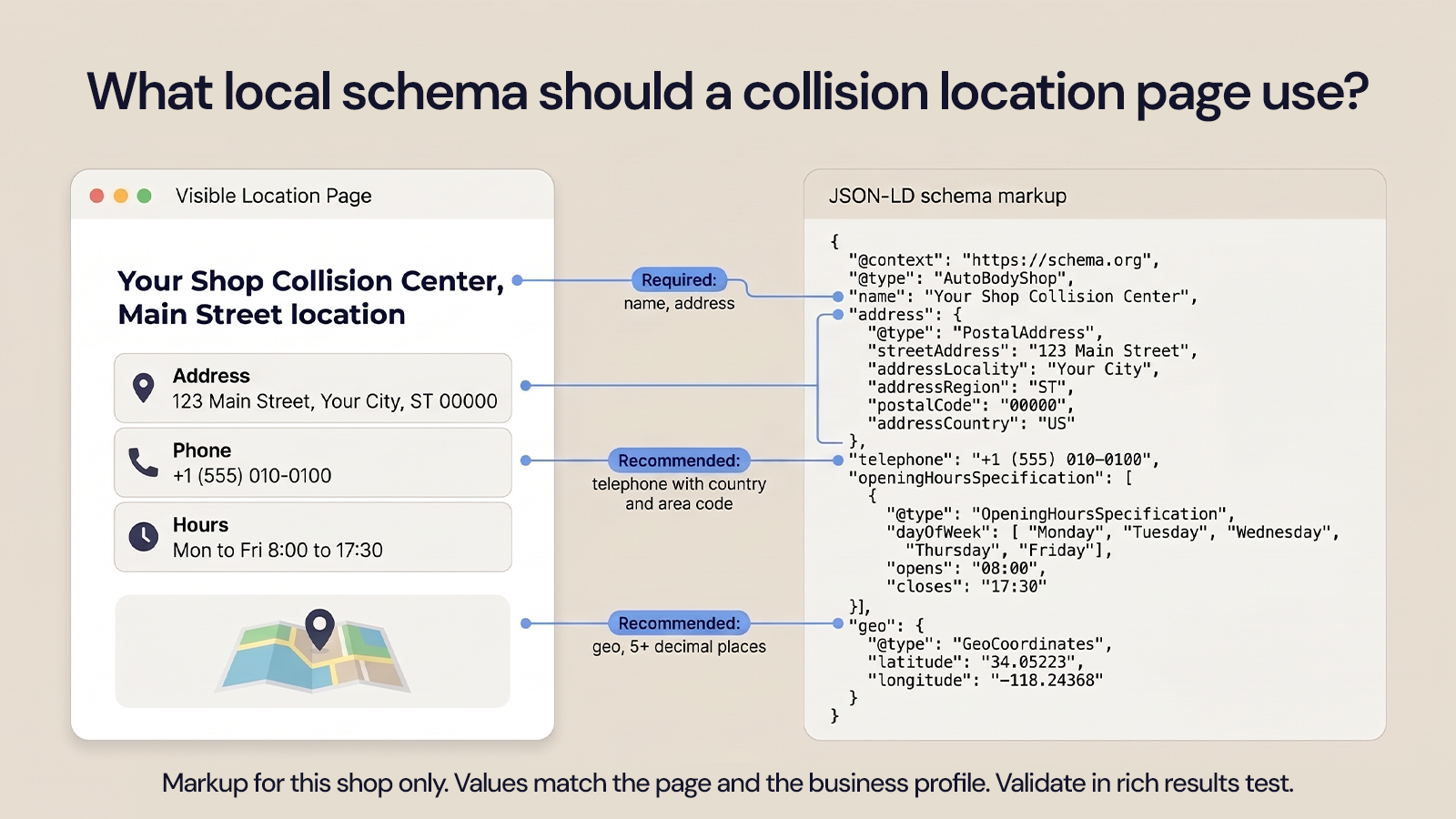
Use LocalBusiness structured data on each location page, with a more specific type such as AutoBodyShop where it fits. Google's documentation lists name and address as required, with the address given as a full postal address. It recommends opening hours, a telephone number that includes the country and area code, and geo coordinates with at least five decimal places.
Each location page should carry markup for that shop only, and the values should match what is visible on the page and on the Business Profile. Validate the markup with Google's Rich Results Test before launch and again after template changes. Schema helps search engines understand which business the page describes, but it does not guarantee any special search feature.
Technical SEO foundations for location pages
Good content needs a technically sound page behind it. The fundamentals: every location page is crawlable and indexable, loads quickly on a phone and is linked from logical places on the site.
- URLs. Use a clear, consistent pattern such as /locations/city-shop-name. Google's SEO Starter Guide recommends descriptive URLs and grouping similar pages in directories.
- Titles and headings. Include the shop type and city in the title tag and the visible H1, written for people rather than stuffed with keywords.
- Internal links. A locations directory should link to every shop. Service and certification pages should link to the locations that offer them, and each location page should link back to its services and the booking page.
- Mobile. Click-to-call, a visible booking button, compressed images and a directions link that opens the phone's map app.
If your site runs on Webflow, many of these fields can live in a CMS collection so every location page follows the same template. Our guide to choosing a Webflow SEO company covers what to expect from a partner on the technical side.
A checklist for scaling collision location pages
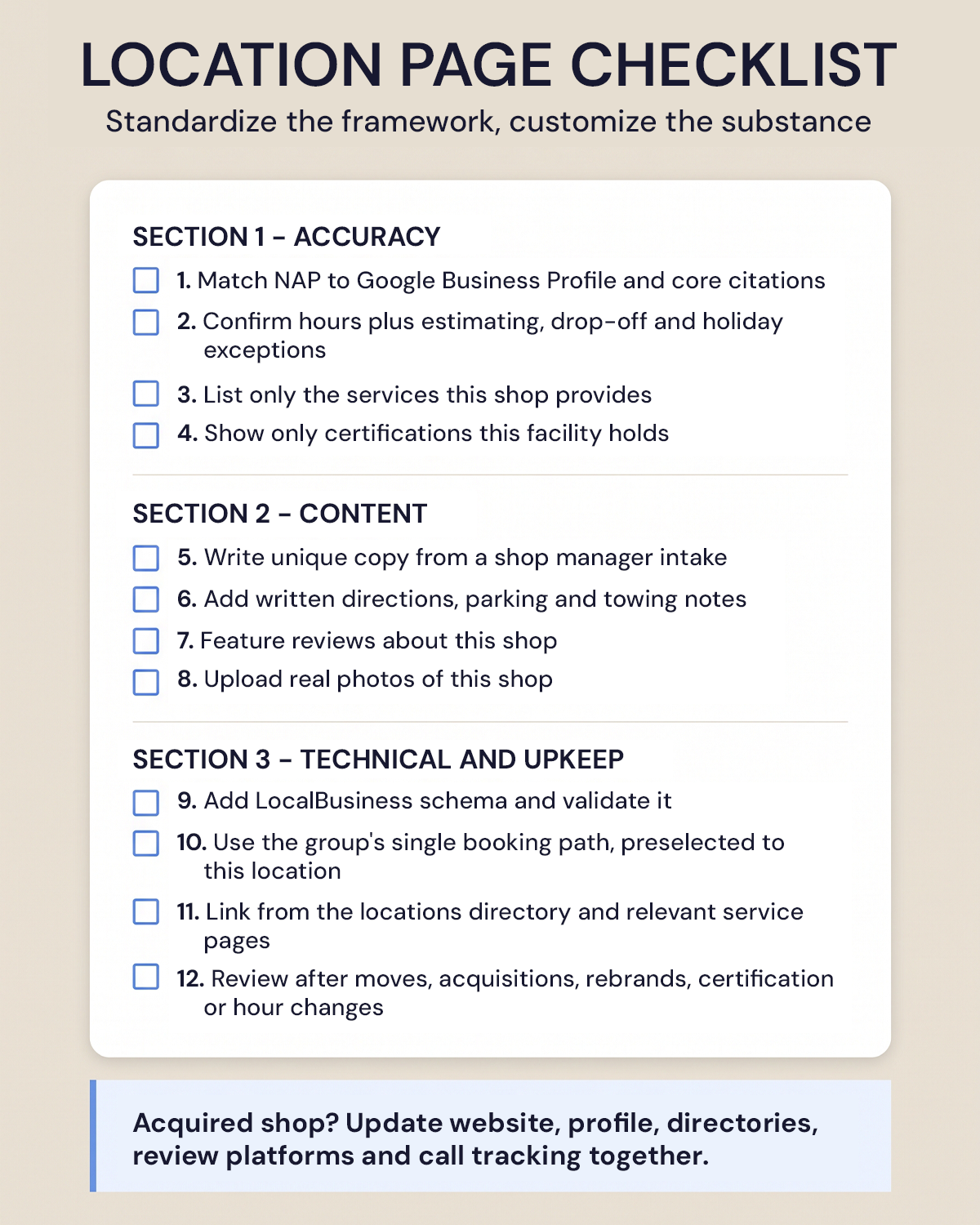
The challenge for multi-location groups is scale. The answer is to standardize the framework and customize the substance: the same sections on every page, filled with details that are true for each shop. A consistent structure is also what makes a good auto body shop website template worth using. Use this list when building new pages or auditing existing ones:
- Match NAP to the Google Business Profile and core citations.
- Confirm regular hours and note estimating, drop-off and holiday exceptions.
- List only the services this shop provides.
- Show only the certifications this facility holds.
- Write unique copy from a short shop manager intake.
- Add written directions, parking and towing notes.
- Feature reviews about this shop.
- Upload real photos of this shop.
- Add LocalBusiness schema and validate it.
- Use the group's single booking path, preselected to this location.
- Link the page from the locations directory and relevant service pages.
- Review the page after moves, acquisitions, rebrands, certification changes or hour changes.
Acquired shops need extra attention. A rebrand, a new phone number or new hours can create mismatches across the website, the Business Profile, directories, review platforms and call tracking numbers, so clean them up together.
Where should a collision group start?
Start with the basics on every page: accurate NAP, hours, services, certifications, directions, reviews, photos, schema and unique copy. Then make the booking path the same everywhere, which we cover in more depth in our guide to turning collision site visitors into booked estimates. SEO built into the structure from the start tends to pay off: when NUUX migrated and redesigned Brandywine Coachworks with SEO built into the redesign, the shop saw about a 5% increase in organic calls, per QCG's own call tracking.
If you want help planning location pages across your group, NUUX handles this as part of our SEO and growth marketing work.
Want results like this
Your website should make money, not excuses. Let us find the revenue hiding in your current experience.
FAQs
Quick answers to the questions we hear most about website conversion and UX design.
Yes, if each shop is a real location that serves customers in person. A separate page lets you show that shop's address, phone number, hours, services, certifications and reviews, and it gives the shop's Google Business Profile a page that represents that location. Google's guidelines ask for a phone number or website that represents the individual location, so a single shared contact page is a weak substitute.
You can use the same template, but not the same copy. Keep the section structure consistent across locations, then fill it with details that are true for each shop: services, certifications, directions, photos and reviews. Pages that only swap the city name give people little reason to trust them, and Google's spam policies warn against substantially similar pages targeted at different cities.
Only on the pages for shops that hold them. Certifications such as I-CAR Gold Class are earned by an individual shop, and many manufacturer programs certify specific facilities. Listing a certification on a shop that does not have it misleads customers and can cause problems with insurers or manufacturers. A certification page that links to the qualifying locations is a cleaner way to show group-wide coverage.
Use LocalBusiness structured data, with the more specific AutoBodyShop type from schema.org where it fits. Include the name and full postal address, which Google lists as required, plus telephone, opening hours and geo coordinates, which it recommends. Put only that shop's details on its page, keep them matching the visible content and validate the markup with Google's Rich Results Test.
Review each page whenever something changes at the shop: hours, phone numbers, services, certifications, management or branding. Beyond that, a quarterly check against the Google Business Profile catches drift before customers notice it. Acquisitions and rebrands deserve a full cleanup across the website, Business Profile, directories and call tracking numbers at the same time, so the details match everywhere.
Related articles
More field notes on conversion, UX, and building websites that sell.


