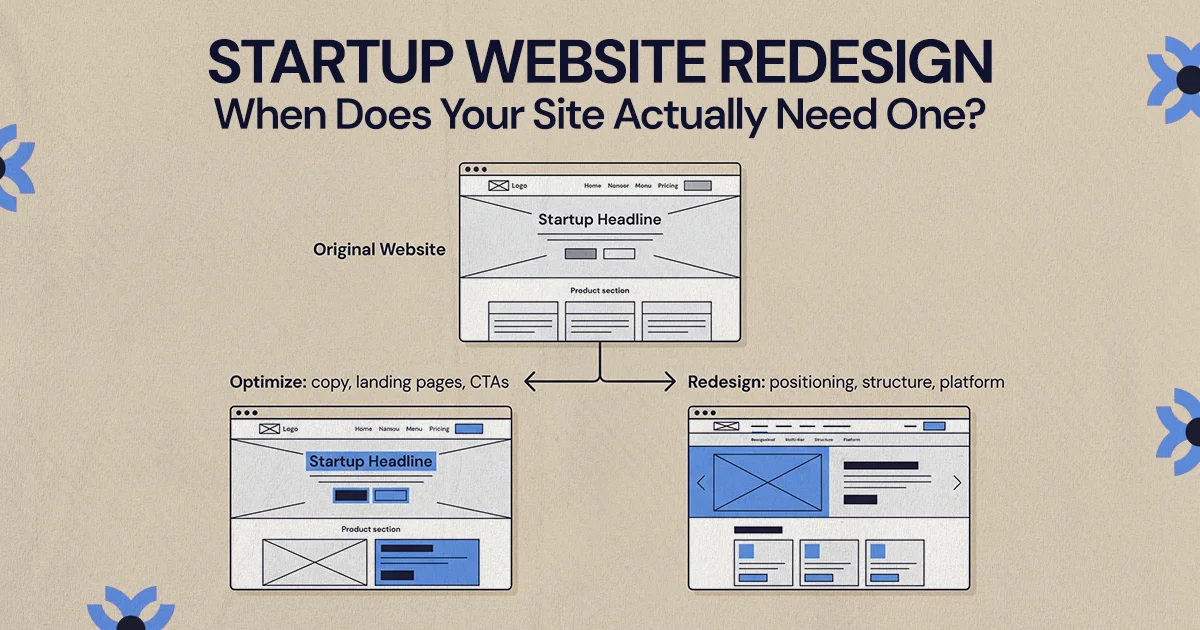
A startup website needs a redesign when it no longer matches your positioning, buyer, sales motion or growth stage. If only a few pages or messages are underperforming, fix those first instead.
A startup website needs a redesign when it no longer supports the company's current positioning, buyer journey, sales motion or growth goals. If the problem is limited to weak copy, a few underperforming landing pages or unclear calls to action, a full startup website redesign is probably unnecessary.
That second point matters. Sometimes the most honest decision is not to redesign at all, especially when runway is tight, product-market fit is still forming, or the team hasn't diagnosed what is actually hurting performance.
The more useful question for founders and heads of marketing is whether the website is helping the right people understand you, trust you and take the next step, rather than whether it looks modern enough. A redesign should be tied to conversion data, sales feedback, ICP changes, funding stage and what the team can realistically take on. A competitor's new site or internal fatigue isn't a reason on its own.
Does your startup need a full redesign or focused optimization?
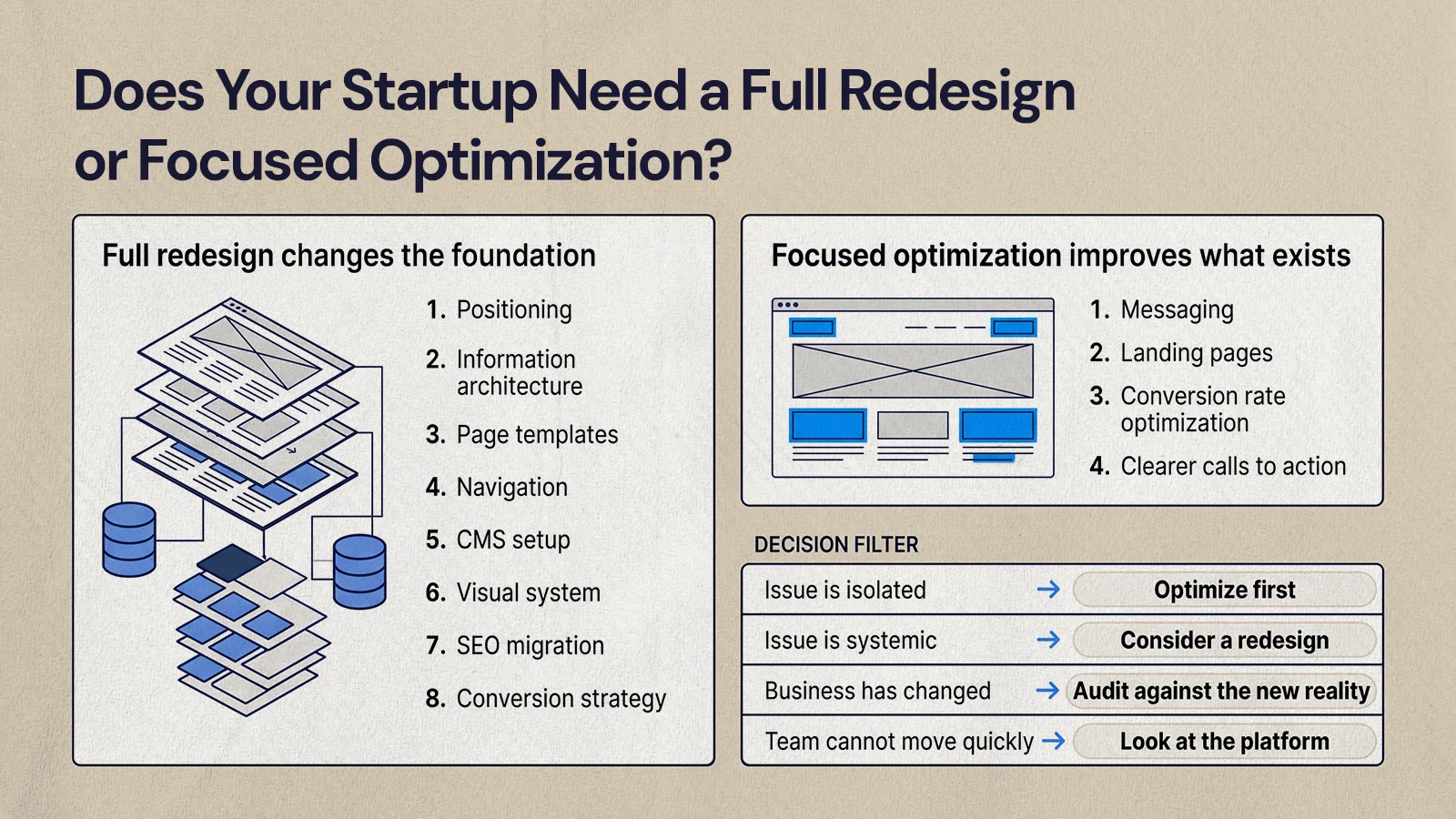
You need a full redesign when the site's structure, messaging, technology and conversion paths no longer match the business you're building now. You need focused optimization when the site still describes the company accurately, but specific pages, messages or flows are underperforming.
A full redesign changes the foundation. It can include new positioning, information architecture, page templates, navigation, CMS setup, a visual system, an SEO migration and a conversion strategy. Focused optimization improves what already exists: better messaging, landing page changes, conversion rate optimization and clearer calls to action.
The distinction matters because startups work under constraints. A pre-product-market fit company needs speed and learning more than a polished brand system. A post-Series A company moving upmarket needs a site that supports longer sales cycles, buying committees and enterprise-level trust. A bootstrapped team may get more from rewriting the homepage and rebuilding two campaign pages than from reworking the whole site.
Run this filter before committing:
- The issue is isolated: optimize first. One weak pricing page or one low-converting campaign doesn't justify rebuilding the site.
- The issue is systemic: consider a redesign. When every major page reflects old positioning, outdated personas, poor navigation or weak conversion logic, small fixes only delay the decision.
- The business has changed: audit against the new reality. A pivot, rebrand, funding round, ICP shift or new sales motion can make the current site strategically wrong.
- The team can't move quickly: look at the platform. If marketing needs a developer for routine page updates, the redesign conversation has to include CMS and workflow decisions.
Which signals actually justify a startup website redesign?
Real redesign signals show up as patterns, not opinions. A founder saying "the site feels old" is a data point, not a business case. The case gets stronger when several signals point the same way: the website is blocking growth or misrepresenting the company.
A positioning shift. Startups change fast after funding, customer learning or a pivot. If the site still explains the product to an old ICP while sales pursues a different buyer, visitors feel the mismatch. A company that started selling to small teams and now targets enterprise departments has to address procurement, integrations, security, implementation and proof. If the whole architecture was built for a different buyer, that's more than a copy tweak.
Conversion friction across every channel. If organic, paid, referral and direct traffic all arrive but qualified visitors don't take the next step, the problem is deeper than one page. Look at demo requests, trial starts, form completion, pricing page behavior and lead quality. If people drop off before they understand the offer, the journey from first impression to decision needs rebuilding.
Repeated confusion on sales calls. If prospects keep asking basic questions after reading the site, misunderstand who the product is for, or compare it to the wrong category, the website isn't qualifying anyone. This is most useful when it repeats across deals and lines up with analytics.
Technical and operational limits. A site that's slow, hard to update, hard to scale or dependent on engineering for basic marketing work limits growth. This is where platform choice becomes relevant. Looking at Webflow, WordPress or a headless CMS makes sense when your marketing workflow, governance needs and page production pace have changed, not because one platform is universally better.
False reasons founders use to justify a redesign
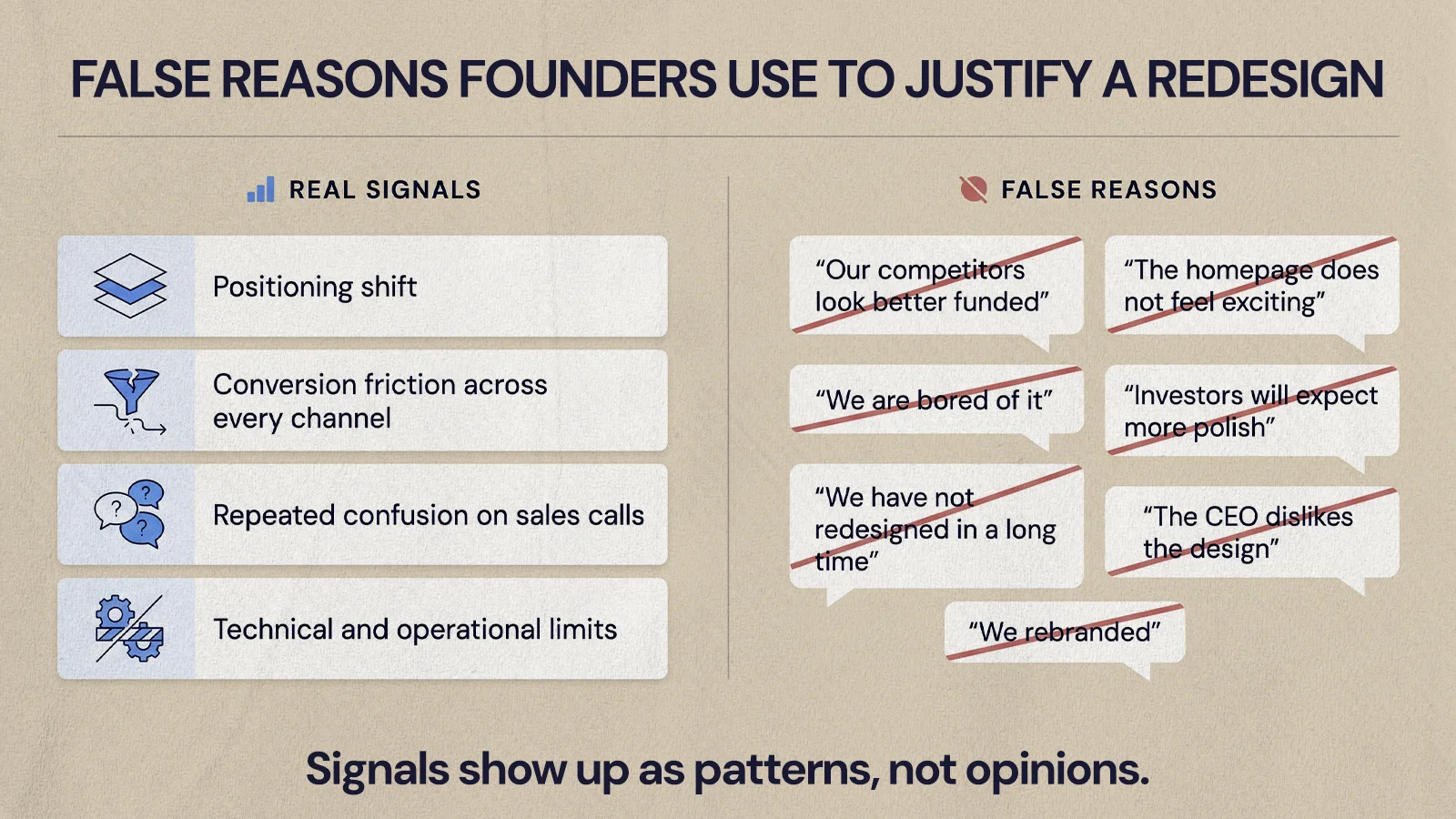
Not every redesign instinct is wrong, but many are incomplete. The riskiest projects start with vague dissatisfaction and treat a new visual direction as the fix. If you're weighing the general case, the signs your website needs a redesign apply to any business. For startups, these are the reasons that most often mislead:
- "Our competitors look better funded than we do." That may point to a trust gap, or it may be a subjective reaction. Their site may serve a different ICP or sales model, and copying it can blur your own positioning.
- "The homepage doesn't feel exciting." Clarity and relevance matter more than excitement.
- "We're bored of it." Your team sees the site every day, so it goes stale internally long before it does for prospects.
- "Investors will expect something more polished." Investor perception matters, but the site still has to work for customers and revenue.
- "We haven't redesigned in a long time." Age on its own isn't a problem; misalignment with the business is.
- "The CEO dislikes the design." Leadership input counts, but weigh it against user behavior, sales feedback and business goals.
- "We rebranded." A new logo and palette don't always need a full redesign. Often the right move is rolling the new identity across high-value pages, then doing structural work only where the site no longer fits the strategy.
A redesign costs more than design and development time. It consumes attention, and for a startup, attention is part of runway.
What should you fix first if a redesign isn't justified?
Fix the parts of the site that most directly affect understanding and action: messaging, landing pages and conversion rate optimization. These changes often clarify the offer on their own, and they show you whether the larger site really needs rebuilding.
Start with messaging. Many startup sites underperform because they explain the product from the company's point of view instead of the buyer's problem. Review the hero, product overview, use case pages and calls to action. Can a visitor tell who it's for, what problem it solves, why it's different and what to do next in a short visit? If not, rewriting is more urgent than redesigning.
Then the landing pages. Campaign, integration, comparison and pricing pages often carry more conversion weight than the homepage. A sharper headline, better proof placement, clearer form expectations or a tighter CTA sequence is easier to test than a full rebuild.
Then conversion rate optimization. For startups, CRO usually means reducing confusion: clearer paths for different roles, stronger demo framing, better trial expectations, objections answered on the page, and a lead form that matches sales capacity.
A practical sequence:
- Review the five pages that most influence pipeline, trials, demos or sales conversations.
- Compare what each page says with what a visitor at that stage needs to know.
- Rewrite unclear sections before redesigning them. Better copy shows whether the layout is actually the problem.
- Cut competing calls to action down to one clear next step per page.
- Read analytics and sales feedback together. Data shows what happens; sales calls explain why.
- Change one thing at a time where you have enough traffic to learn from it.
All of this is useful even if you redesign later. It turns the redesign brief into a list of real constraints instead of preferences.
How does startup stage change the decision?
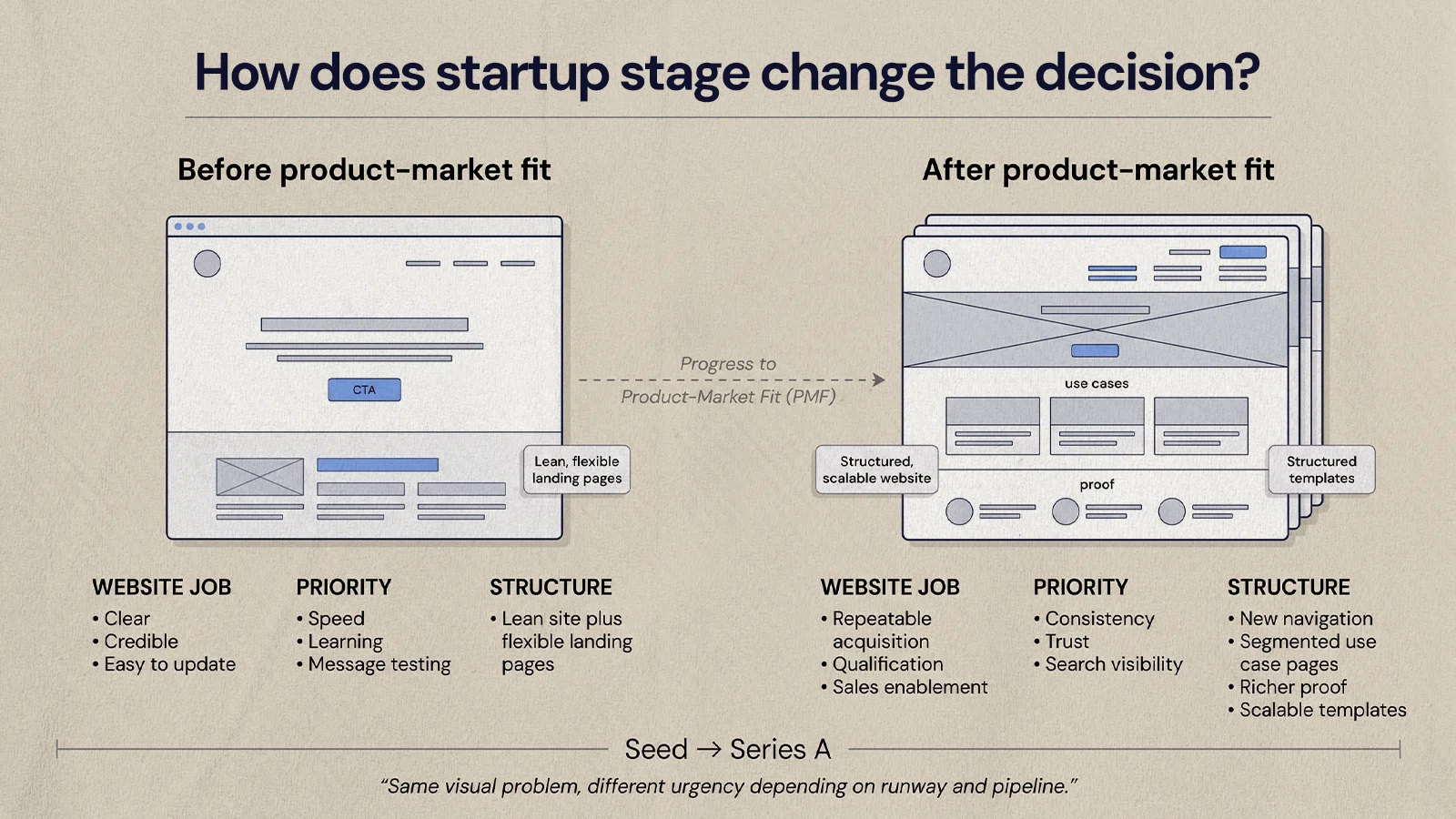
A company still searching for product-market fit should prioritize speed, learning and message testing. A company scaling a validated motion needs consistency, trust, search visibility and efficiency.
Before product-market fit, a full redesign is usually a distraction while the offer, ICP and sales process are still moving. The site should be clear, credible and easy to update, but it doesn't need to anticipate every future segment. A lean structure with flexible landing pages is often enough while you learn which messages convert. Our guide to website design for startups covers what that lean version needs.
After product-market fit, the website's job changes. It has to support repeatable acquisition, qualification and sales enablement. If you've raised, entered a new category, expanded the product or moved from founder-led sales to a go-to-market team, the site may need a stronger system: new navigation, a clearer resource structure, segmented use case pages, richer proof and templates that scale.
Funding stage changes the risk. A seed-stage company rarely wants a months-long rebuild unless the current site is blocking learning or revenue. A Series A company may need the site to support paid acquisition, content marketing, partner pages, hiring and enterprise sales. The same visual problem has very different urgency depending on runway and pipeline.
Rebrands and ICP shifts need a closer look. If the ICP moved from technical users to business buyers, you likely need a new narrative and page structure. If the ICP stayed the same and the rebrand is visual, a phased update may be enough. If sales says prospects trust the product but misunderstand pricing or implementation, the highest-value work is content and conversion flow, not a visual overhaul.
What should a redesign include beyond new visuals?
A successful redesign covers strategy, structure, content, technical planning and measurement. The goal is a site that's accurate, useful and sustainable for the company's next stage.
Positioning comes first. Before wireframes, agree on the ICP, category, primary use cases, objections and buying process. A site built on unclear positioning still feels unclear after launch, which is why good redesigns start with sales call reviews, analytics and stakeholder alignment.
Then information architecture. Visitors shouldn't have to decode your org chart to find what matters. Navigation should follow how buyers think: problems, roles, use cases, product areas, pricing, integrations and proof.
Content gets the same attention as design. A redesign is the moment to clarify key pages and to remove the ones that no longer serve the business. More pages aren't automatically better.
SEO planning happens before launch, not after traffic drops. If URLs change, map every redirect. Google's own site move guidance recommends a mapping of old to new URLs and permanent server-side redirects. Keep valuable metadata, review internal links, check what's indexable, and don't remove content that's earning traffic without a reason.
A useful redesign brief covers:
- Business context: stage, runway, funding, growth targets and major strategic shifts.
- Audience: current ICP, new ICP if it's changing, buyer roles, objections and sales cycle.
- Messaging: core promise, category language, differentiation and proof.
- Conversion goals: demos, trials, contact forms, signups or self-serve actions.
- Content scope: pages to keep, rewrite, merge, remove or create.
- SEO requirements: URL mapping, redirects, metadata, internal links and launch monitoring.
- Platform needs: who updates the site, how often pages launch, and how much developer support is realistic.
- Measurement: baseline conversion data, post-launch checkpoints and who owns ongoing optimization.
A brief like this stops the common mistake of approving beautiful screens that don't solve the underlying business problem.
How should founders make the call?
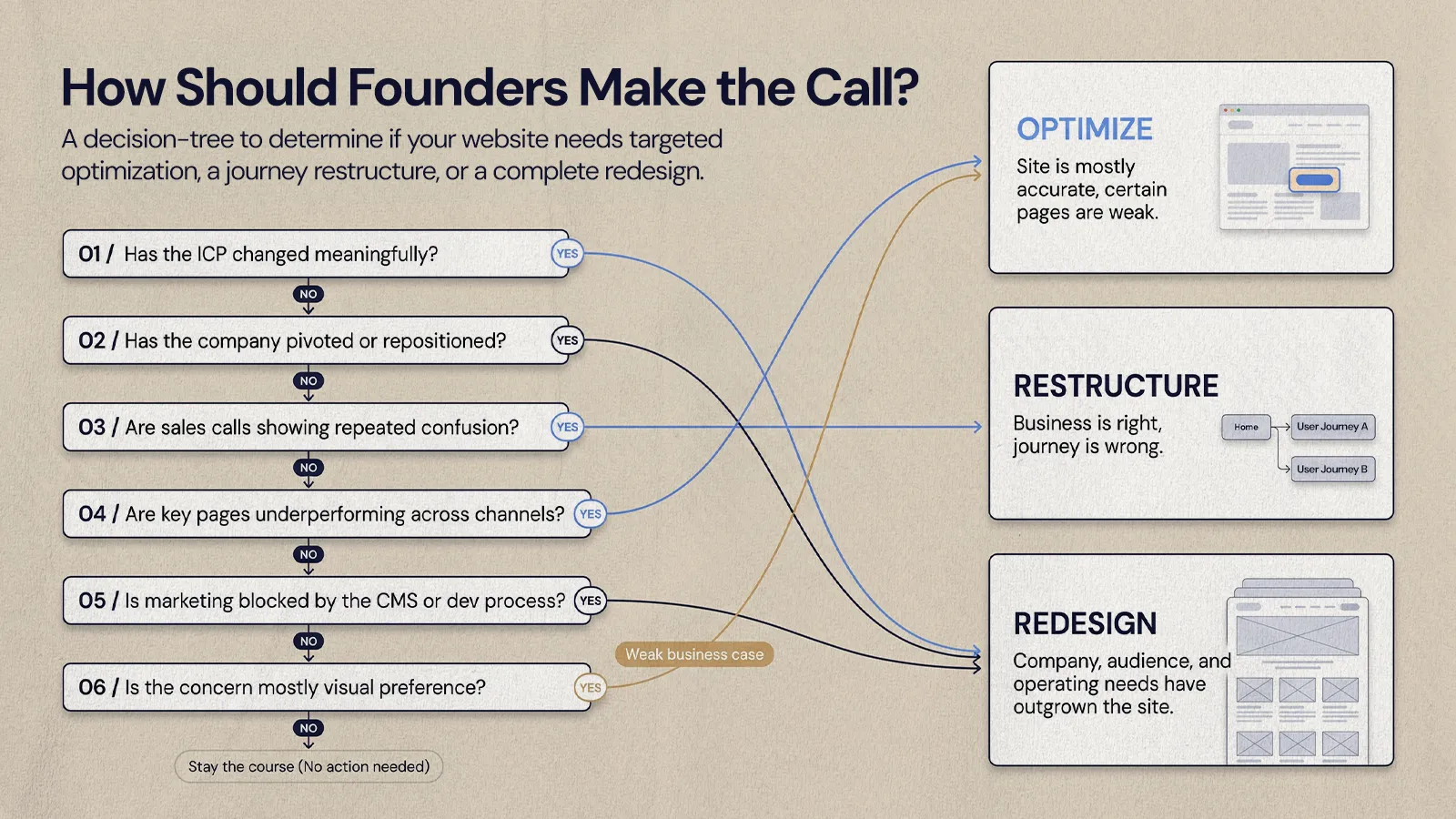
Make the decision with evidence, in one working session with the founder, head of marketing, sales lead and whoever owns analytics. Work through these questions:
- Has the ICP changed meaningfully? If yes, the site may be speaking to the wrong buyer. Likely action: rework messaging and possibly restructure key pages.
- Has the company pivoted or repositioned? If yes, the site may describe an outdated business. Likely action: consider a strategic redesign.
- Are sales calls showing repeated confusion? If yes, the site isn't setting expectations. Likely action: fix messaging, proof and the buyer journey.
- Are key pages underperforming across channels? If yes, the issue may be systemic. Likely action: audit conversion paths and consider a redesign.
- Is marketing blocked by the CMS or dev process? If yes, the site is limiting campaign speed. Likely action: evaluate platform and template changes.
- Is the concern mostly visual preference? If yes, the business case is weak. Likely action: optimize copy and priority pages first.
Then pick one of three paths:
- Optimize when the site is mostly accurate but certain pages are weak.
- Restructure when the business is right but the journey is wrong: new navigation, page hierarchy and buyer paths without a full visual reinvention.
- Redesign when the company, audience, positioning and operating needs have outgrown the current site.
Redesign when the website is strategically wrong, structurally limiting or holding the team back. Don't redesign only because it feels old. Protect runway, diagnose the real problem, and match the level of change to your current stage.
If you're weighing a redesign and want a second opinion on which path fits, NUUX's UX/UI design work starts with content and information architecture before any visuals, which is where that diagnosis happens.
Want results like this
Your website should make money, not excuses. Let us find the revenue hiding in your current experience.
FAQs
Quick answers to the questions we hear most about website conversion and UX design.
There's no fixed schedule. Redesign when positioning, ICP, sales motion or platform needs change enough that the current site misrepresents the business. The trigger is often a funding round, a pivot or a move upmarket rather than a date on the calendar. Between those moments, regular copy updates, new landing pages and conversion testing usually keep the site accurate without a rebuild.
No. A rebrand changes the visual identity: logo, color, type and sometimes the name or voice. A redesign changes structure, messaging and conversion paths. A rebrand can often be rolled out across key pages without a full redesign, starting with the homepage, pricing and top landing pages. A redesign is only needed if the business behind the brand has also changed.
Usually not. Before product-market fit, a clear, easy-to-update site with flexible landing pages is worth more than a polished rebuild, because the message is still changing. Put the effort into testing headlines, offers and audiences instead. Once the ICP and sales motion settle, you'll have the evidence to brief a redesign that fits the business you're actually building.
Start with messaging, your highest-traffic landing pages and conversion paths. Rewrite the hero and product overview from the buyer's point of view, tighten calls to action to one clear next step per page, and match the lead form to what sales actually needs. Those changes are cheap to test and show whether the underlying structure is really the problem.
It can if URLs change without redirects or ranking content is removed. Before launch, map every old URL to its new equivalent, set permanent redirects, keep metadata that's working and review internal links. After launch, monitor rankings, crawl errors and organic traffic in Google Search Console so you can catch and fix problems in the first few weeks.
Related articles
More field notes on conversion, UX, and building websites that sell.