Auto repair shops should bid on urgent, local, high-intent searches like "collision repair near me," "brake repair [city]" and their own shop name, using tightly built search campaigns tied to real services. Test Local Services Ads if your category is available, send each click to a matching service or location page, and use call tracking and negative keywords to cut waste before raising spend.
For Google Ads for auto repair shops, the searches worth bidding on are the urgent, local, high-intent ones: "collision repair near me," "auto body shop [city]," "brake repair," "check engine light diagnosis," "transmission repair" and your own shop name. Start with tightly built search campaigns around the services you actually perform, test Local Services Ads if your category is available in your market, and cut waste with negative keywords and call tracking before you raise spend.
Not every repair-related search deserves a bid. Paid search pays off when the keyword, the ad, the landing page and the person answering the phone all point at the same customer: someone in your service area who is ready to call, book or ask for an estimate. The rest of this guide covers how to get there, whether you run one independent shop or a multi-location collision group.
What should auto repair shops bid on in Google Ads?
Bid on keywords that show a clear need, a local intent and a realistic path to a repair order. A search like "car making clicking noise" often comes from someone researching a problem. "Brake repair near me" or "bumper repair [city]" comes from someone much closer to booking. The first kind can wait until your core campaigns are profitable. The second kind is where most shops should start.
Build the list from your real service menu, not a generic template. An independent mechanical shop might prioritize brakes, diagnostics, AC repair, suspension and scheduled maintenance. A collision facility might focus on accident repair, bumper repair, dent repair, frame repair, refinishing and hail damage. A multi-location group needs the same thinking per market, because demand and competition in one metro rarely match another.
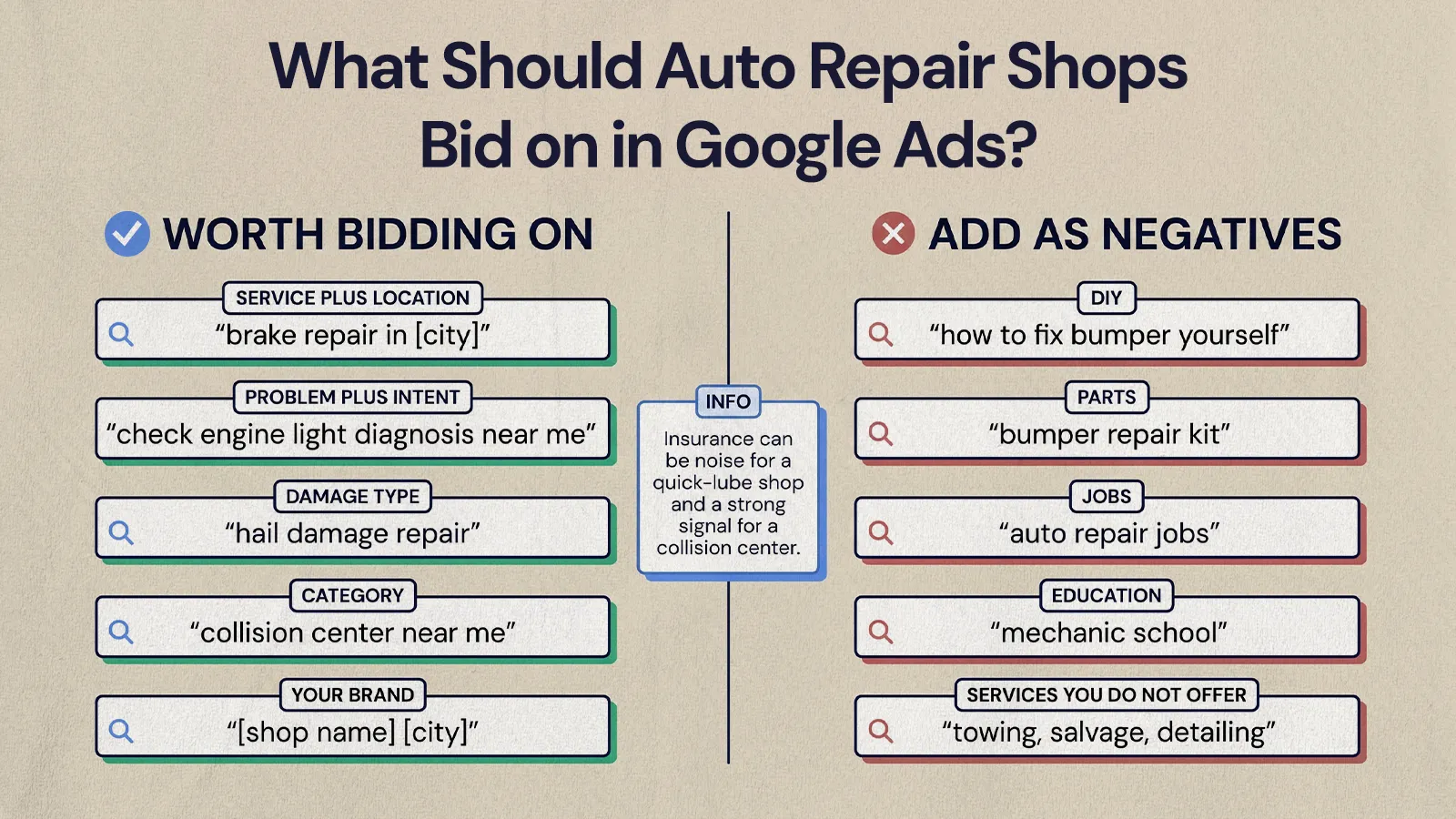
Keyword groups that usually earn their budget:
- Service plus location: "brake repair in [city]," "collision repair [neighborhood]," "auto body shop [city]."
- Problem plus intent: "car AC not blowing cold repair," "check engine light diagnosis near me," "car leaking oil repair."
- Damage type: "hail damage repair," "front end collision repair," "scratch and dent repair."
- Category searches: "auto repair shop near me," "collision center near me."
- Your brand: the shop name, common misspellings and "[shop name] [city]" for each location.
Brand campaigns get overlooked because people assume branded searchers will find you anyway. When a competitor bids on your name, or a group has several locations with similar names, a cheap branded campaign keeps the call, directions and booking path clean and routes each driver to the right shop.
Which searches are a waste of money for repair shops?
Automotive searches are messy. People look for parts, manuals, tutorials, jobs, classes and salvage vehicles using the same words that appear in profitable service searches. Negative keywords tell Google which searches should not trigger your ads, and they are the fastest way to stop paying for clicks that were never going to become jobs.
A collision shop bidding on "bumper repair" probably does not want "bumper repair kit," "how to fix bumper yourself" or "used bumper for sale." A mechanical shop probably does not want "auto repair jobs," "mechanic school" or "repair manual pdf." Common negative themes:
- DIY intent: how to, tutorial, video, yourself, at home.
- Parts and supplies: kit, tool, paint pen, part number, wholesale.
- Employment: jobs, careers, hiring, salary, apprenticeship.
- Education: school, class, course, training.
- Services you don't offer: towing, junkyard, salvage, detailing, if they aren't on your menu.
Two details matter here. First, Google's documentation says negative keywords do not match close variants, so an ad can still show for a plural or misspelling of a term you excluded. Add the variations you see in real search terms. Second, be careful not to block valuable searches. "Insurance" might be noise for a quick-lube shop and a strong signal for a collision center that helps customers through claims. Review the search terms report on a regular schedule and add negatives from what people actually typed, not from a list you wrote once.
Local Services Ads vs search ads: which is better for repair shops?
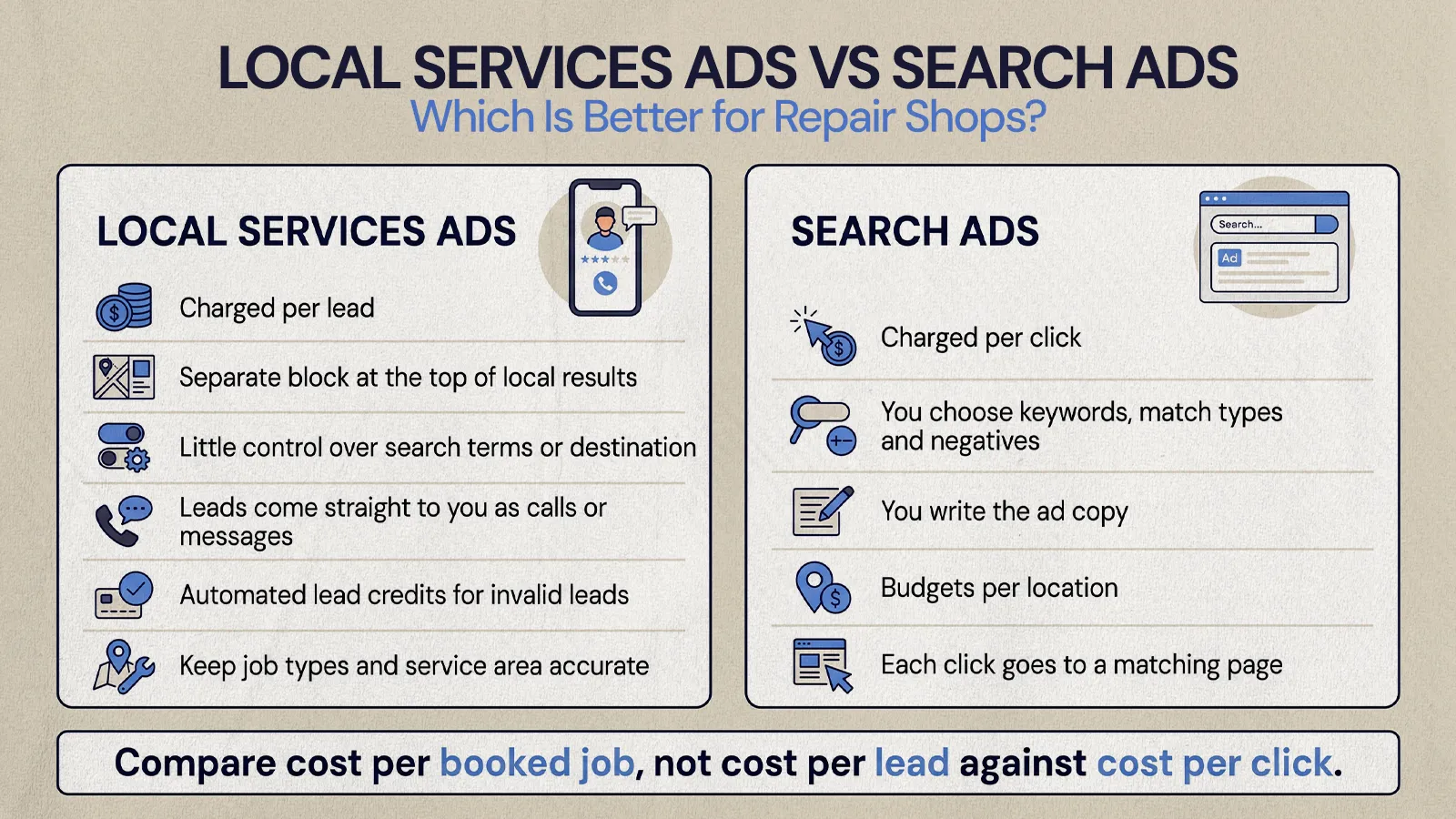
They do different jobs, and many shops end up testing both. In the United States, Google's Local Services Ads program lists auto categories including Auto Body Shop, Auto Repair Shop, Brake Shop, Transmission Shop, Tire Shop and Oil Change Service. Local Services Ads charge per lead rather than per click, and they show in a separate block at the top of local results. Search ads charge per click and give you far more control.
Local Services Ads work well when your category is available, your service area and job types are set up accurately, and your team answers the phone. You have little say over the exact search terms or the destination, because the lead comes straight to you as a call or message. Google now uses automated lead credits: leads it judges invalid or low quality are not charged, and charged leads can be credited later. Google's help center also says it no longer supports credits for "job type not serviced" or "geo not serviced" leads, which makes keeping your job types and service area accurate part of cost control. At the time of writing, Google also notes that its Google Verified badge is unavailable for auto categories, so check current eligibility in your market before you plan around it.
Search ads are the better tool when you want precision. You pick the keywords and match types, write the ad copy, add negatives, set budgets per location and send each click to a page that matches the search. For a group that wants collision, mechanical and brand campaigns reported separately by store, that control is hard to replace.
To compare them fairly, look at cost per booked job from each source rather than cost per lead against cost per click. You can only see that if you track calls and ask where each customer came from.
How should landing pages match your ads?
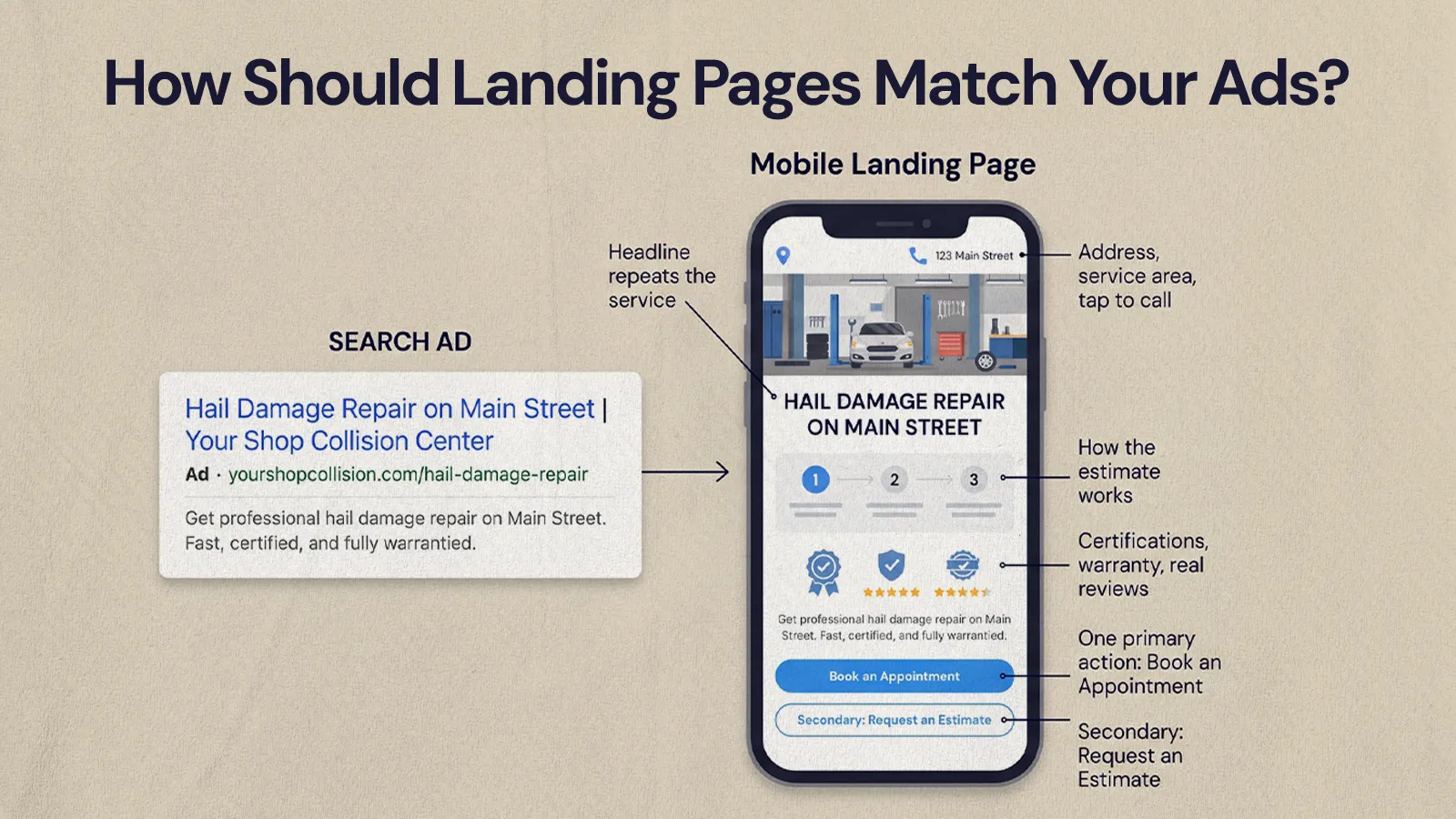
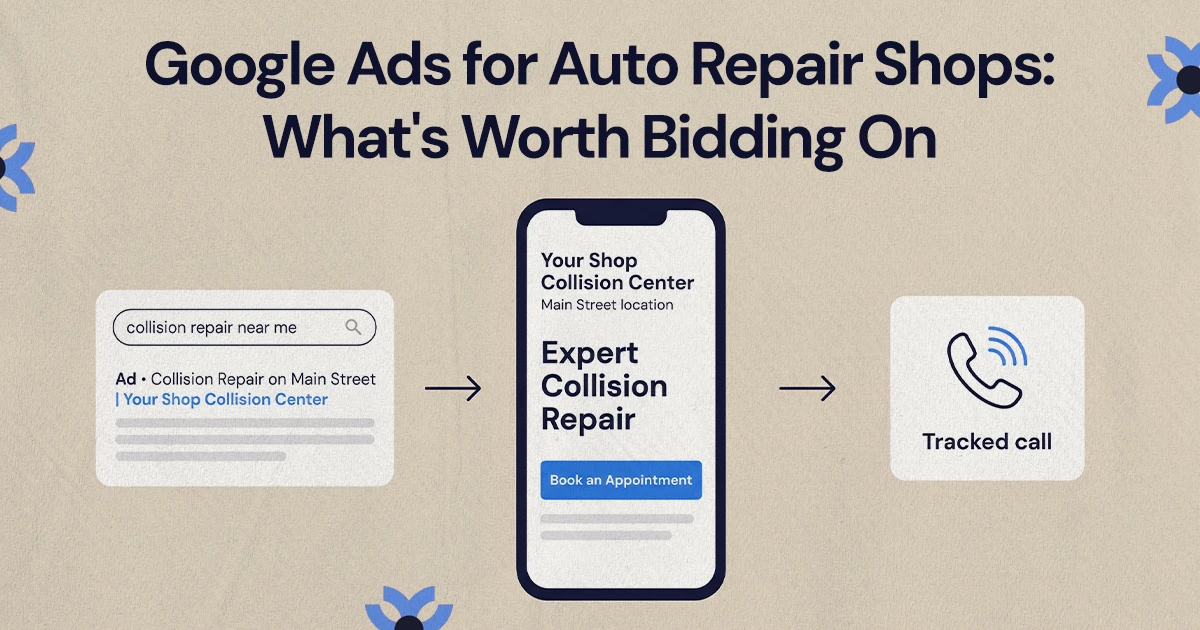
The landing page should repeat the promise of the ad: the same service, the same location and the same next step. If an ad says "Hail Damage Repair in Denver," the click should land on a hail repair page for that shop, not a homepage where the driver has to hunt for it. The closer the match, the faster the visitor trusts they are in the right place.
A good ad landing page answers the practical questions in the first screen on a phone:
- A headline that reflects the service in the ad.
- The shop address, service area and a tap-to-call phone number.
- A short explanation of how the estimate or repair process works.
- Trust signals you can back up, such as manufacturer certifications, warranty terms and real reviews.
- One primary action, such as booking an appointment, with a secondary option if the customer isn't ready.
For more on the page itself, see how collision shops turn website visitors into booked estimates and the checklist of what an auto body shop site needs to convert. The general principles of building landing pages that turn traffic into leads apply here too.
For multi-location groups, never send every ad to one corporate page. Each location should have its own page with its address, hours, phone number, services and certifications. If someone searched in a specific city, the page should confirm that this shop serves that city.
How do you track calls from Google Ads?
Phone calls are often the main conversion for repair advertising, and without tracking them you are guessing. You will see clicks and spend but not which keywords, ads or locations produced real conversations, which makes it hard to decide what to raise, pause or fix.
Google Ads has call assets, which add a phone number or call button to search ads, and call reporting, which uses Google forwarding numbers to record calls from ads and lets you count them as conversions. Google also notes that counting call conversions can affect bids if you use automated bidding, so decide what a qualifying call is before you turn it on. Many shops add a third-party call tracking tool with dynamic number insertion so calls from the landing page are tied back to the campaign too.
A workable call tracking setup:
- Track calls from the ad itself and calls from the landing page separately. They behave differently.
- Set a minimum call length for a conversion so hang-ups and wrong numbers don't train your bidding.
- Record which location received each call.
- Review recordings or transcripts where your state's consent rules allow it, and look for patterns in lead quality and missed opportunities.
- Mark which calls became booked estimates or repair orders, even if it starts as a simple spreadsheet.
Call data also exposes problems ad reports never show. A campaign can look weak when the real issue is missed calls at lunch, a phone tree that routes to the wrong store, or long hold times. If the phone isn't answered, a better bid won't help.
How should single shops and multi-location groups structure campaigns?
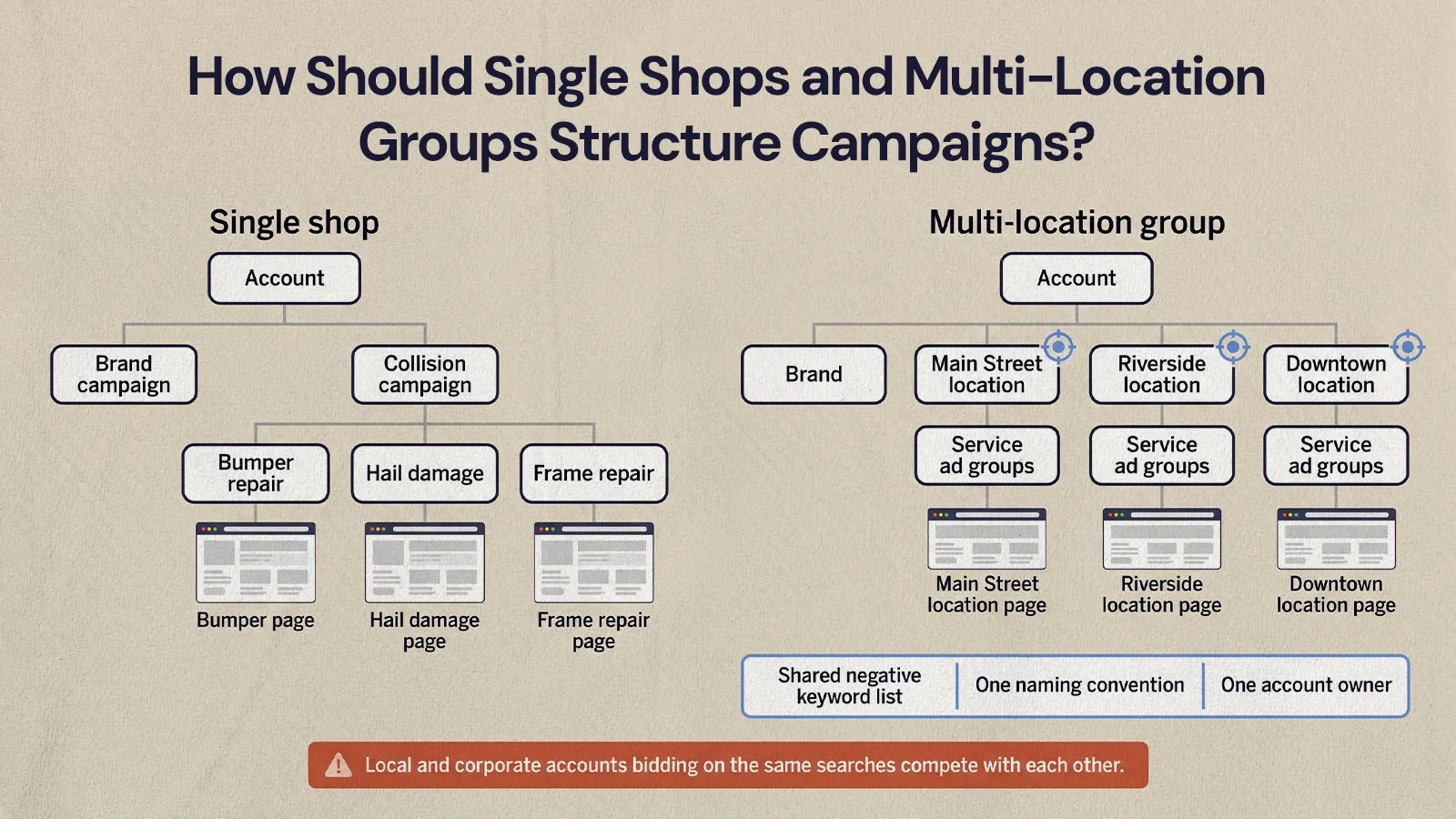
For a single shop, a clean starting structure is a branded campaign, one campaign for your main service line (collision or mechanical), and ad groups split by service theme so each one points to its own page. Keep unrelated repairs out of the same ad group. "Brake repair" and "hail damage" need different ads and different pages.
For a multi-location collision group, organize campaigns by market or location. That keeps one busy metro from eating the budget meant for another, and it makes reporting useful for the people running each store. Set location targeting to the area each shop can realistically serve, and check that ad copy, call routing and landing pages match the location, not the group headquarters.
Groups also need to decide who owns what. If local managers run their own accounts while corporate runs a brand campaign, the two can end up bidding against each other on the same searches. One account structure, clear naming and shared negative keyword lists prevent most of that.
How much should an auto repair shop spend on Google Ads?
There isn't an honest single number. Click costs vary by market, service and competition, and what matters is whether the spend turns into booked work your shop wants. The better approach is to decide what the budget is for, then let results tell you where to add or cut.
Budget decisions should follow:
- Margin and priority: which repairs are most profitable or strategically important right now.
- Capacity: which locations have open bays and estimators who can handle more work.
- Lead quality: which campaigns produce booked estimates, not just calls and form fills.
- Consistency: which campaigns keep producing good work month after month.
For example, a hypothetical collision shop with a backlog of heavy hits but open capacity for cosmetic work could shift budget toward bumper, scratch and dent searches for a few weeks, then shift back. A group with a newer location might give it a larger share of brand and category spend while a mature store runs a tighter, service-specific campaign. Pair platform numbers with call outcomes and estimate counts so you are judging the ads by the work they bring in.
Setting up Google Ads for auto repair shops: a pre-launch checklist
Before you scale spend, run through the basics:
- Separate campaigns for brand, collision, mechanical and priority locations where volume supports it.
- Ad groups built around one service theme each.
- Every ad group pointing to a matching service or location page.
- Call assets scheduled for the hours someone actually answers the phone.
- Call reporting and conversion tracking set up, with a clear definition of a qualified call.
- A starting negative keyword list, plus a recurring search terms review.
- Ad copy that names the service, the location and the next step, with claims you can verify.
- If you run Local Services Ads, job types and service areas that match what you really do.
- Reporting by location for multi-shop groups.
Owners and marketing managers should also agree on what a good lead is. For one shop it's a scheduled estimate. For another it's a diagnostic appointment tied to a specific service line. Defining that upfront keeps campaigns from being optimized toward easy conversions that don't turn into work.
Where to start
Google Ads can bring motivated drivers to your shop, but it can't fix a confusing website, unanswered phones or unclear services. Start with the highest-intent local searches for the work you want most, send each click to a page that matches it, track calls properly and keep trimming waste with negatives. Once that loop is working, expanding into more services, more locations or Local Services Ads becomes a decision based on your own data.
If you want help connecting ads, landing pages and tracking into one path, NUUX's growth marketing team works on exactly that.
Want results like this
Your website should make money, not excuses. Let us find the revenue hiding in your current experience.
FAQs
Quick answers to the questions we hear most about website conversion and UX design.
They can be, if your category is available in your market and your team answers calls quickly. Local Services Ads charge per lead rather than per click, and Google automatically credits leads it judges invalid or low quality. Google no longer credits leads for job types or areas you don't serve, so keep those settings accurate. Compare cost per booked job against your search campaigns before shifting budget.
Start with DIY terms (how to, tutorial, yourself), parts and supplies (kit, paint pen, part number), employment (jobs, hiring, salary), education (school, course) and any services you don't offer, such as towing or salvage. Negative keywords don't match close variants, so add plurals and misspellings you see in your search terms report, and review that report on a regular schedule.
Usually not. A homepage makes the visitor search for the service they just clicked on. Send each ad group to a page that matches the service and location in the ad, with the address, a tap-to-call number and one clear next step, such as booking an appointment. For multi-location groups, each shop should have its own location page so the click lands on the right store.
Track calls and forms back to the campaign, then record which ones became booked estimates or repair orders. Google Ads call reporting can count calls from ads as conversions, and a call tracking tool with dynamic number insertion can cover calls from the landing page. Set a minimum call length, note the location that took the call and review outcomes regularly so you judge ads by the work they bring in.
In most cases, yes. Branded clicks are usually inexpensive and high intent, and a branded campaign protects you when competitors bid on your name. It also lets multi-location groups route each driver to the correct store with the right phone number and directions, instead of a generic corporate page. Keep the ad copy specific to the location and the next step.
Related articles
More field notes on conversion, UX, and building websites that sell.