
The marketing channels that bring auto body shops the most estimates are Google Business Profile, customer and local business referrals, insurer and DRP relationships, dealership relationships, paid search and consistent community involvement. Shops do best running several together and tracking which ones produce repair orders by location.
The auto body shop marketing channels that bring in estimates are Google Business Profile, customer and local business referrals, insurer and DRP relationships, dealership relationships, paid search, and steady involvement in the local community. Most shops get the best results by running several of these together, because drivers choose a body shop through search, recommendations and insurance conversations at the same time.
This article covers the off-site side: the channels that put your name in front of a driver or a referral partner before they ever reach your website. It's written for independent collision and auto repair shops and for multi-location collision groups, where the same channels apply but consistency across stores gets harder.
Which auto body shop marketing channels bring in estimates?
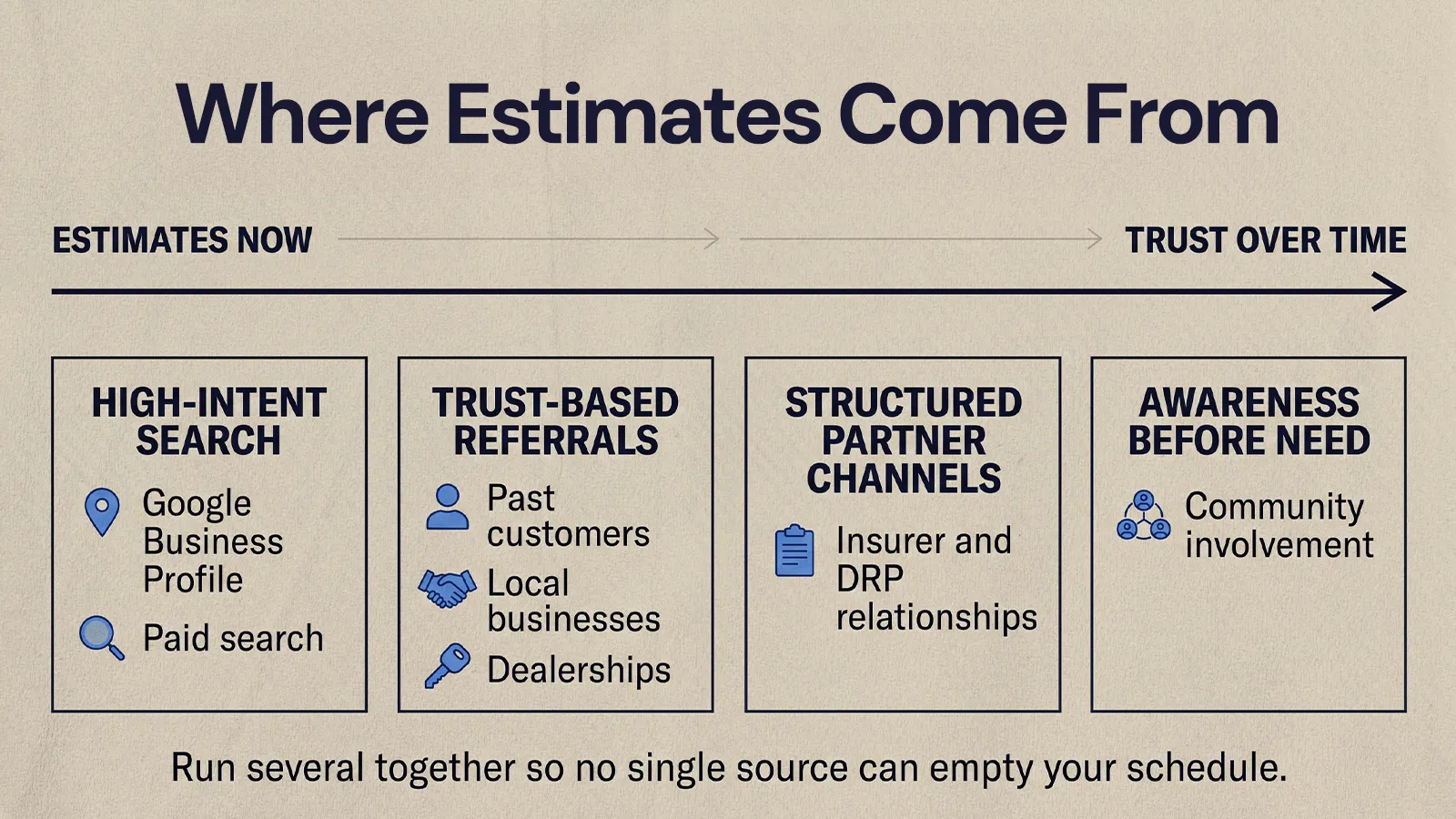
The channels closest to active repair need usually produce estimates fastest. The ones built on trust take longer but tend to hold up when search gets more competitive. A useful way to sort them:
- High-intent search: Google Business Profile and paid search reach drivers who are looking for a shop right now.
- Trust-based referrals: past customers, local businesses and dealerships recommend you when someone asks.
- Structured partner channels: insurer and DRP relationships can create repeat estimate flow when the operational fit is right.
- Awareness before need: community involvement keeps your name familiar before a crash, a hailstorm or a parking lot scrape.
The right mix depends on your market, capacity, certifications, insurance relationships and number of locations. A single independent shop may lean on its Business Profile and referrals. A multi-location group may have strong insurer relationships at some stores and rely on search at others. The goal is that no single source can empty your schedule if it slows down.
How do you get more estimates from Google Business Profile?

For many drivers, your Google Business Profile is the first thing they see after searching "collision repair near me." It shows your location on the map, your hours, reviews and photos, and lets people call or get directions without visiting your site. Google says local results are mainly based on relevance, distance and how well known a business is, so an accurate, complete, active profile matters.
Start with Google's own guidelines, which are specific:
- Name: use your real-world business name, as it appears on your sign. Adding keywords like "Best Collision Repair Downtown" goes against the guidelines.
- Address: a real, staffed location with permanent signage. One profile per location.
- Categories: choose the fewest, most specific categories. Google's test is whether the category completes "this business IS a," so "Auto body shop" rather than a list of everything you offer.
- Hours: keep them current, including holidays and weather closures.
Beyond the basics, add recent photos of the building, the team and finished work, list your services accurately, and check calls, direction requests and messages in the profile's performance data each month.
For multi-location groups, each store needs its own profile that reflects the real store rather than a copy of corporate language. The website link on each profile should go to that location's page, not the homepage. On the Quality Collision Group partner sites, NUUX built one page per location, which gives every Business Profile a matching destination with the right address, hours and booking path. For what that page should include, see what an auto body shop website needs to convert.
What's the right way to ask for Google reviews?

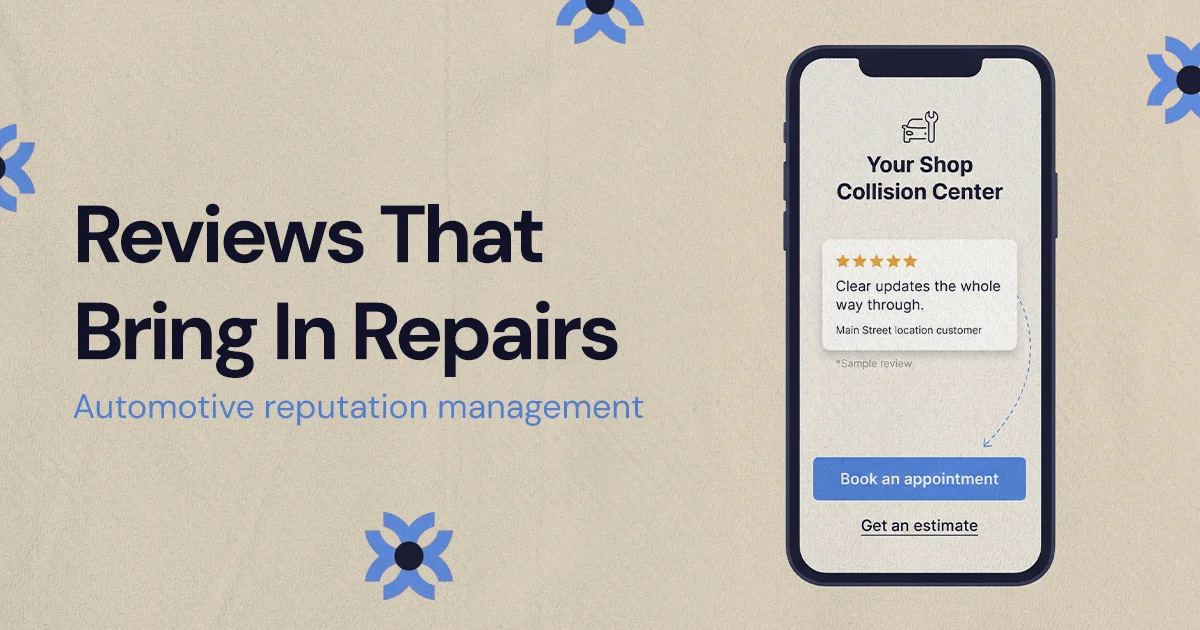
Reviews carry a lot of weight in this category. Drivers choosing a body shop are often stressed and unsure what happens next, and specific reviews from real customers help answer that. Google says more reviews and positive ratings can help a business's local ranking, and that replying to reviews shows you value the feedback.
Google's review policy also sets clear limits. Businesses may not offer incentives such as discounts or free services in exchange for reviews, may not discourage negative reviews or selectively ask only happy customers, and may not ask staff to collect a quota of reviews or reviews with specific content. Breaking these rules can get reviews removed.
A compliant process is simple: ask every customer at delivery, send a short follow-up with a direct review link, and reply to every review, good or bad, without sharing claim or repair details that belong to the customer. For groups, assign one person per location to own replies so no store goes quiet.
Referrals from customers and local businesses
Collision repair runs on trust. After an accident, many drivers ask a friend, a coworker, their mechanic or the tow operator where to go. A shop that is easy to recommend wins some of those jobs before the driver ever searches.
Past customers are the obvious source, but local businesses that see damaged vehicles matter too: independent mechanical shops that don't do body work, tire shops, glass companies, detailers, towing companies, fleet managers and rental offices. The relationship works when each side knows what the other handles and how to send someone over.
- Explain your specialties and certifications clearly so partners send the right jobs.
- Give partners one contact and one phone number for referred customers.
- Thank people promptly when they send someone your way.
- Record the referral source on every estimate so you can see which relationships are active.
- Skip aggressive incentives, which can erode the trust the referral depends on.
For multi-location groups, the brand can provide structure, but local managers and estimators usually hold the relationships that produce estimates. Make it part of their role, not an extra.
How should shops approach insurer and DRP relationships?
Treat insurer and direct repair program relationships as operational partnerships more than marketing. A DRP can connect your shop with customers who already have an active claim, but it comes with expectations around documentation, cycle time, communication, repair procedures and administrative work.
The fit depends on your capacity, staffing, equipment, approach to OEM repair procedures and financial goals. A program that sends volume but strains production or margins may not help the business. Before pursuing or expanding one, review:
- Whether estimating, parts, production and admin can support the workflow.
- How assignments are distributed and how disputes are handled.
- How it affects scheduling for customers outside the program.
- Which locations are best suited to it, for groups with several stores.
- Whether performance is judged by store, region or group, since one weak location can affect the whole relationship.
Insurer relationships don't replace local brand building. Even with a claim in hand, many drivers still read reviews and want to feel confident about the shop they choose.
Dealership relationships that send repair-ready customers
Dealership staff get asked where to take a car for body work all the time, by service customers, by buyers of used vehicles and by people who just want the car repaired properly. If your shop is known and trusted by the service advisors, parts manager and used car manager, that question can end in an estimate at your shop.
The relationship has to work for the dealer. They want confidence that you'll communicate well, respect their customer relationship and follow the manufacturer's repair procedures where they apply. Manufacturer certifications you actually hold help here, especially for brands the dealer sells.
- Pick a small number of nearby dealerships whose makes match your capabilities and certifications.
- Meet the service and parts teams, and make it about how you can help their customers, not only about referrals.
- Keep contacts updated when your hours, certifications or services change.
- Give dealership staff an easy way to hand off a customer to the right person at your shop.
Groups can match specific stores to nearby dealer rooftops based on geography and certifications, rather than every store chasing every dealer.
When do paid ads make sense for auto body shops?
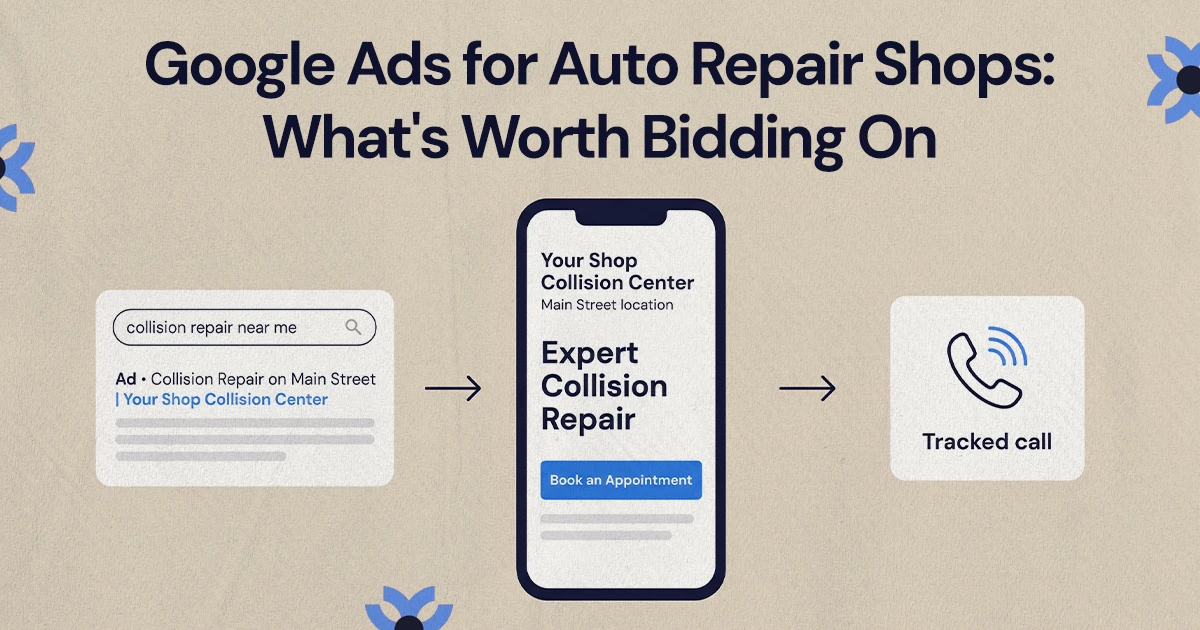
Paid ads make sense when you want more control over visibility in a defined service area, especially for searches like "collision repair near me" or "hail damage repair [city]." Paid search reaches people who are already looking, which is why it's usually the most direct ad channel for body shops.
In the United States, Google's Local Services Ads program also includes an Auto Body Shop category, where you pay per lead rather than per click. Social ads can help with local awareness or seasonal messages after a hailstorm, but judge them differently from search, because the viewer usually isn't looking for a repair at that moment.
- Target only the service area each shop can realistically handle.
- Run separate campaigns by location when stores serve different markets.
- Use language that matches real searches, and never advertise certifications or insurer relationships you don't have.
- Track calls and estimates from each campaign, not just clicks.
- Pull back when the schedule is full.
Our guide to turning collision repair website visitors into booked estimates covers what should happen once an ad click reaches your site.
Community involvement that people remember
Most people don't think about body shops until something goes wrong. Showing up in the community, through youth sports sponsorships, school safety events, charity drives, car shows or the local chamber, makes your name easier to recall when they do.
It doesn't need to be flashy. Pick a few organizations that fit the shop's values and budget and stay with them. Consistent presence builds more recognition than a single big sponsorship followed by silence. Employees who live in the area are often your best representatives, and community events give owners and managers natural reasons to meet other local business owners who may refer customers later.
Treat this as relationship building, not a quick lead source. Its value shows up over time through recognition and referrals, which is why it helps to ask customers how they heard about you.
How do you know which marketing channels are working?

A channel that sends lots of poor-fit inquiries creates work without improving the business. Track where estimates come from, which ones turn into repair orders, and which locations benefit. Ask every customer how they found you, and record it in the estimate or shop management system.
What to review for each channel:
- Google Business Profile: calls, direction requests, messages and review volume by location.
- Referrals: which people and businesses send customers, and whether those jobs fit your work.
- Insurer and DRP: assignment volume against production strain and margin.
- Dealerships: referred estimates by dealer and by store.
- Paid ads: call quality, estimate volume and cost per booked job.
- Community: how often customers mention it, and new relationships it creates.
For groups, expect each store's mix to differ. One may run mostly on insurer assignments while another depends on search and dealerships. Let local results shape each store's plan instead of forcing one mix everywhere. If you're choosing a template for a new store's site, our note on what to look for in auto body shop website templates covers the location-page basics.
Putting the channels together
Auto body shop marketing works best when it's local, consistent and measured by estimates rather than attention. Start with the channels closest to active repair need, your Business Profile and search, build the referral, dealership and insurer relationships that drive trust, and review results by location so each store gets the mix that fits its market.
If you want help with the search, ads and tracking side, NUUX's growth marketing services are a good place to start.
Want results like this
Your website should make money, not excuses. Let us find the revenue hiding in your current experience.
FAQs
Quick answers to the questions we hear most about website conversion and UX design.
Most growth comes from being easy to find and easy to recommend. Keep a complete, accurate Google Business Profile with steady reviews, build referral relationships with mechanics, tow operators and dealerships, evaluate insurer programs that fit your operation, and use paid search in the areas you can serve. Ask every customer how they found you so you know which channel to invest in.
No. Google's review policy prohibits offering incentives such as payment, discounts or free services in exchange for reviews. It also prohibits asking only happy customers for reviews or setting review quotas for staff. Ask every customer at delivery, send a direct review link, and reply to reviews professionally without sharing claim or repair details.
It depends on the fit. A direct repair program can bring steady estimate volume from customers who already have a claim, but it comes with documentation, cycle time and communication expectations. Check whether your estimating, parts and production teams can support the workflow, how it affects scheduling for other customers, and whether the volume supports your margins over time.
Yes. Google's guidelines call for one profile per real, staffed location with permanent signage. Each profile should have that store's own hours, phone number, photos and reviews, and its website link should point to that location's page rather than the group homepage, so drivers land on the right shop with the right booking path.
Focus on a few nearby dealerships whose makes match your capabilities and manufacturer certifications. Meet the service advisors and parts team, explain what you handle and how you communicate with customers, and give them one easy contact for handoffs. Dealers refer shops they trust to protect their customer relationship, so reliability matters more than promotions.
Related articles
More field notes on conversion, UX, and building websites that sell.