A website redesign RFP should explain who you are and why the current site is not working, then set out goals, scope, technical environment, content responsibilities, a budget range, timeline, evaluation criteria and submission instructions. The more clearly you describe what agencies must price, the easier the proposals are to compare.
To write a website redesign RFP, explain who you are and why the current site is not working, then set out your goals, scope, technical environment, content responsibilities, budget range, timeline, evaluation criteria and submission instructions. The more specific you are about what agencies need to price, the easier it is to compare the proposals that come back.
We write this from the other side of the table. When NUUX responds to an RFP, the documents that produce the most useful proposals are the ones that are clear about the business problem and leave room for the agency to recommend how to solve it. This guide covers what to include, what agencies need to price accurately, the mistakes that lead to proposals you cannot compare, and a template outline you can copy.
What should a website redesign RFP include?
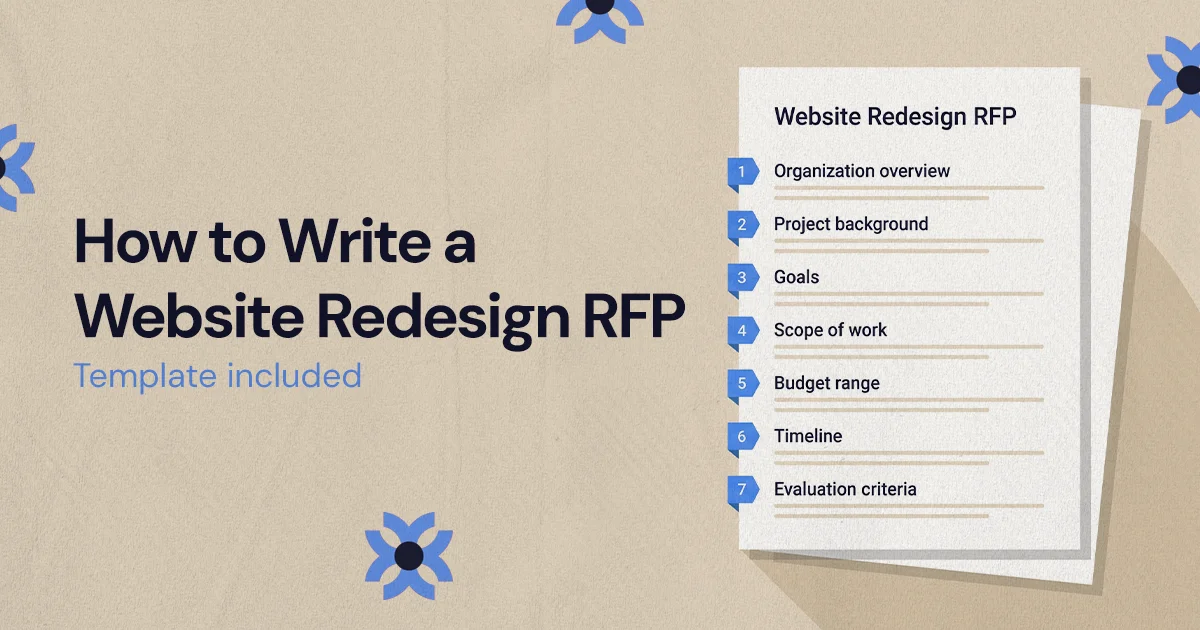
A website redesign RFP should give an agency enough to understand the project, judge whether it is a fit, estimate the effort, spot the risks and write a realistic proposal. At a minimum, include:
- Organization overview: who you are, who you serve and what job the website does for you.
- Project background: why the redesign is happening now and what is not working today.
- Goals and success criteria: what the new site needs to help you accomplish, and how you will know.
- Audiences: primary and secondary users, including internal users such as content editors.
- Scope of work: strategy, UX, design, content, development, integrations, accessibility, SEO, migration, training and support.
- Technical context: current CMS, hosting, analytics, CRM, forms, portals, payment or donation tools and APIs.
- Content requirements: approximate page count, who writes and approves content, and what needs migrating.
- Budget or budget range: enough guidance for agencies to recommend the right level of work.
- Timeline: key milestones, launch drivers and any fixed dates.
- Evaluation process: criteria, decision-makers and interview steps.
- Submission instructions: format, due date, contact person and how questions are handled.
You do not need to prescribe every design decision. The RFP should describe the problem well enough that qualified agencies can propose the best way to solve it.
Start with the business case, not a design wish list
Plenty of RFPs open with "modernize the homepage" or "make the site easier to update." Those are real needs, but they do not tell an agency what to prioritize or how much work is involved. Agencies need to know what the website has to do for your organization.
For a company, that might be better lead quality, clearer service positioning, support for the sales team or consolidating several sites into one. For a nonprofit, it might be explaining programs clearly, supporting fundraising or making resources easier to find. For a local government, it is usually helping residents complete tasks, find public information and trust that what they read is current.
Say what the current site costs you. If it causes confusion, creates manual work for staff, blocks content updates or fails a key audience, put that in writing. If you are still deciding whether you need a full redesign at all, our list of signs a website needs a redesign rather than a refresh can help frame this section. Useful prompts:
- What prompted the redesign?
- Which internal teams depend on the website?
- What complaints from users or staff come up again and again?
- Which organizational goals should the new site support?
- What constraints must the project respect?
This section also helps procurement compare proposals on substance. A response that addresses your business case directly is more useful than one that promises attractive layouts.
How much detail do agencies need to price a website redesign?
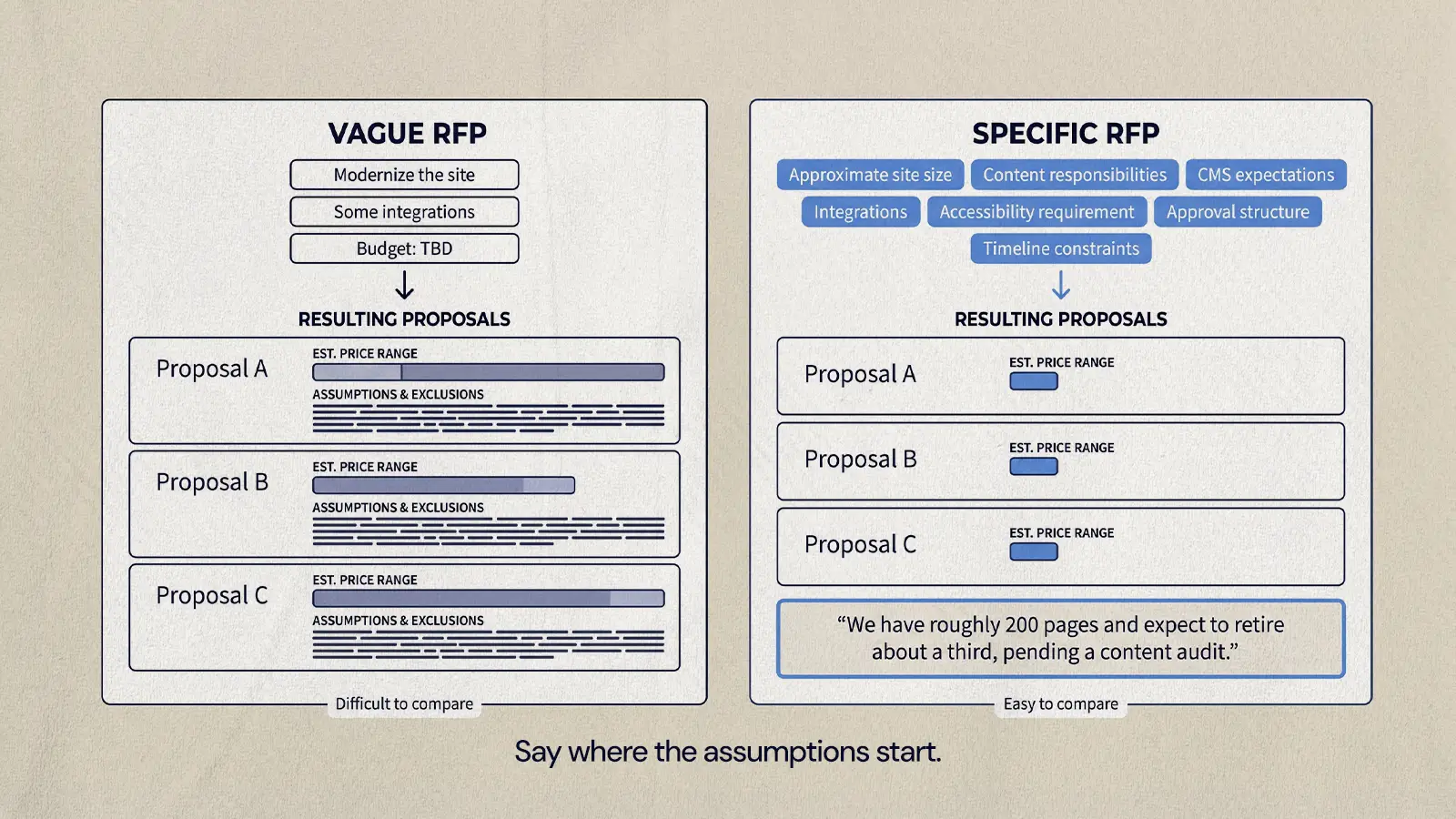
Agencies need enough detail to estimate strategy, design, content, development, project management, testing and launch support. When key information is missing, proposals fill the gaps with broad assumptions, wide price ranges or long exclusion lists, and comparing them becomes guesswork.
The biggest pricing drivers are usually scope, complexity, content, integrations, accessibility requirements, the review process and the timeline. A 30-page marketing site on a standard CMS is a very different job from a public-sector site with hundreds of pages, service directories, searchable documents, third-party tools and strict governance. For more on how those variables turn into fees, see our guide to UI/UX design agency pricing.
To help agencies price accurately, include:
- Approximate site size: current page count, expected new pages and sections likely to be removed, combined or expanded.
- Content responsibilities: whether your team writes, edits and migrates content or expects the agency to handle some or all of it.
- CMS expectations: your current CMS, whether you want to keep it or are open to a change, and what editor training you need.
- Integrations: CRMs, payment or donation tools, job boards, calendars, maps, permitting systems, sign-in tools, email platforms or databases.
- Accessibility requirements: the standard you must meet and any internal policy that applies.
- Approval structure: who reviews work, who gives final approval and whether boards, councils, legal, IT or department heads are involved.
- Timeline constraints: fixed dates such as campaign launches, fiscal year deadlines, grant requirements or board meetings.
If you are unsure about something, say so. Agencies can work with uncertainty, but they need to know where the assumptions start. From our side, a line like "we have roughly 200 pages and expect to retire about a third, pending a content audit" is far more useful than no number at all.
Scope sections that make proposals easier to compare
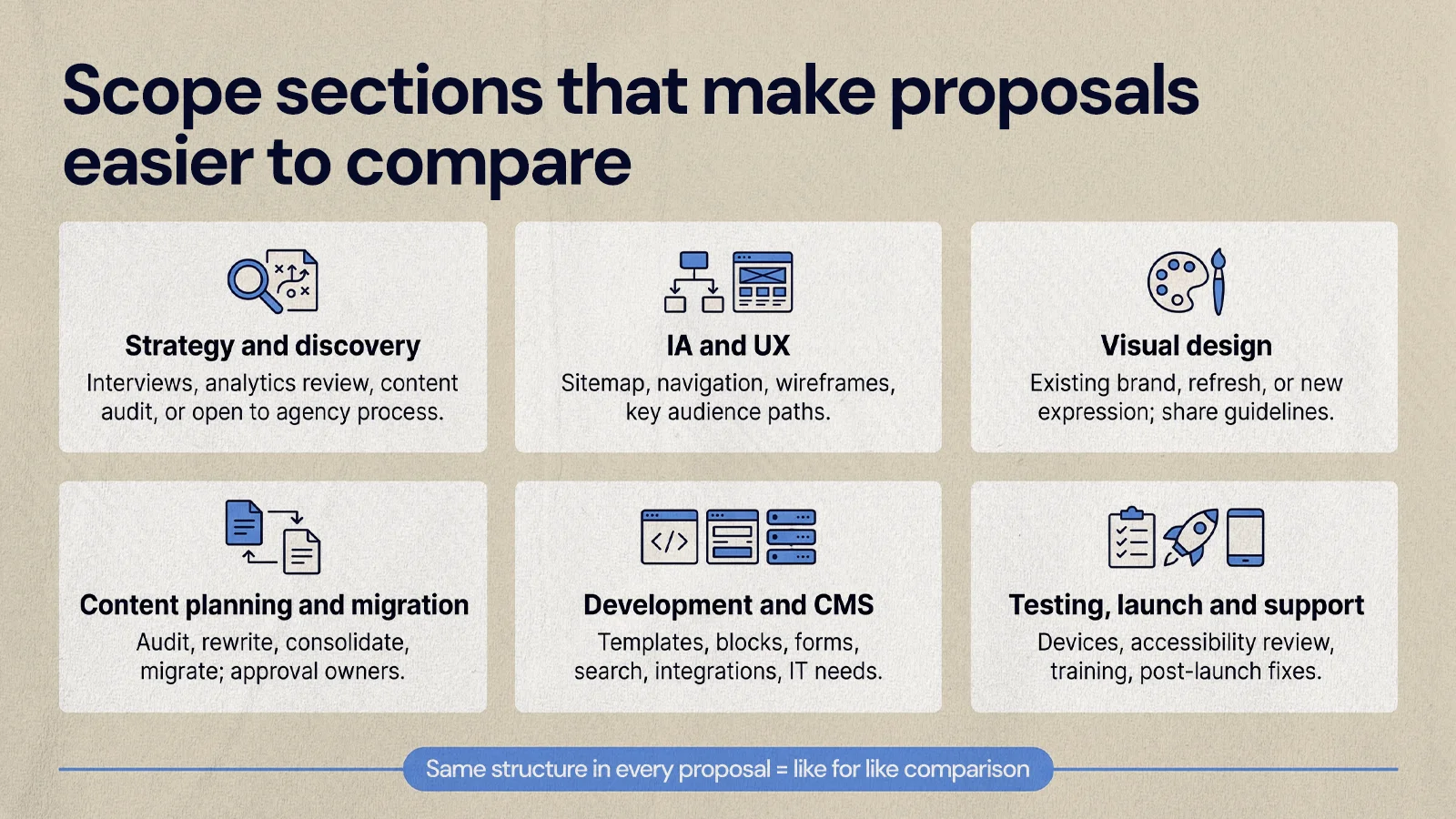
Splitting scope into clear work areas helps agencies respond consistently and helps your evaluation team compare like with like.
Strategy and discovery
If you expect stakeholder interviews, analytics review, user research, a content audit or journey mapping, list them. If you are open to the agency's recommended process, say that instead of prescribing one.
Information architecture and user experience
Redesigns often disappoint when the site looks better but is still hard to navigate. State whether you need sitemap planning, navigation strategy, wireframes, search improvements or defined paths for specific audiences. Nonprofits and local governments should list program pages, service categories, resource libraries and the most common tasks people come to do.
Visual design
Say whether the agency is working within an existing brand system, refreshing it for the web or expected to develop a stronger visual expression. Share brand guidelines, color and contrast requirements, logo files and photography standards.
Content planning and migration
Content is one of the most common causes of delay. State whether content will be audited, rewritten, consolidated, migrated or created from scratch, and how approvals work when several departments own pages. If migration is a large part of the job, our CMS migration checklist shows the kind of detail an agency will need.
Development and CMS implementation
Describe the functionality you expect: page templates, reusable content blocks, forms, search and filtering, multilingual content, member areas, staff directories, document libraries or custom workflows. Note any IT requirements for hosting, security, backups or deployment.
Testing, launch and support
Set expectations for browser and device testing, accessibility review, CMS training, launch coordination, post-launch fixes and ongoing support, including any documentation for content editors.
What accessibility standard should an RFP require?
Name a specific standard rather than asking for an "accessible website." WCAG 2.2 is the current W3C Recommendation, and Level AA is the level most organizations target. If you are a state or local government in the US, the Department of Justice's ADA Title II rule adopts WCAG 2.1 Level AA as the technical standard for web content and mobile apps. The DOJ extended the rule's compliance dates in April 2026, so check ada.gov for the dates that apply to your entity size. Our overview of ADA Title II website accessibility for local governments covers what the rule asks for.
Because WCAG 2.2 is backward compatible, a site that conforms to 2.2 AA also meets 2.1 AA. Asking for 2.2 AA in the RFP keeps you ahead of the current legal baseline. Also say how you expect conformance to be demonstrated, for example automated testing plus manual keyboard and screen reader checks, and whether you want an accessibility statement or audit report at launch.
What mistakes should you avoid in a website redesign RFP?
The most common mistake is asking for a detailed solution without giving agencies enough context, budget guidance or time. The result is proposals that look polished but rest on guesswork. Other mistakes that weaken responses:
- No budget guidance: without a range, agencies propose wildly different levels of effort.
- Overprescribing the solution: dictating every feature and page type early can rule out better recommendations.
- Vague goals: "improve user experience" only helps when paired with specific audiences, tasks or pain points.
- Ignoring content ownership: if nobody knows who writes, approves and migrates content, the project stalls.
- An unrealistic timeline: compressed schedules squeeze discovery, testing, accessibility review and stakeholder alignment.
- Asking for unpaid spec work: requesting full creative concepts or detailed technical architecture before selection discourages strong agencies from bidding.
- Hidden decision criteria: agencies should know how proposals will be scored and what matters most.
- No question period: a published Q&A gives every vendor the same information and reduces assumptions.
Should you include a budget in an RFP?
Yes, if you can. Some organizations leave budget out to see what the market returns, which is understandable when procurement has to demonstrate fairness. In our experience reading RFPs, a budget range still produces better proposals, because agencies can shape the recommendation around a realistic level of investment instead of guessing.
If you cannot publish a figure, give context. Ask respondents to recommend an approach that balances scope, quality and long-term maintainability, or ask for phased options: a required launch scope plus optional enhancements priced separately.
Timeline guidance should be just as practical. Beyond the launch date, include the selection date, expected kickoff, major review windows and any periods when key stakeholders are unavailable. If board approval, council review, legal review, IT security review or grant reporting affects the schedule, list those checkpoints. Agencies do not need a perfect timeline. They need to know which dates are fixed and what might slow approvals down.
How do you evaluate website redesign proposals fairly?
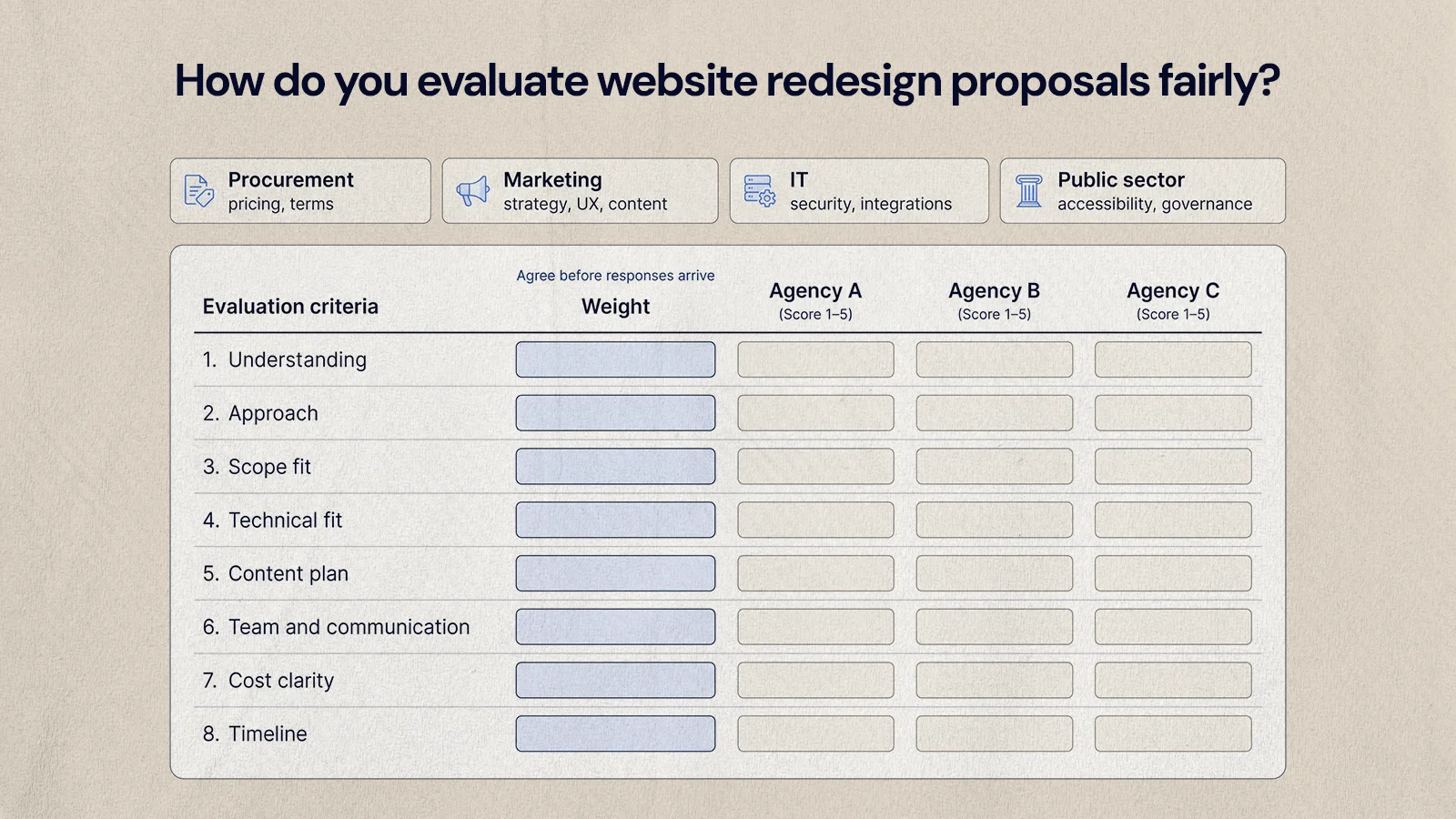
Score every proposal against the same criteria, set before responses arrive. A fair process compares how each agency would solve your specific problem, not how impressive the document looks.
Different teams will weight things differently. Procurement tends to focus on compliance, pricing, insurance, contract terms and vendor qualifications. Marketing tends to focus on strategy, UX, content, design quality and CMS usability. IT looks at security, integrations, hosting and maintainability. Nonprofits and local governments often give extra weight to accessibility and governance. Agree on the weighting first. Useful categories:
- Understanding: does the proposal reflect your goals, audiences and constraints accurately?
- Approach: is the process clear, practical and right-sized for the scope?
- Scope fit: does it include the services you actually need?
- Technical fit: can the agency support your CMS, integrations, accessibility and security requirements?
- Content plan: does it address content creation, migration and approvals?
- Team and communication: are roles, responsibilities and communication expectations clear?
- Cost clarity: are fees, assumptions, exclusions and optional items easy to understand?
- Timeline: is the schedule realistic for your review process and launch needs?
In interviews, ask each agency to explain tradeoffs: what they would prioritize, what they would defer and where your RFP might need refining. A strong partner will tell you.
Website redesign RFP template outline
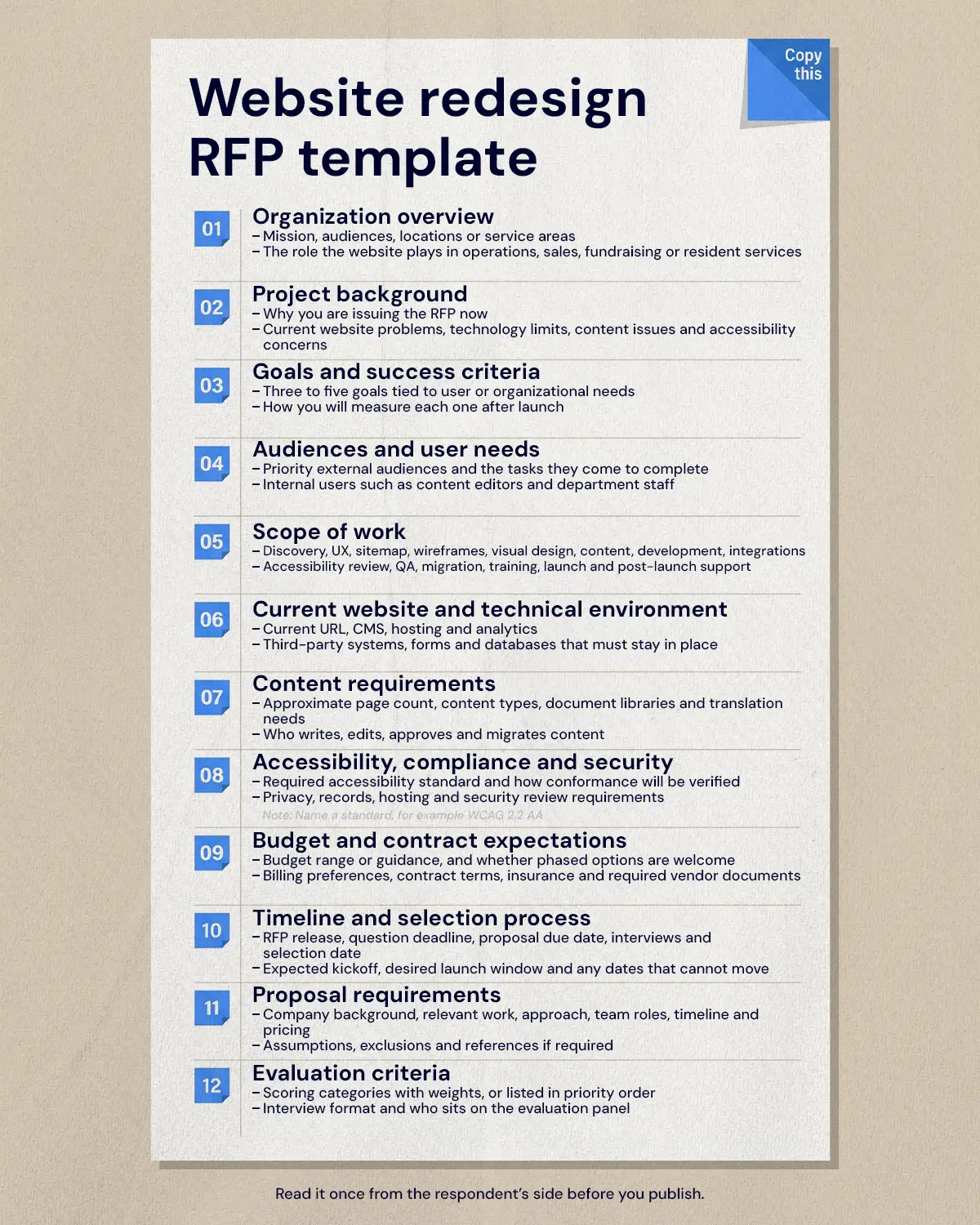
Copy this outline as a starting point and adapt it to your procurement rules and project size.
- Organization overview
- Mission, audiences, locations or service areas
- The role the website plays in operations, sales, fundraising or resident services
- Project background
- Why you are issuing the RFP now
- Current website problems, technology limits, content issues and accessibility concerns
- Goals and success criteria
- Three to five goals tied to user or organizational needs
- How you will measure each one after launch
- Audiences and user needs
- Priority external audiences and the tasks they come to complete
- Internal users such as content editors and department staff
- Scope of work
- Discovery, UX, sitemap, wireframes, visual design, content, development, integrations
- Accessibility review, QA, migration, training, launch and post-launch support
- Current website and technical environment
- Current URL, CMS, hosting and analytics
- Third-party systems, forms and databases that must stay in place
- Content requirements
- Approximate page count, content types, document libraries and translation needs
- Who writes, edits, approves and migrates content
- Accessibility, compliance and security
- Required accessibility standard and how conformance will be verified
- Privacy, records, hosting and security review requirements
- Budget and contract expectations
- Budget range or guidance, and whether phased options are welcome
- Billing preferences, contract terms, insurance and required vendor documents
- Timeline and selection process
- RFP release, question deadline, proposal due date, interviews and selection date
- Expected kickoff, desired launch window and any dates that cannot move
- Proposal requirements
- Company background, relevant work, approach, team roles, timeline and pricing
- Assumptions, exclusions and references if required
- Evaluation criteria
- Scoring categories with weights, or listed in priority order
- Interview format and who sits on the evaluation panel
Before you publish the RFP
Read it once from the respondent's side. Could an agency understand your goals, estimate the work, spot the risks and explain a practical path forward from what is on the page? If so, you are likely to get proposals that are useful, comparable and grounded in the real project.
If you are preparing a redesign RFP and want to see how an agency would read it, our web design and development team is happy to talk it through.
Want results like this
Your website should make money, not excuses. Let us find the revenue hiding in your current experience.
FAQs
Quick answers to the questions we hear most about website conversion and UX design.
There is no required length. Most useful RFPs are long enough to cover the organization, goals, scope, technical environment, content, budget, timeline and evaluation criteria, and no longer. Legal and procurement boilerplate can go in an appendix. If a section only restates a general wish like a modern design, cut it and add specifics about audiences, integrations or page counts instead.
Give agencies enough time to ask questions, receive answers and write a considered proposal. Many organizations allow a few weeks, with a question deadline partway through and answers published to every respondent. Very short windows tend to reduce the number of strong responses and push agencies toward generic proposals. Check your own procurement rules, since some public bodies set minimum periods.
An RFI (request for information) gathers general information about vendors and approaches before you define the project. An RFQ (request for quotation) asks for pricing on a clearly defined scope, where price is the main differentiator. An RFP (request for proposal) asks vendors to propose an approach, team, timeline and price for a problem, and is the usual choice for a website redesign.
Usually not. Asking for speculative design concepts before selection is unpaid work, and many strong agencies decline to bid on that basis. Concepts made without discovery also say little about how the agency would really solve your problem. Ask instead for relevant past work, a described approach and, at interview stage, a walkthrough of how they would tackle your specific goals.
Include the people who will use, approve and maintain the site. That usually means marketing or communications, procurement, IT and at least one person who edits content day to day. For nonprofits and local governments, add program or department leads. Agree on goals and evaluation weighting before drafting, so the RFP reflects shared priorities rather than one team's wish list.
Related articles
More field notes on conversion, UX, and building websites that sell.