
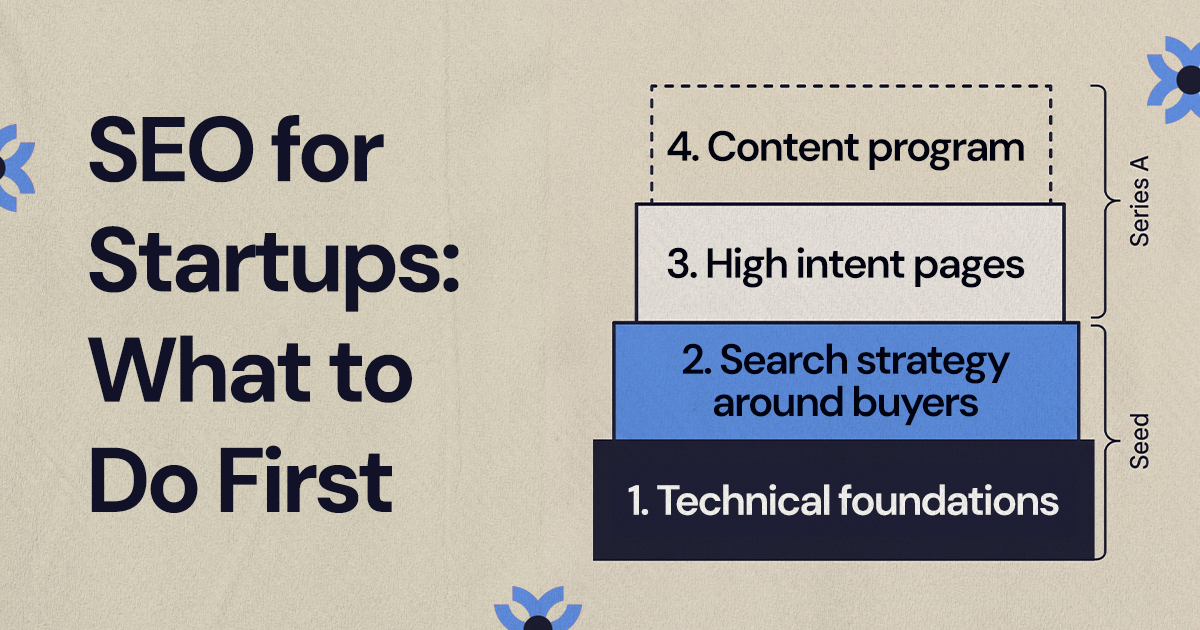
Startups should buy SEO in order: technical foundations first, then a buyer-focused search strategy, then a small set of high-intent pages, and a larger content program only after product-market fit. Outsource technical audits, research and briefs, but keep positioning and customer insight in-house.
Seed and Series A teams need SEO services for startups in a specific order: technical foundations first, then a search strategy built around the buyers you actually sell to, then a small set of high-intent pages, and only after that a larger content program. Before product-market fit, SEO should mostly help you learn how buyers describe the problem. After product-market fit, it becomes a repeatable acquisition channel that grows over time.
The most common mistake is starting with the wrong work, usually a big editorial calendar on a site that search engines can't fully crawl, with positioning that still changes every quarter. This guide covers what to do at each stage, what to buy from an agency and what to keep in-house.
What SEO services do startups need first?
Startups need technical SEO, basic search strategy, analytics and a focused page plan before they need high-volume publishing. That first layer tells you whether search can support the business, what buyers are looking for and whether the site can earn and convert qualified traffic.
At seed stage, SEO is partly a discovery exercise. You are testing language, learning how prospects describe their pain and building pages that make the product easier to understand. By Series A there is usually more clarity on the customer, the sales motion and the priority use cases, so SEO becomes more operational.
A sensible first engagement covers:
- Crawlability and indexing. Can search engines find, render and index your most important pages?
- Site structure. Is the site organized around customers, use cases, product capabilities and conversion paths?
- Keyword and intent research. Which searches signal pain, evaluation or readiness to buy?
- Measurement. Can the team see which pages bring qualified traffic and contribute to signups or pipeline?
- Page priorities. Which pages should exist now, and which should wait until positioning settles?
The order matters because SEO decisions get harder to unwind as a site grows. On a weak foundation, more content usually creates more cleanup, not more traction. If you are still deciding what the site itself should look like, our guide to website design for startups covers the structural decisions that SEO depends on.
Why should technical SEO come before content?
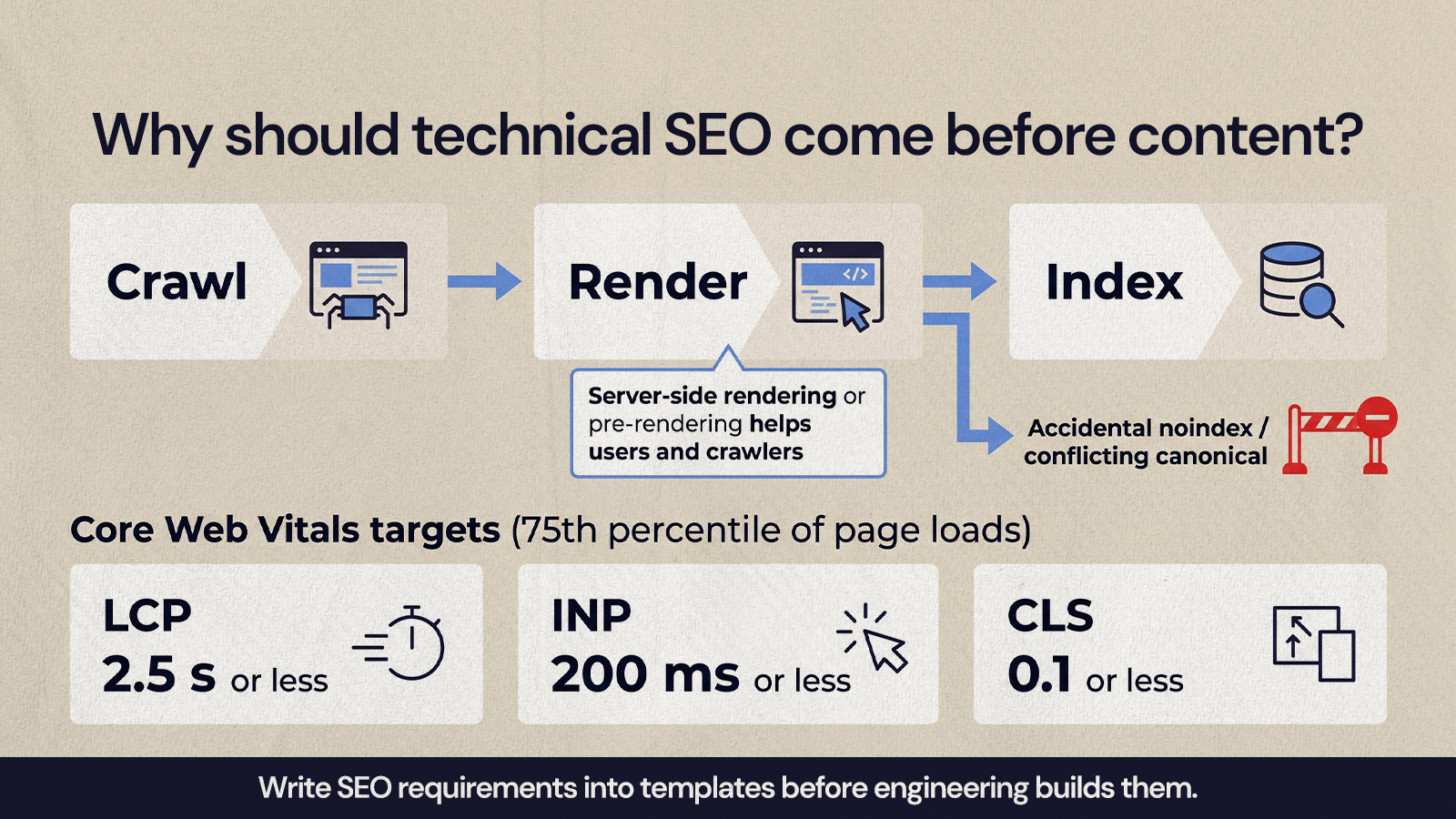
Blog posts and landing pages only perform when the technical base lets search engines discover, render and index them, and lets visitors convert once they arrive.
Early-stage technical SEO does not need to be overbuilt. It needs to remove the problems that stop search engines and people from understanding the site: indexing controls, internal linking, metadata patterns, clean URLs, canonical tags, an XML sitemap, structured data where it helps and a sensible hierarchy for product and resource pages.
For SaaS and technology startups, this is also an engineering conversation. Marketing wants flexible landing pages, while engineering owns templates, routing and rendering. Google's JavaScript SEO documentation explains that it processes JavaScript apps in three phases (crawling, rendering and indexing) and says server-side rendering or pre-rendering is "still a great idea" because it makes sites faster for users and crawlers and not all bots can run JavaScript. If those requirements come up late, the team may be publishing into a front end that limits growth.
Page experience belongs on the list too. Google's Core Web Vitals give concrete targets: Largest Contentful Paint within 2.5 seconds, Interaction to Next Paint of 200 milliseconds or less and Cumulative Layout Shift of 0.1 or less, measured at the 75th percentile of page loads.
A short technical checklist:
- Confirm priority pages are crawlable and indexable.
- Remove accidental noindex tags, duplicate pages and conflicting canonical signals.
- Build navigation around product, solutions, resources and company pages.
- Link from your strongest pages to your most strategic ones.
- Set clean title tag, meta description and heading patterns for each template.
- Verify analytics, conversion tracking and Google Search Console.
- Write SEO requirements into new templates before engineering builds them.
We work this way on our own site. When NUUX redesigned nuuxstudios.com, the blog moved to /blog/ with short keyword-led slugs, and the CMS template got a dedicated Quick Answer field for answer engines and numbered source fields, so every article ships with those elements by default instead of having them added later.
How should SEO change before and after product-market fit?
Before product-market fit, SEO should help the team learn which problems, categories and customer language matter. After product-market fit, it should scale the parts of the go-to-market motion that are already working, by expanding content, improving conversion paths and building authority around the strongest use cases.
Before product-market fit, avoid locking into a large content program built on assumptions. You may not yet know whether your best customers search by job to be done, product category, pain point, integration, alternative or compliance need. The work at this stage:
- Collect customer language from sales calls, demos and support tickets.
- Get the technical basics right so the site isn't blocking future visibility.
- Build a small number of high-intent pages tied to core use cases.
- Keep product messaging clear and easy to revise.
- Measure engagement and conversion, not just visits.
After product-market fit, you can move from testing to controlled expansion: a broader editorial plan, comparison pages, integration pages, templates and possibly programmatic pages. Even then, expand the topics and formats that bring the right accounts. Be careful with programmatic work in particular, since Google's spam policies treat generating many pages primarily to manipulate rankings as scaled content abuse.
Build search strategy around customers before keywords
Keyword research matters, but the starting point is the customer: who they are, what triggers their search, what alternatives they consider and what they need to believe before taking the next step.
Starting there prevents a common startup problem, ranking for terms that don't matter. A keyword may have volume, but if most searchers are students, job seekers or buyers outside your segment, it won't help the business. A smaller keyword can be worth far more if it reflects urgent pain from exactly the buyer you need.
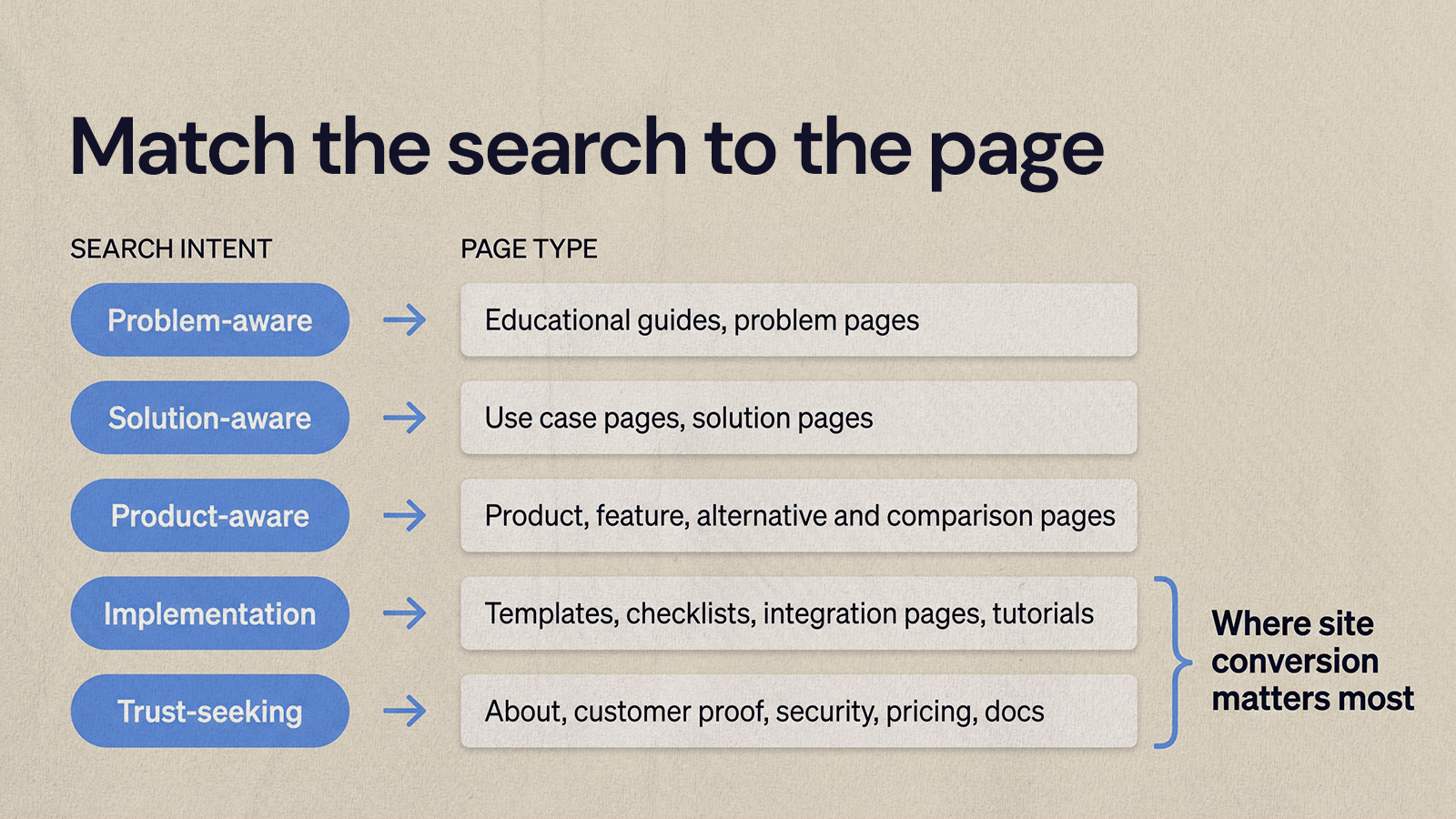
A practical way to map intent to page types:
- Problem-aware searches (understanding a pain or risk) fit educational guides and problem pages.
- Solution-aware searches (comparing approaches) fit use case and solution pages.
- Product-aware searches (evaluating tools or vendors) fit product, feature, alternative and comparison pages.
- Implementation searches (learning how to do the work) fit templates, checklists, integration pages and tutorials.
- Trust-seeking searches (checking credibility) fit about, customer proof, security, pricing and documentation pages.
The map also stops the blog from being the answer to every SEO need. Some searches deserve a product page, some deserve documentation, some deserve founder-led perspective and some aren't worth targeting yet. Product-aware and trust-seeking visitors are also where site conversion matters most, which we cover in what makes a SaaS website convert.
What SEO services for startups should you outsource to an agency?
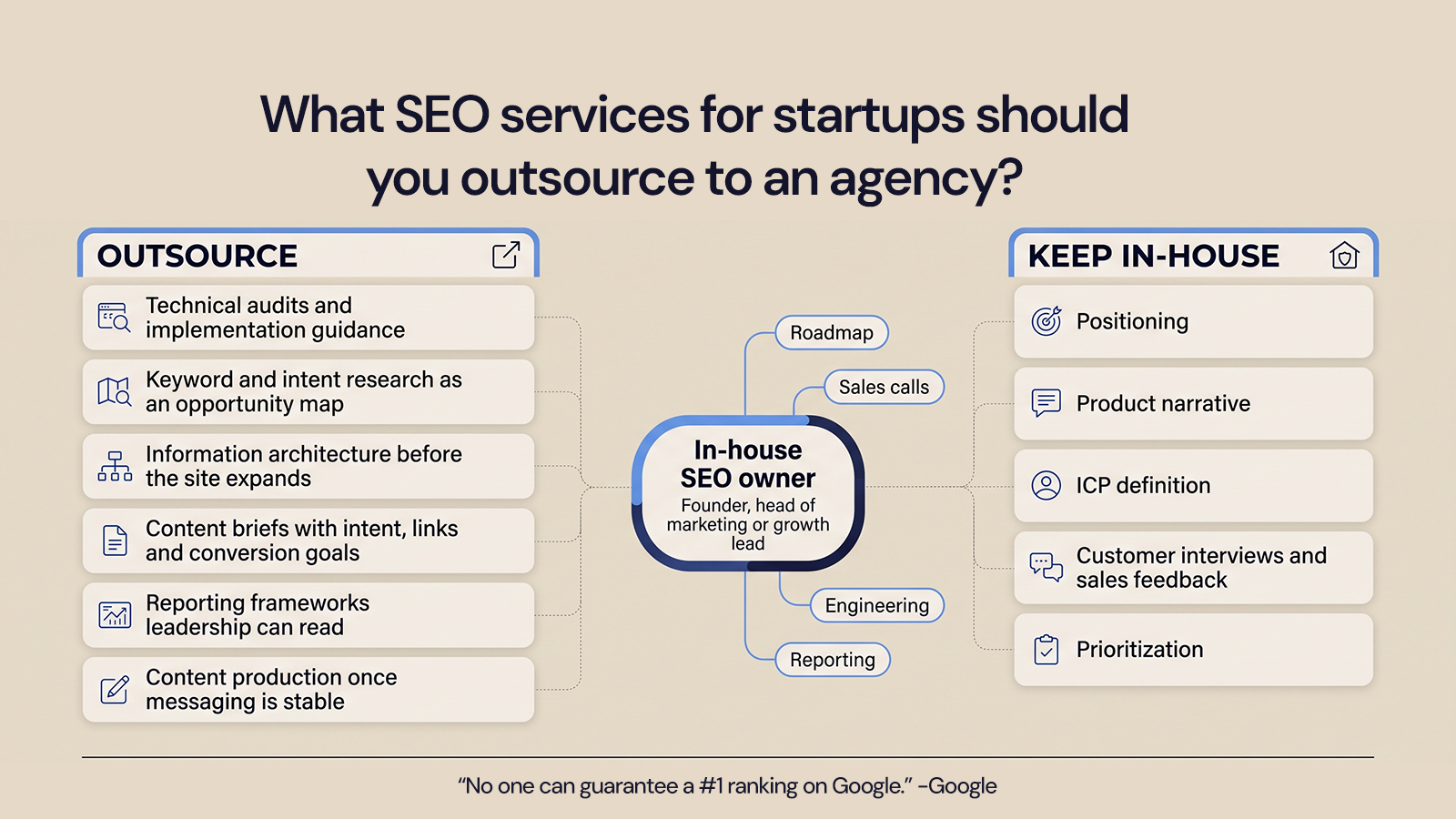
Outsource specialized work when you need expertise, speed or an operating structure that would be inefficient to build internally. Keep strategy-critical knowledge, customer insight and final positioning decisions with the founding or marketing team.
Seed and Series A teams often have no dedicated SEO hire, and the head of marketing may be covering demand generation, messaging, the website, sales enablement, analytics and launches at once. In that situation, a good partner adds structure and prevents avoidable mistakes. Good candidates to outsource:
- Technical audits and implementation guidance, especially on JavaScript frameworks, custom CMS setups or complex routing.
- Keyword and intent research that produces an opportunity map rather than a spreadsheet of generic terms.
- Information architecture for product, solution, industry and resource pages before the site expands.
- Content briefs with search intent, audience context, internal link targets and conversion goals.
- Reporting frameworks leadership can read.
- Content production, once messaging is stable and you have a review process.
Keep positioning, product narrative, ICP definition, customer interviews, sales feedback and prioritization close to the company. An agency can facilitate and challenge those decisions, but it shouldn't invent the strategy alone. When you are comparing partners, Google's own advice is useful: ask what results they expect and in what timeframe, how they measure success, and whether they follow Google Search Essentials. Google also says plainly that "no one can guarantee a #1 ranking on Google," so treat ranking guarantees as a warning sign. Our guide to choosing an agency for your startup covers the wider evaluation.
The in-house owner makes agency work better
Even with an agency, someone inside the company has to own the channel. At seed stage that can be a founder, head of marketing, growth lead or content lead who understands the customer and can make decisions quickly. That person keeps SEO priorities aligned with the product roadmap and sales motion, has access to sales calls and customer feedback, coordinates engineering tasks on templates and performance, and reports progress in business terms rather than rankings alone. The role matters more at Series A, when content, product marketing, demand generation, sales and engineering all touch the website.
When should a startup invest in content for SEO?
Invest heavily in SEO content once the technical base is stable, the audience is defined and the team knows which topics support real business goals. Before that, keep content selective and use it to test assumptions.
Choose the first pieces because they help a qualified buyer understand a problem, evaluate a solution or move toward a decision, not because they are easy to write. Google's guidance on helpful content asks directly whether you are "producing lots of content on many different topics in hopes that some of it might perform well," and that is a useful test for any startup content plan. A staged approach:
- Foundation pages: homepage, product and solution pages, pricing or demo paths and clear company information.
- High-intent pages: use cases, comparisons, integrations, alternatives and pain-point pages.
- Sales-support content: guides, explainers, checklists and templates that answer common buyer questions.
- Authority content: deeper articles, original perspectives and expert-led resources.
- Scale content: repeatable templates or topic clusters, once you know what converts and can keep quality up.
Early content should sound like it comes from people who understand the market. Founders and subject matter experts don't need to write every word, but they should supply the insight that makes it credible.
Which SEO metrics matter at seed and Series A?
Rankings and traffic can mislead startups if they are the only numbers on the report. At seed stage, more useful indicators are indexing health, impressions for priority topics in Search Console, the quality of the queries you appear for, engagement on core pages and behavior on signup or demo paths. They show whether the site is becoming visible for the right language and whether visitors understand the offer.
At Series A, reporting should connect to trials, signups, pipeline, assisted conversions and account quality, depending on the model. Track operational measures too: publishing pace, pages that need refreshing, technical issues and pages close to meaningful visibility.
Don't judge SEO on a paid acquisition timeline. Google's SEO Starter Guide notes that some changes take effect in hours while others can take several months, and suggests waiting a few weeks before assessing whether a change helped. Judge early progress on leading indicators, then on business outcomes as the channel matures.
Common SEO mistakes seed and Series A teams make
Most startup SEO problems come from doing reasonable things in the wrong order. Common ones:
- Publishing lots of content before fixing crawlability, indexing and site structure.
- Targeting high-volume keywords that don't match the ICP.
- Letting an agency write without access to product, sales or customer insight.
- Building pages around internal terminology customers don't use.
- Measuring success by traffic instead of qualified engagement and conversions.
- Ignoring internal links, which help both people and search engines understand what matters.
- Rebuilding the website without SEO requirements in the design and development process.
- Treating SEO as a one-time project instead of an ongoing discipline.
If your site runs on Webflow, our guide to choosing a Webflow SEO company covers what a partner should handle during a rebuild so SEO isn't bolted on afterwards.
What should the first 90 days of startup SEO look like?
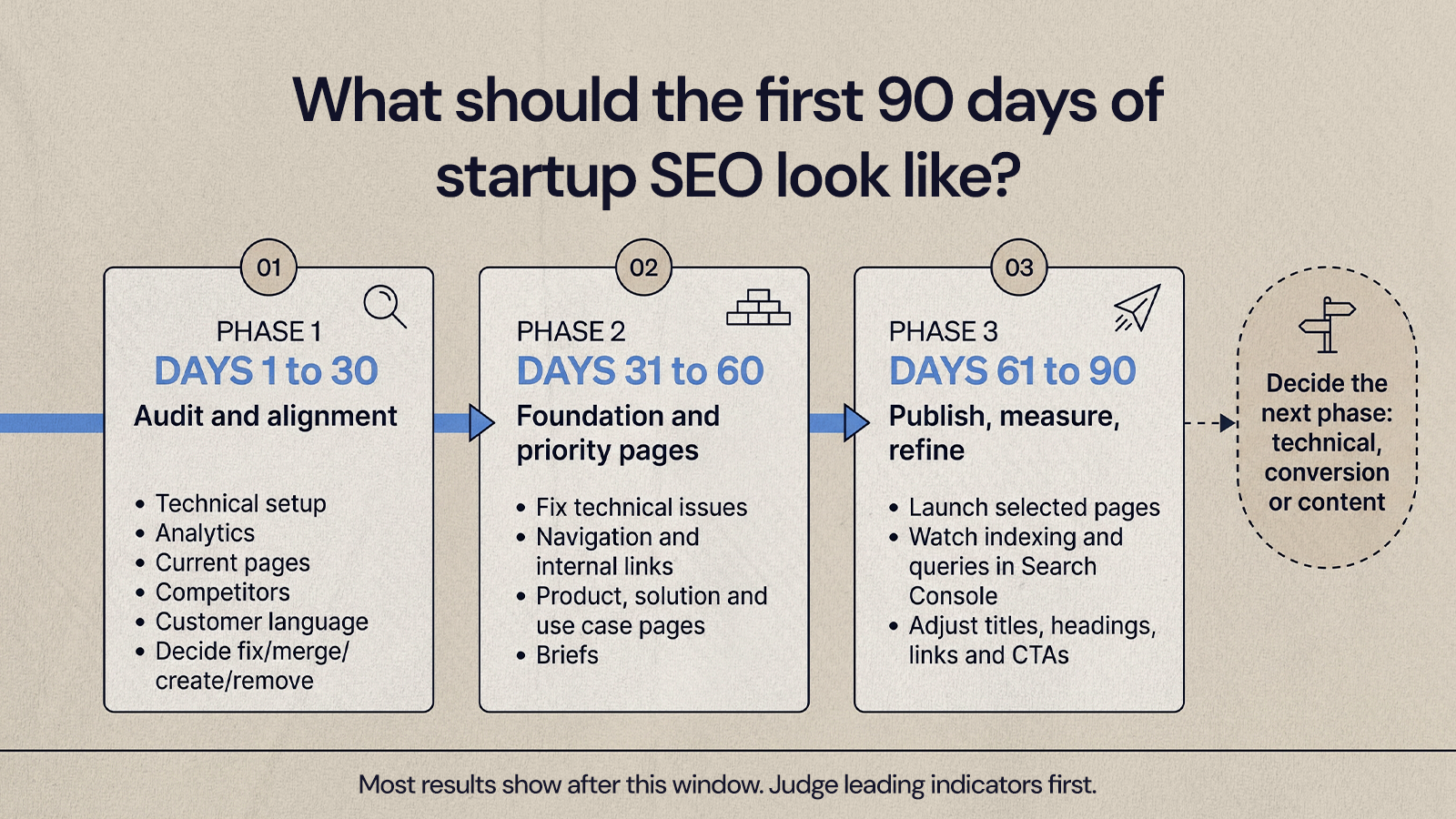
The first 90 days should create clarity and remove blockers. Most results won't show up inside that window, but by the end the team should know what exists, what is broken, what matters and what to build next.
Days 1 to 30: audit and alignment. Review the technical setup, analytics, current pages, search visibility, competitors, customer language and ICP assumptions. Decide which pages to fix, merge, create or remove, and agree on what SEO is expected to support.
Days 31 to 60: foundation and priority pages. Fix technical issues, improve navigation and internal linking, and create or update the most important product, solution and use case pages. Write briefs for the highest-priority opportunities.
Days 61 to 90: publish, measure and refine. Launch selected pages, watch indexing and early query data in Search Console and review user behavior. Adjust titles, headings, internal links and calls to action based on what you see, then decide whether the next phase should focus on technical work, conversion or content.
Where should founders start?
Start with the foundation, then clarify the customer and the search intent behind their problem. Keep positioning and customer insight inside the company, and outsource specialized work where it speeds up learning or execution. Sequenced this way, SEO sharpens your messaging, improves the website and gives the team a practical path from early learning to a channel that grows.
If you want a partner for the technical and strategic groundwork, that is part of our growth marketing and SEO services.
Want results like this
Your website should make money, not excuses. Let us find the revenue hiding in your current experience.
FAQs
Quick answers to the questions we hear most about website conversion and UX design.
It depends on runway, how much of your pipeline could realistically come from search and how much the team can do in-house. Cost is driven mostly by scope: a one-time technical audit and strategy costs far less than ongoing content production. Many seed teams start with a foundation project, then decide on retained work once they can see early query and engagement data.
Google says some changes take effect within hours while others can take several months, and suggests waiting a few weeks before judging whether a change helped. Judge early progress on indexing, impressions and query quality in Search Console, then look for signups and pipeline as the channel matures.
At seed and early Series A, most teams get more from an agency or consultant for specialized work, paired with one internal owner who knows the customer. A full-time SEO hire makes more sense once search is a proven channel and there is enough ongoing work to fill the role. Either way, positioning and customer insight should stay inside the company.
Some SEO is. Technical basics are cheap to get right early and expensive to fix later, and keyword research helps you learn how buyers describe their problem. What usually isn't worth it before product-market fit is a large content program, because positioning, ICP and messaging are still changing and much of that content will need rewriting.
Technical SEO makes sure search engines can crawl, render, index and understand your pages: site structure, URLs, canonical tags, sitemaps, rendering, speed and structured data. Content SEO is about what those pages say: choosing topics that match search intent and writing pages that answer them well. Content depends on the technical layer, which is why startups should fix the foundation first.
Related articles
More field notes on conversion, UX, and building websites that sell.