
Choose an auto repair marketing company that has real experience with collision or mechanical repair shops, ties its plan to calls, estimate requests and repair orders, and reports in plain language you can check. It should leave you owning your website, ad accounts and data, and it should never guarantee rankings.
To choose an auto repair marketing company, look for real experience with collision or mechanical repair shops, a plan tied to calls, estimate requests and repair orders, and reporting you can check against what your front office actually sees. The best of the auto repair marketing companies you talk to will explain how its work turns into booked jobs, give you ownership of your accounts and data, and tell you plainly what it can't promise.
This guide is written for owners and marketing managers at independent collision repair shops, auto repair shops and multi-location collision groups in the US. It covers how to vet an agency, the questions worth asking on a sales call, the red flags that should slow you down, and what a useful monthly report looks like.
How do you choose the right auto repair marketing company?
Start with your own goals, then judge each agency on how well its plan fits them. Are you trying to grow non-DRP work, fill a second location, win more certified repairs for a specific make, or reduce how many calls come from price shoppers? A shop that knows what it wants can tell quickly whether an agency has a real plan or a standard package with your logo on it.
It also helps to define what a lead means for your shop. For a collision center, a lead might be a call from someone who has already filed a claim, a photo estimate request, or a search for certified collision repair nearby. For a mechanical shop, it might be a brake, diagnostic or maintenance appointment. An agency that can't tell those apart will report on the wrong things.
A practical vetting process covers:
- Experience with auto repair shops, collision centers or other automotive service businesses, backed by examples of the strategy rather than screenshots of rankings.
- How the agency measures calls, forms, estimate requests and appointment requests, and how it decides which ones are qualified.
- Working knowledge of local SEO, Google Business Profile, paid search, website conversion and reviews.
- Reports written in plain English that an owner can read in five minutes.
- A named person who manages your account, and a clear meeting rhythm.
- Contract terms, cancellation terms and who owns the website, ad accounts and content.
Google gives similar advice for hiring an SEO provider. Its own checklist includes asking about the provider's experience in your industry and your city, what results to expect and in what timeframe, and how they will communicate changes they make to your site.
Why does collision repair experience matter when comparing auto repair marketing companies?
A driver who needs collision repair is usually stressed, dealing with an insurer, and trying to work out whether your shop repairs their make and works with their carrier. Marketing for that customer has to answer those questions fast and build trust before the first call. That's a different job from marketing a restaurant or a gym.
Agencies that have never worked in collision tend to cost shops time while they learn the basics. They might chase broad keywords that look good in a report but bring in few repair opportunities, promote discounts that attract price shoppers, or skip the pages that matter most, such as manufacturer certification pages, insurance claim guidance, photo estimate instructions and an explanation of the repair process.
Multi-location groups raise the stakes further. Each location needs an accurate location page, consistent name, address and phone details, a well-managed Google Business Profile, its own reviews and clean tracking. A campaign that treats every store the same can spend budget in the wrong markets.
Structure is a good test of whether an agency understands the category. An agency with collision experience should be able to explain how it would organize your services, certifications and locations. Our guide to what an auto body shop website needs to convert goes deeper on those page types.
What services should an auto repair marketing company offer?
Most agencies list similar services. What differs is what they actually do each month and how they measure it, so ask for that detail in the proposal.
Local SEO and Google Business Profile
For most independent shops, local search is the foundation, because people searching for "collision repair near me" or "brake repair near me" usually need help soon. Google says local results are based mainly on relevance, distance and prominence, and that more reviews and positive ratings can help a business's local ranking. An agency should be able to explain how it will work on each of those for you: service and location pages for relevance, accurate profile details for every location, and a steady review process for prominence.
For collision shops, useful supporting pages often cover aluminum repair, frame repair, paintless dent repair, ADAS calibration and each manufacturer certification you hold, but only services you really offer.
Paid search
Paid search can work well when it's managed tightly. A good agency separates campaigns by service, location and intent, uses negative keywords, tracks calls and forms as conversions, and sends clicks to landing pages that match the search. Judge it by qualified calls and estimate requests, not clicks. Ask how the agency handles after-hours calls, mobile landing pages and reviewing call recordings for lead quality.
Website strategy and conversion
Your website should make it easy to call, book, request an estimate, upload photos where that fits, find the nearest location and understand what happens next. An agency that only talks about how the site will look, and not how it will convert, is a warning sign. Our article on turning collision repair website visitors into booked estimates covers this in more detail.
Reviews and reputation
Reviews affect both trust and local visibility. A good agency helps your team ask for reviews consistently, respond professionally, and spot service issues that keep showing up in feedback. Collision reviews often mention communication, turnaround and insurance handling, which gives your managers useful information beyond marketing.
What questions should you ask before hiring an agency?

Ask questions that show whether the agency understands repair shop economics, local search, lead quality and accountability. A good agency will be glad to answer detailed questions, because it has a process it can explain.
- What experience do you have with collision repair shops, auto repair shops or multi-location groups? Listen for specifics about services, locations and lead types rather than general claims.
- How do you define a qualified lead for a shop like ours? It might be a call over a certain length, an estimate request with photos or a booked appointment. The definition should match how your front office works.
- Which channels would you start with, and why? The answer should depend on your goals, budget, competition, website and number of locations. Be careful if every shop gets the same plan.
- How will you track calls, forms and booked appointments? Ask about tracking numbers, call recordings, lead source reporting and whether you keep access to all of it.
- How do you manage Google Business Profiles across locations? Ask about categories, services, photos, duplicate listings, reviews and location updates.
- Who writes the content, and how is accuracy checked? Your team should review technical pages so the site never promises a repair or certification you don't offer.
- What happens if we end the relationship? Get clear answers on the website, domain, ad accounts, analytics, tracking numbers, creative files and content.
- How often will we meet, and what will we cover? You should know whether meetings focus on lead quality, budget pacing and next steps, or just rankings.
These questions let you compare agencies on more than the monthly fee. A cheaper retainer can cost more over time if the agency hides data or sends traffic that never turns into repair work.
Red flags that should slow the decision down
Some warning signs are obvious, such as guaranteed first-place rankings or pressure to sign this week. Google's own guidance is direct on this point: no one can guarantee a number one ranking on Google. Other warning signs are easier to miss.
- Guaranteed rankings or lead volume. Search results and ad auctions don't allow that kind of certainty.
- No repair industry context. If the agency doesn't understand estimates, insurance claims, cycle time or location-based search, you'll spend months teaching it.
- Reports full of vanity metrics. Impressions and traffic only matter when they connect to calls, estimate requests and booked work.
- No call or conversion tracking. Without it, nobody can tell which campaigns produce real inquiries.
- Locked accounts or hidden data. You should keep your ad accounts, analytics and performance history if you change vendors.
- Generic content. Pages that could apply to any shop in any city rarely help a customer choose you.
- Unclear ownership terms. Know who owns the domain, website, content, photos and ad accounts before you sign.
- A single-channel answer to every problem. SEO, paid search, reviews and website conversion usually work together.
Weak tracking is the most expensive of these. A campaign can look successful on paper while your estimators see no change at the counter.
What reporting should a good auto repair marketing agency provide?
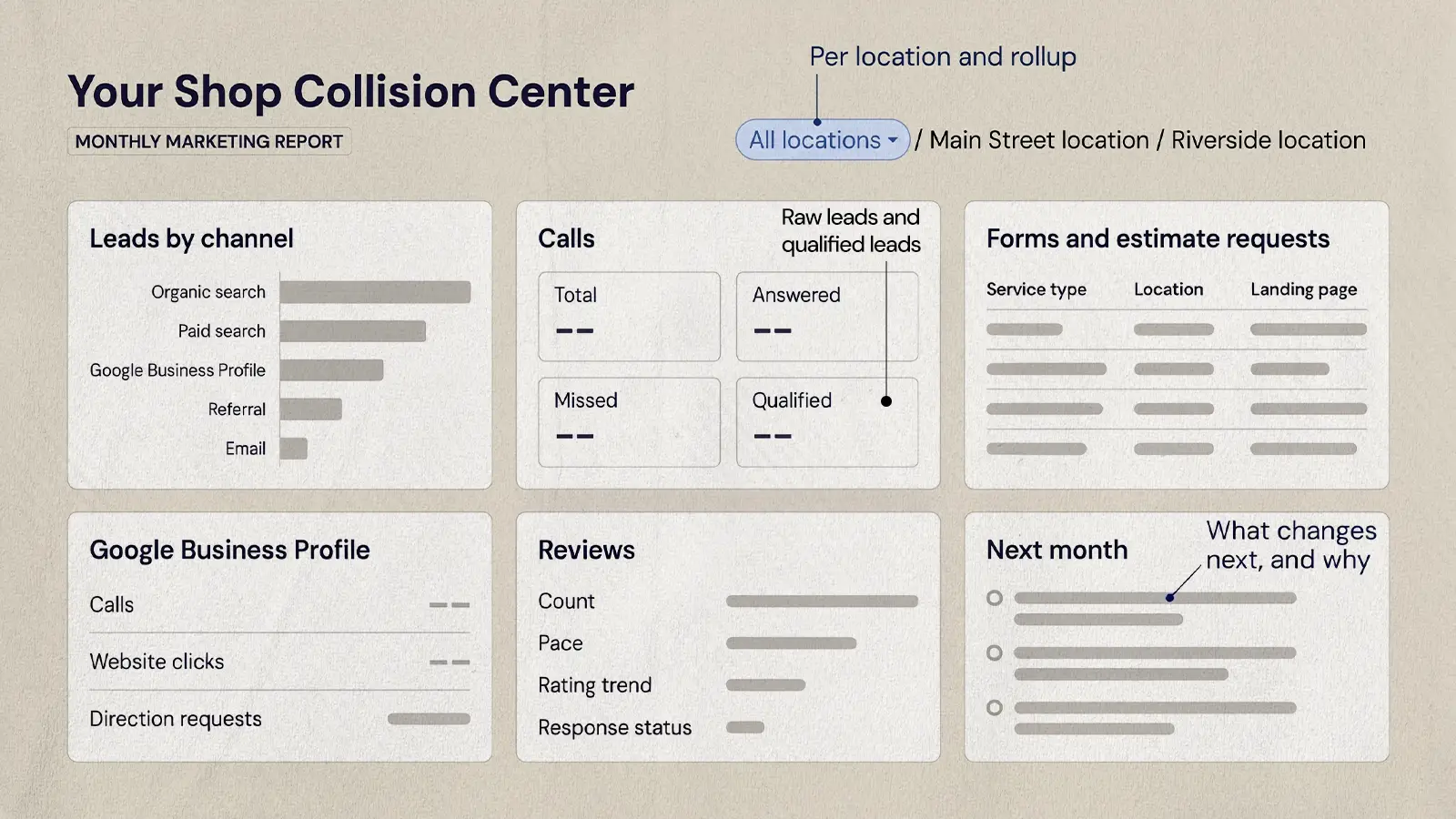
A good report shows what the agency did, which leads came in, where they came from and what changes next. It should be simple enough for an owner and detailed enough for a marketing manager to check.
At a minimum, expect:
- Leads by channel: organic search, paid search, Google Business Profile, referral, email and any other campaigns.
- Calls: total, answered, missed and qualified calls by source and location.
- Forms and estimate requests: submissions by service type, location and landing page.
- Google Business Profile activity: calls, website clicks, direction requests and review trends.
- SEO: visibility for priority services and locations, technical issues and content changes.
- Paid search: spend, cost per qualified lead, search terms and budget pacing.
- Reviews: count, pace, rating trend, response status and recurring themes.
- Next steps: what the agency will change next month, and why.
The best reports separate raw leads from useful ones. Some calls will be wrong numbers, job seekers, parts vendors or people outside your area. Reviewing calls and lead notes keeps the numbers honest. Some shops also match leads back to repair orders, which is the closest you'll get to a true return on the spend. For multi-location groups, reporting should be available per location and as a rollup, since executives and location managers need different views.
Real outcomes are often modest and specific. For one QCG brand, Brandywine Coachworks, the result NUUX can point to after the site was migrated and redesigned with SEO built in is about a 5% increase in organic calls, per QCG's own call tracking. An agency that reports a narrow, verifiable number like that is usually more trustworthy than one promising dramatic growth.
How do you compare auto repair marketing agencies side by side?
When you search for auto repair marketing companies, you'll find specialist agencies, general digital firms, website vendors, SEO providers and platforms that handle one piece such as reviews or listings. The label matters less than whether the company can solve your specific growth problem. A specialist may get up to speed faster. A broader agency may be a good fit if it has documented repair industry work. A platform can handle a narrow task well but usually won't own the strategy.
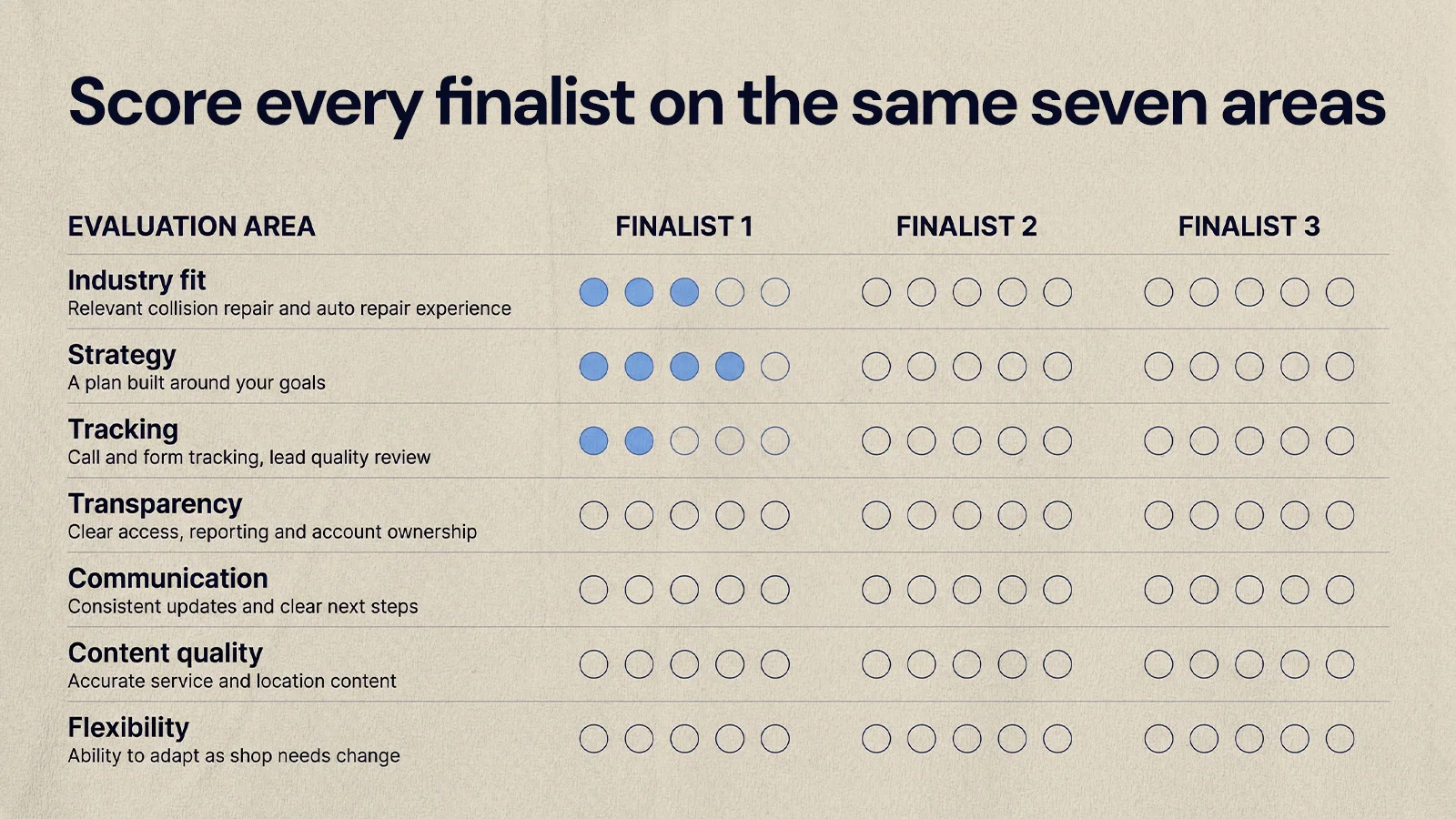
To keep the comparison fair, score each finalist on the same areas:
- Industry fit: experience with collision repair, mechanical repair or multi-location automotive service.
- Strategy: a plan tied to calls, estimate requests, appointments and locations.
- Tracking: call tracking, form tracking and a process for reviewing lead quality.
- Transparency: access to accounts, plain-English reports and clear ownership terms.
- Communication: a named contact, regular meetings and written next steps.
- Content quality: accurate service pages with local, shop-specific detail.
- Flexibility: recommendations based on your goals rather than a fixed package.
If you're weighing a specialist SEO partner separately, our guide on how to choose a Webflow SEO company has more questions you can reuse.
Narrowing your shortlist
Pick three to five agencies that clearly serve repair or collision businesses, or local service businesses with similar search needs. Ask each for a discovery call, a short written recommendation, a sample report and clear answers on account ownership. Don't expect a full strategy for free, but you should get enough detail to see how each agency thinks.
After the calls, compare them on fit, clarity and accountability. Did they ask about your repair mix, locations, capacity, current lead sources and how your front office handles inquiries? Did they explain what the first few months would look like? Did they push back on any of your assumptions in a useful way? If you come out of a sales process more confused than you went in, the working relationship probably won't get clearer.
Choosing between auto repair marketing companies is a business decision more than a marketing purchase. Favor the agency that understands how your shop makes money, shows you exactly what it will measure and keeps your data in your hands. If you'd like a second opinion on your site, tracking or local search setup, NUUX's growth marketing team is happy to take a look.
Want results like this
Your website should make money, not excuses. Let us find the revenue hiding in your current experience.
FAQs
Quick answers to the questions we hear most about website conversion and UX design.
There is no single right number. Spend depends on your market, competition, number of locations, current website and how much capacity you have to take on more work. A useful approach is to set a test budget for a few months, track qualified calls and estimate requests back to repair orders, and then adjust based on which channels actually produce booked jobs rather than clicks.
They usually work best together. Paid search can bring in calls quickly for specific services and locations, while local SEO and Google Business Profile work builds visibility that keeps producing calls over time. A good agency will recommend a starting mix based on your goals, budget and competition, and will track both channels by qualified leads, not just traffic.
Be careful with long lock-ins, especially before an agency has shown results. Ask about the minimum term, cancellation notice and what happens to your website, ad accounts, tracking numbers and content if you leave. A confident agency will usually be flexible on terms, and it should never hold your accounts or performance history hostage when the relationship ends.
Usually not. One agency can manage several locations well if it builds separate location pages, keeps each Google Business Profile accurate, tracks calls and forms by store, and reports per location as well as in total. What matters is that each location is treated as its own local market instead of being folded into one generic campaign.
At a minimum: leads by channel, calls by source and location, form and estimate requests, Google Business Profile activity, paid search spend and cost per qualified lead, review trends, and planned next steps. The most useful reports also separate raw leads from qualified ones, and some shops go further by matching leads back to repair orders.
Related articles
More field notes on conversion, UX, and building websites that sell.