.svg)
ADA Title II Website Accessibility Deadline: What Local Governments Need to Know in 2026
%20(1).jpg)
A wheelchair ramp that stops at the front door of City Hall would never pass inspection. Yet every day, residents with disabilities hit that exact wall the moment they go online to pay a bill, pull a permit, or read a public notice. The ramp exists. The digital door does not open.
Under the DOJ's final rule on digital accessibility, that gap is now a legal violation. ADA Title II requires every public-facing digital service to be fully accessible, the same way your buildings are. Depending on your city's population, the deadline is April 2026 or April 2027. For many municipalities, that is not far away enough to be comfortable.
The 2026 and 2027 Deadlines: When Does Your Local Government Need to Comply?
%20(1).jpg)
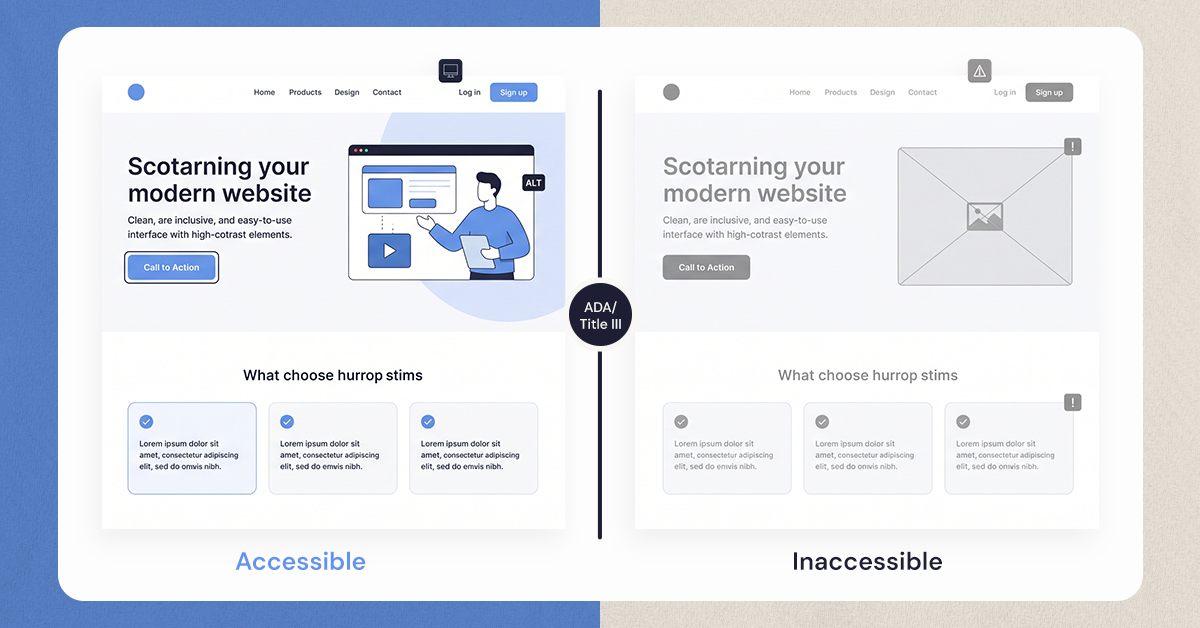
Knowing a website must be accessible is only half the battle; the real question is when the work must finish. While Title II vs Title III digital regulations can sometimes confuse folks, Title III covers private businesses like restaurants, the Department of Justice has made the rules for public entities crystal clear. The clock is officially ticking to achieve true ADA compliance for everyday government services, meaning your community needs a realistic multi-year timeline for its digital renovation today.
To make this transition manageable, the federal government created a staggered implementation timeline for large vs small municipalities. Your deadline depends entirely on your community’s total population from the most recent U.S. Census, dividing local governments into two primary categories:
- Tier 1 (50,000 or more residents): Large cities and counties must have all digital services fully accessible by April 24, 2026.
- Tier 2 (Under 50,000 residents): Smaller towns and special districts receive an extra year, with a final compliance cut-off date of April 24, 2027.
Hitting these dates requires immediate action, as upgrading hundreds of public notices, community apps, and webpages cannot happen overnight. Once a town marks its target year on the calendar, the next crucial step involves mastering the specific federal checklist those online services must pass—specifically, the WCAG 2.1 Level AA standards.
WCAG 2.1 Level AA Explained: The Four Pillars of a Digital Sidewalk
Meeting the new federal deadlines requires a specific blueprint known as the WCAG 2.1 Level AA standards. While that sounds highly technical, it simply serves as the international gold standard for web design. Historically, a city might judge its digital presence based on visual appeal, bright colors, beautiful photos of local parks, and sleek drop-down menus. However, accessible design asks a different, more important question: Can every citizen actually use those beautiful features, regardless of their physical abilities?
To answer that question, web developers rely on four foundational pillars, commonly called the POUR principles. Think of these as the concrete and rebar supporting your community's digital sidewalk:
- Perceivable: Information must be presented so users can easily process it, like using "alt-text" (hidden descriptions read aloud by screen reader software) on a photo of a detour map so a blind resident understands the new route.
- Operable: Citizens must be able to navigate the interface, such as allowing a user with limited mobility to pay a water bill using only a keyboard instead of a computer mouse.
- Understandable: Content should be clear and predictable, meaning public health alerts avoid confusing jargon and navigation menus behave exactly as residents expect.
- Robust: The digital service must work reliably across different technologies, ensuring community updates function just as well on assistive devices as they do on standard web browsers.
Implementing these strict ADA guidelines does not mean your town's homepage will suddenly look boring or stripped down. Instead, it guarantees that the unseen mechanics of the site welcome everyone equally. By focusing on true website accessibility, local governments remove invisible barriers, allowing all neighbors to participate fully in civic life.
Securing the main website is a massive step forward, but a modern local government shares information in many different formats. Evaluating all the extra materials residents download and use every day is essential, as the law extends far beyond the main homepage.
Beyond the Home Page: Why PDFs, Mobile Apps, and Social Media Count Too
Most local governments focus on the main website and overlook the dozens of other digital touchpoints that residents use daily. The DOJ rules cover all of them.
Every format counts, scanned meeting minutes, online utility portals, park booking apps, emergency alert systems, and even social media posts published after your compliance deadline. If a resident interacts with it as part of a government service, it falls under Title II.
The most common blind spot is documents. Thousands of scanned flyers, permit forms, and public notices exist across government servers as flat image files. Screen reader software cannot read a photographed page of text. That document is inaccessible, and it is a liability.
Remediating inaccessible local government PDFs is now a legal requirement, not a best-practice suggestion. Every document that residents rely on to interact with their local government must be made readable by assistive technology.
Solving the PDF Problem: How to Fix Thousands of Public Documents
%20(1).jpg)
The volume of legacy documents in most local governments is staggering. Zoning maps from 2009, scanned council minutes, archived public notices, all potentially non-compliant. The good news is that the law does not require fixing everything at once.
The technology used to convert scanned images into readable text is called Optical Character Recognition (OCR). It transforms a photograph of a document into actual, machine-readable text that assistive software can process.
Rather than attempting to remediate everything simultaneously, a tiered approach is far more effective:
- Current documents: Every new upload must be accessible from day one.
- High-impact forms: Prioritize documents residents use most — building permits, tax relief applications, utility enrollment forms.
- On-request archives: For older, rarely accessed records, establish a fast response process that delivers accessible versions within a defined timeframe when a resident requests them.
This approach protects community access without overwhelming your staff or budget.
Handling Third-Party Vendors: Ensuring Your Parking App Doesn't Break the Law
A city that contracts out its parking payment app, utility portal, or permit system does not transfer its legal obligation along with the contract. When a resident cannot use a third-party tool to access a government service, your municipality is the one named in the complaint.
Managing third-party vendor accessibility contracts means auditing current agreements for compliance gaps and building accessibility requirements into every future contract before it is signed.
Before renewing or entering any vendor agreement, request an Accessibility Conformance Report (ACR) — a standardized document that proves the vendor's software meets WCAG 2.1 Level AA. Without it, you have no evidence of due diligence if a complaint is filed.
Requiring ACRs shifts liability to the vendor where it belongs, while ensuring that every resident-facing digital service actually works.
What Doesn't Need Fixing? Understanding Technical Exceptions for Archived Content
Upgrading a city’s entire digital footprint might sound expensive, but the law includes practical boundaries to protect taxpayer resources. Not every old document gathering digital dust needs a complete renovation. To save local governments time and budget, the rules provide specific technical exceptions for archived web content. If a file is kept purely for historical reference and isn't used for current services, it safely bypasses the strict new standards.
Clear limits help your town focus funding on the digital tools that genuinely impact daily civic life. When evaluating Title II accessibility, achieving ADA compliance does not mean fixing the whole internet. To streamline the process, officials should recognize the five primary exceptions under the DOJ final rule:
- Archived materials: Historic web pages maintained strictly for reference.
- Old electronic documents: Pre-existing PDFs not tied to active government programs.
- Past social media: Official government posts published before your community's compliance deadline.
- Public comments: Third-party user content, like citizen replies left on city profiles.
- Private digital portals: Password-protected screens designed for individualized use, not the general public.
Knowing what to leave alone is just as crucial as identifying what needs immediate renovation. However, navigating these technical exemptions requires dedicated leadership rather than casual guesswork. Ensuring these decisions protect the community efficiently means putting a human in charge of the process.
The Digital Accessibility Coordinator: Putting a Human in Charge of the Process
Accessibility compliance does not sustain itself through policy documents alone. Without a dedicated person overseeing the process, responsibilities diffuse across departments and progress stalls.
Appointing a digital accessibility coordinator creates a clear, accountable point of contact — for both internal teams and residents who encounter barriers. When a resident reports that a critical public notice is unreadable with assistive technology, the coordinator ensures that problem is resolved quickly rather than sitting in a shared inbox.
This role also serves a legal function. Every remediation step your government takes needs to be documented. A coordinator who maintains a clear record of audit findings, fixes implemented, and timelines met gives your municipality a defensible paper trail if a complaint is ever filed.
Without that record, good-faith effort is difficult to prove.
Auditing Your Assets: Combining Automated Tools with Human Testing
With a coordinator in place, the next step is uncovering where your digital sidewalks are broken. Auditing public website accessibility for 2026 begins with automated scans. Think of these tools like a digital spell-checker. They quickly sweep city webpages to flag obvious errors, like an invisible "Pay Water Bill" button. While fast and helpful, scanners cannot understand human context.
Relying on software alone leaves massive gaps in a town's inclusion efforts. Understanding automated vs manual accessibility testing for cities is crucial because computers miss most everyday barriers. Here, a manual audit becomes essential. Human experts must navigate the site to ensure the experience actually works for citizens. Towns should also avoid "quick fix" accessibility overlays—software plugins promising instant results that frequently block the assistive devices residents already use.
True inclusion requires bringing the local disability community directly into the evaluation process. Real-world evaluations, particularly screen reader testing, ensure the software used by people with vision loss to hear a screen accurately translates your content. If a blind neighbor cannot independently submit a park permit, the site remains closed off, regardless of what basic web accessibility laws dictate on paper.
Combining automated sweeps with thorough human reviews creates a reliable roadmap for your community's digital renovations. Taking these steps thoughtfully prevents wasted effort and builds a civic space everyone can navigate. However, realizing this inclusive vision requires careful financial planning that balances immediate budget constraints against long-term legal necessity.
The Cost of Waiting: Balancing Budget Constraints with Legal Necessity
Delaying remediation does not make it cheaper. It increases legal exposure and compresses the time available to fix issues without crisis-level scrambling.
The DOJ does not expect perfection overnight. What regulators look for is good-faith effort — documented, ongoing progress toward full compliance. A municipality that has audited its site, appointed a coordinator, begun remediating high-priority documents, and established a clear plan is in a fundamentally different legal position than one that has done nothing.
Beyond legal risk, there is a direct operational return. An accessible city website means fewer residents calling the clerk's office because they could not complete a form online. It means faster permit submissions, fewer errors on applications filled out without staff assistance, and broader reach across the full taxpaying public — including older adults who benefit from the same clarity and usability that assistive technology users require.
Treating digital accessibility as a public works project, budgeted, phased, and managed, is far less expensive than treating it as an emergency after a complaint lands.
Your 2026 Readiness Plan: Five Steps to Start Your Roadmap Today
Local governments that are ahead of this deadline share one thing in common: they started before they felt ready.
The practical path forward is straightforward:
- Audit: Run an initial scan of your current digital services to identify the highest-priority barriers.
- Appoint: Designate a dedicated accessibility coordinator with clear authority and accountability.
- Plan: Build a phased remediation timeline that prioritizes active, high-traffic services first.
- Train: Equip staff across all departments to create accessible documents and content from day one.
- Maintain: Establish ongoing review processes so newly published content does not undo the progress made.
Digital accessibility is not a project with a finish line. It is an operational standard — the same way building codes govern every new structure your municipality builds or renovates. Embedding these practices into standard workflows means compliance is maintained rather than chased.
The deadline is fixed. The work required is known. The only variable is when your government decides to start.
.svg)


.jpg)
.jpg)

.svg)

.svg)

.svg)
